

Ingo Swann shaped how scientists and military teams studied psychic skill in the past. He worked closely with Harold Puthoff at Stanford to develop protocols that later guided intelligence work. This introduction outlines why his writings matter and what readers can learn from historical tests.
Swann argued in Everybody’s Guide to Natural ESP that people can access nonconscious information as it rises to awareness. That idea links to experiments where trained subjects described distant targets. A clear example from lab records shows intuition drawing on subtle fields beneath physical reality.
To understand this work, we’ll review scientific reports and firsthand accounts. The goal is a friendly, concise guide for readers curious about the history of natural ESP and the studies that tested human ESP.
Key Takeaways
- Ingo Swann played a central role in formalizing protocols used for intelligence testing.
- Collaboration with Harold Puthoff brought experimental rigor to the field.
- Swann’s writing explains how nonconscious perception can surface to awareness.
- Lab records provide concrete examples of successful sessions under controlled conditions.
- This section sets the stage for a deeper look at historical literature and experiments.
Understanding the Legacy of Ingo Swann
A lifetime of laboratory trials made Ingo Swann a central figure in studies of psi.
He spent roughly twenty years as a research subject, writer, and artist, working inside controlled lab settings. Those sessions numbered in the hundreds of thousands, which led author Martin Ebon to call him parapsychology’s most tested subject.
The arc of his career is striking. Trained in biology and art, he brought a creative eye to experimental work. That blend helped him move from student to a visionary pioneer in psychic research.
Many analysts credit his records with nudging scientific opinion toward a reappraisal of psi. Examining his life shows how closely his claims faced rigorous testing and peer scrutiny.
“He became a focal point for systematic study, not merely anecdote.”
- Rigorous testing: Extensive trials under controlled conditions.
- Cross-disciplinary roots: Science and art informed his methods.
- Lasting influence: Work that prompted careful reevaluation.
The Best Books on Ingo Swann and Remote Viewing
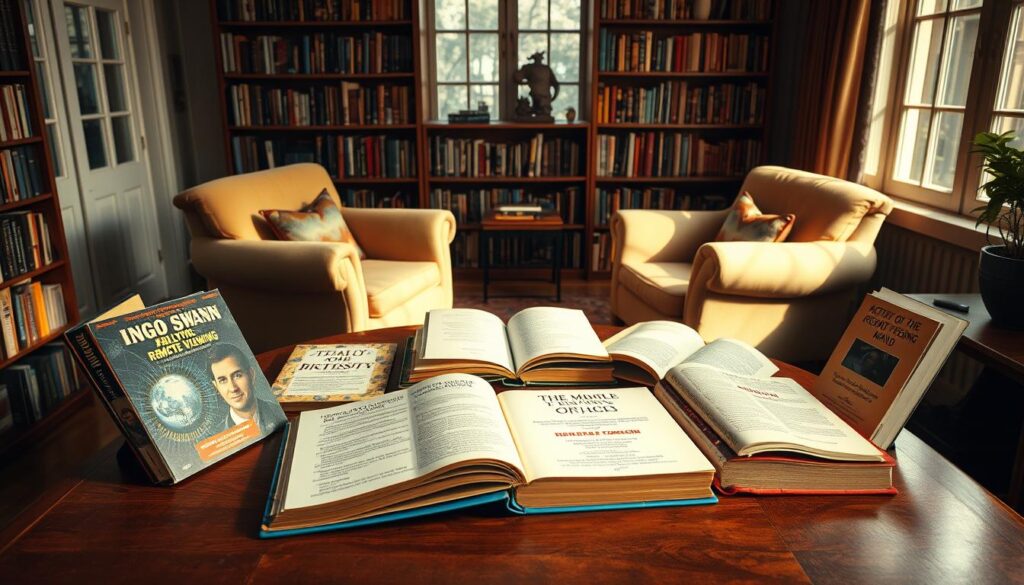
Choosing titles that mix biography with technical manuals helps readers grasp both the person and the practice. This short guide points to works that explain Swann’s life, the training method, and the broader history of the field.
Essential Biographies
Look for a swann book that traces early life, lab years, and public reception. Biographies give context for the claims made in lab reports and show how personal art and science shaped his approach.
Why read a biography? It clarifies motives, timeline, and how perception was described in first-person accounts.
Technical Manuals
Technical manuals detail protocol steps used in experiments. A clear manual explains training drills, feedback loops, and scoring so readers can judge results for themselves.
- Practical value: Learn the method used by trained subjects.
- Historical insight: Manuals document how protocols evolved in lab settings.
Early Life and Scientific Foundations
Before laboratory fame, ingo swann drew on formal study in two fields. He earned a double bachelor’s in biology and art at Westminster College. That mix gave him both experimental rigor and a visual sense for describing impressions.

By 1969, at age 36, ingo swann began active parapsychology work that lasted about twenty years. His training helped him separate observed phenomena from the mental acts that produced them.
A clear example came in 1971 at City College, New York. Experiments examined psychokinetic effects on thermistors and showed how careful controls tested specific claims.
His reading in occult texts during the 1950s and 1960s influenced theory. He also blended Eastern Yoga ideas with developmental psychology such as Maslow’s work by 1969.
“He treated perception as a skill that can be trained and measured.”
- Academic roots: biology + art at Westminster.
- Early experiments: psychokinetic thermistor trials (1971).
- Theoretical mix: occult study, Yoga, and humanist psychology.
| Year | Focus | Significance |
|---|---|---|
| College years | Biology & Art | Foundation for method and description |
| 1969 | Research start | Two decades of formal testing |
| 1971 | Thermistor tests | Example of psychokinetic protocol |
For a compact research profile, see this research profile.
The Birth of Remote Viewing Protocols
In 1972 a formal label emerged for the lab work that would shape decades of study. Researchers at the Stanford Research Institute (SRI) turned informal tests into repeatable steps.
The Stanford Research Institute Era
SRI teams refined the process with careful controls. Harold Puthoff and Russell Targ ran sessions that used blind targets and strict records.
A primary example of success was when a viewer described a distant target using only geographic coordinates. Those reports helped codify a training method called Coordinate Remote Viewing.
- Teaching process: Structured drills and feedback raised accuracy across repeated sessions.
- Sustained performance: Ingo Swann could reproduce effects reliably when others declined.
- Official review: Declassified CIA files in July 1995 confirm twenty-plus years of sponsorship.
“The SRI era turned anecdote into protocol, with repeatable stages and measurable output.”

For a closer comparison of natural practice versus the structured method, see this natural ESP vs structured method.
Exploring the Subliminal Barrier
The subliminal barrier, as ingo swann framed it, acts like a gate between inner sight and daily life.
He described this filter as necessary to stop the mind from being swamped. Without it, our awareness would be flooded — like listening to a thousand radio channels at once.

Every book that discusses his theory stresses that the deeper self links to an energetic, perhaps quantum, layer of the world. That layer seems to operate beyond usual rules of space and time.
A clear example is how the barrier lets only a few signals pass into waking consciousness. This selectivity makes intuitive hits manageable and testable in lab settings.
“The barrier prevents overload so perception can be useful rather than chaotic.”
Understanding this idea is vital for readers of any book about how he viewed the relationship between subconscious processes and physical reality.
How the Deeper Self Communicates
Observers describe an inner web of form and pattern that delivers raw impressions to the conscious mind. This view treats perception as a decoding task: the mind must translate energetic traces into a usable form.

The Matrix and Patterns
The Matrix is imagined as a storehouse in the unconscious that holds records of people, places, and events. In reports linked to ingo swann, this space supplies symbolic hints rather than clear photographs.
Writers of each related book describe how patterns appear as shapes, textures, or feelings. These simple signals give the mind a framework to build an image.
Signal Line Theory
Signal lines are described as distinct energy threads that connect a target to a viewer’s inner sense. Each thread carries a recognizable pattern that the mind can follow.
A common example is the sudden gut sense when someone is hurt. That visceral cue often arrives before any logical clue. Swann noted such hits can shoot to the surface of consciousness, surprising the person who receives them.
“The deeper self sends notes that the waking mind transcribes into meaning.”
- Pattern processing: The mind converts raw signals into a coherent form for analysis.
- Surface awareness: Spontaneous impressions can pierce ordinary consciousness.
- Practical note: For a technical comparison of structured methods, see this difference between coordinate and extended protocols.
The Role of Conceptualizing Filters
Conceptualizing filters act like lenses that color sudden impressions before they reach awareness. Ingo Swann named these filters as frames the mind uses to interpret vague input.
A book by Ingo Swann gives a clear example where raw intuitive content arrives partial or distorted. The author shows how familiar ideas can overwrite fresh signals.
The conscious mind uses filters to sort meaning. That way, people can function without being overwhelmed. Yet those same filters can misinterpret pure impressions and make them seem ordinary.
“When the mind forces an image into an existing schema, accuracy can slip.”
Training raises awareness of these habits. With practice, a reader of the book learns to notice which bits are interpretation and which are direct content.

Insights from Secrets of Power
Secrets of Power invites readers to see awareness as the first step toward personal authority. The text argues that people use only a fraction of their innate capacities.
Societal conditioning, the book claims, often pushes those capacities into hiding. That suppression keeps knowledge concentrated among elites and limits broad empowerment.
Unlocking Innate Human Potential
A clear example in the work shows how cultural structures discourage teaching subtle skills. The result is a public that rarely explores inner tools available to every person.
In practical terms, increasing awareness means simple, repeatable practices that expand perception and confidence. The book encourages questioning inherited rules of power and seeking direct experience instead.
“Raising awareness of these capacities is the first step toward real growth.”
| Claim | Implication | Action |
|---|---|---|
| Latent human powers | Underused by most people | Practice awareness drills |
| Societal suppression | Knowledge concentrated in elites | Share skills publicly |
| Personal empowerment | Greater self-reliance | Apply techniques daily |
For free practice tools that mirror structured exercises in this swann book tradition, try this target generator resource.
Analyzing the Military Connection
Military interest turned private experiments into training programs with clear operational goals.
In April 1983, Ingo Swann delivered a documented speech in Las Vegas about Psyops that appears in his personal papers. That event shows how public presentations and classified work overlapped.
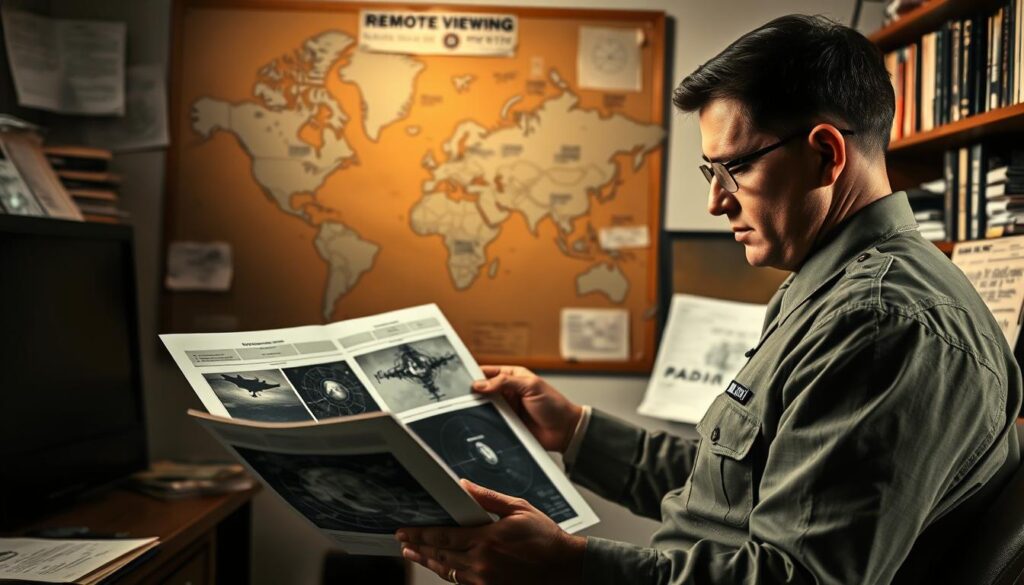
The U.S. military funded studies to test whether psychic skills could aid intelligence. A notable example is Project SUN STREAK, which refined Coordinate Remote Viewing into a teachable format for analysts.
A key claim from Ingo Swann was that the method did not create psi; it removed blocks so natural ability could surface. Training emphasized protocol, scoring, and repeatability for field use.
- Purpose: Assess utility for national security.
- Outcome: Structured drills became part of official programs.
- Legacy: This strand of research features in one notable book that traces the program’s history.
“Analyzing the military connection gives a unique view of how laboratory work entered official practice.”
The Artistic Vision of a Psychic Pioneer
His canvases traced a private map of inner journeys, where color and line echoed impressions from a life split between studio work and parapsychology research.
Ingo Swann was a self-taught artist whose oil paintings expressed out-of-body experiences and cosmic curiosity. His final collection, Cosmic Intelligence, shows a desire to transcend ordinary sight through color, texture, and symbolic form.
A striking example came in 1973, when he sketched a ring of asteroids around Jupiter during a probe session. That image later matched scientific findings from 1979, and it became a celebrated point in many a book about his life.
His art periods mirrored shifts in perception. Early work focused on representational scenes. Later pieces grew more abstract, reflecting deeper exploration of consciousness.
“Art became the language that made private impressions public.”
- Medium: oils and mixed media that tracked inner experience.
- Trajectory: student to visionary, seen across published accounts.
- Legacy: visual records that accompanied experimental notes.

| Period | Art Style | Research Link |
|---|---|---|
| Early career | Figurative oils | Training and visual description practice |
| Mid career | Symbolic abstraction | Laboratory sessions and planetary sketches (1973 example) |
| Late work | Conceptual cosmic themes | Cosmic Intelligence and public writings |
For readers who want training resources influenced by his methods, see this training course guide.
Bridging Science and Intuition
His career shows how disciplined testing can meet intuitive practice without losing scientific rigor. For decades, ingo swann pushed for careful methods that let intuition be measured.
He took part in hundreds of thousands of trials that many a book cite as key evidence. Those records gave researchers data they could analyze.
An important example involved work with Josephson junctions, where focused visualization reportedly influenced tiny magnetic signals in controlled setups. That study tied mental practice to measurable effects.

Ingo Swann argued that applying clear protocol to intuitive acts helps reveal the mechanics of consciousness. He believed this approach linked the deeper self to subtle physical processes.
A modern reader will find that a careful, scientific frame moved certain topics from occult chatter into formal parapsychology. This shift made it possible for more researchers to test the claims seriously.
“By making intuition testable, he helped change how science treats unusual human capacities.”
- Legacy: rigorous records that invite analysis.
- Model: protocol applied to subtle perception.
- Impact: greater scientific interest and clearer debate.
Practical Applications of Natural ESP
Applied practice teaches a person to bring unconscious content into conscious awareness in a repeatable way.
Ingo Swann taught that practical use of natural esp rests on simple, repeatable training that clears the mind. The goal is controlled access to subtle cues so usable impressions surface during focused tasks.
A book by Ingo Swann stresses that productive sessions happen when the viewer is well rested and free from hunger or sickness. This way physical discomfort does not cloud the inner sense.
One clear example of the process is the idiogram. A quick mark registers the signal line of a gestalt and then leads to layered impressions about the target.
- Clear channels: Remove distractions to let subtle content rise.
- Repeatable process: Practice the same steps to improve accuracy.
- Skill development: While some have innate gifts, anyone can sharpen ESP through steady drills.
“Clear the mind, follow the first mark, and let the sense unfold.”

Evaluating the Evidence for Psi Phenomena
Historic laboratory records offer a clear path to evaluation. Researchers must read detailed session notes and raw sketches to judge claims fairly.
Ingo Swann appears in multiple controlled trials where success was recorded under strict conditions. Those reports show sustained performance that reduced the decline effect many others experienced.
An important example is the 1971 American Society for Psychical Research test. In that case, sealed boxes held targets that were hidden from ordinary senses.
The reality of the results rests on accuracy. Swann described shielded targets with specifics that matched later inspection. Such outcomes force a debate about whether perception can bypass spatial limits.

- Data-driven: analysis focuses on session records, not anecdotes.
- Repeatability: sustained success over time strengthens claims.
- Implication: content of reports suggests effects independent of space and time.
“When sealed tests return detailed matches, the question shifts from possibility to mechanism.”
Conclusion
Many researchers still cite his sessions as a clear example of disciplined, repeatable testing that bridged intuition with experimental method.
In this guide, ingo swann remains a pivotal figure whose work shaped how people study subtle perception and consciousness.
Readers are encouraged to explore the recommended titles to gain a fuller view of his life, protocols, and influence.
By studying his methods and theories, a reader can better grasp hidden talents in the human mind and how information systems may register subtle signals.
We hope this guide serves as a useful resource for your journey into that history and the questions it still raises.