

Ingo Swann was born in Telluride, Colorado, on September 14, 1933, and died in New York City on January 31, 2013.
He became known as the primary creator of the term remote viewing, a method that claims to use extrasensory perception to detect distant events.
The work he did with scientific institutions aimed to collect empirical data on the measurable effects of unusual human perception.
His studies left a lasting impact on modern dialogues about how formal inquiry can meet explorations of non-local human awareness.
Today, many lessons from his career guide ongoing inquiry into human potential and the methods used to test subtle cognitive phenomena.
Key Takeaways
- Born in 1933, he helped define the term remote viewing.
- He partnered with institutions to gather empirical data on perception.
- His legacy shapes modern study of human potential and subtle mind states.
- Contemporary discussions link his findings to scientific methods.
- Read more on related topics at psychic superpowers.
The Life and Legacy of Ingo Swann
A complex career tied fame to controversy, with many people debating his methods.
Ingo Swann spent years balancing a job as an artist with intense study of remote viewing. He rose to fame in the 1970s, became a public Scientologist, and reached the Operating Thetan level.
Early memories shaped his path. He wrote that an out-of-body event during a tonsil removal at age three sparked lifelong interest in psi. Later controlled tests, such as a 1972 out-of-body experiment by Karlis Osis, placed him in formal settings.

“Many people who studied his life saw a mix of art, claims, and high-profile program ties that no simple label fits.”
Government files show the CIA’s Stargate program examined his clairvoyant claims. His book To Kiss Earth Goodbye details early struggles, nights working in a quiet room, and attempts to prove that psychics could reveal data beyond money or standard methods.
| Year | Event | Setting | Note |
|---|---|---|---|
| 1972 | Out-of-body test | Laboratory | K. Osis led the experiment |
| 1970s | Scientology status | Public life | Reached Operating Thetan |
| 1980s | Stargate involvement | CIA program | Examined for clairvoyance |
For deeper reading, consult the recommended book list that covers training, authors, and titles readers often find useful.
Foundations of Ingo Swann Psychic Abilities and Consciousness Research
Childhood experiences of leaving the physical body laid the groundwork for later experimental protocols. He described seeing colorful auras around nearby objects from age three, an early memory that shaped his sense of nonlocal perception.

Early Out-of-Body Experiences
These early episodes taught him to direct awareness beyond the body. Over time, these moments became a repeatable skill he could attempt on command.
The Development of Remote Viewing
The formal method emerged when Russell Targ and Harold Puthoff created protocols at the Stanford Research Institute. Sessions used only geographical coordinates so descriptions came without prior knowledge.
Judges later used blind scoring to match sketches with targets. In a notable 1972 test, electrodes monitored him while he tried to describe an object on a high shelf. That session and others produced paper records and raw data that challenged how the brain processes distant information.
“Recording views on paper turned spontaneous reports into testable information and drew skeptical attention from the scientific community.”
For practical training and further reading, see psychic development resources.
Scientific Investigations at the Stanford Research Institute
A controlled set of lab tests at Stanford focused on whether focused attention could alter physical instruments. On June 6, 1972, a magnetometer psychokinesis test took place in the Varian Physics Building.
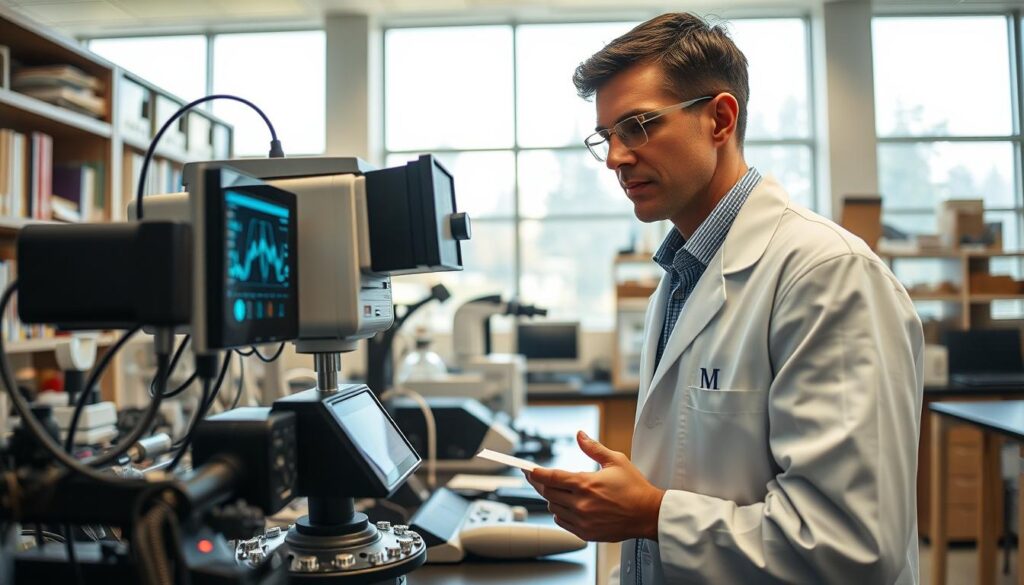
Dr. Arthur Heberd monitored the magnetometer while the subject concentrated on the interior of the magnetic probe. The device showed anomalous oscillations during the session.
Researchers intended to see if mental focus could affect the magnetic field without physical contact. Following the initial run, the equipment behaved erratically, which prevented straightforward replication.
Magnetometer Psychokinesis Tests
Dr. Kenneth A. Kress later noted that the variations recorded that day were not seen before or after the experiment. Many people who observed the event found the data puzzling.
The program documented the day as a key subject worth further work, and the book accounts by the participant describe feeling drained after long focus sessions.
“The anomalous oscillations provided information that challenged some assumptions about the nature of instrument readings.”
- This example shows how a laboratory protocol tried to tie remote viewing sessions to measurable data.
- Others remained skeptical, yet the recorded day continues to appear in discussions about early psi program findings.
For related context on trained practice and program history, see psychic powers.
The Famous Jupiter Remote Viewing Session
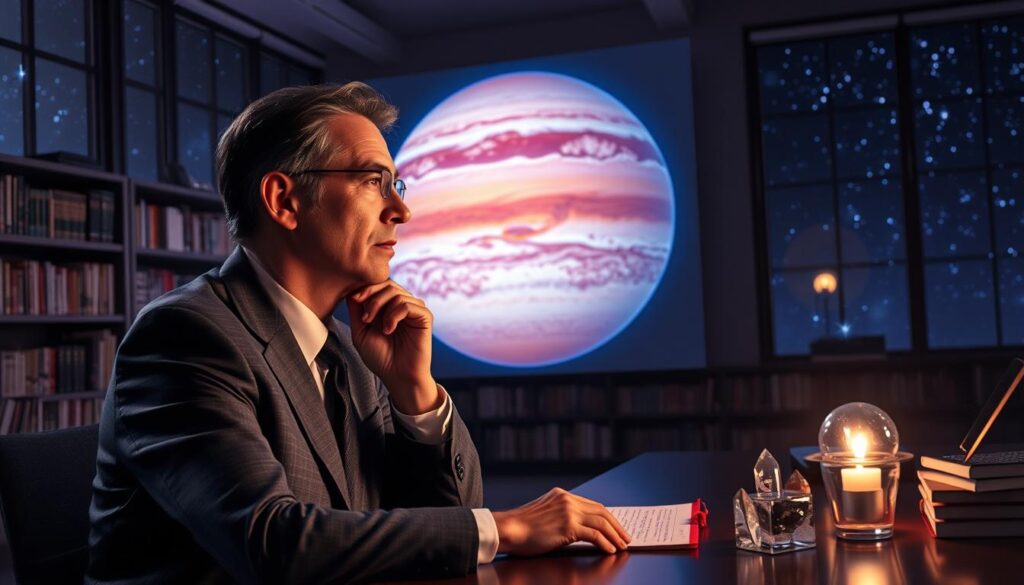
In April 1973 a focused, recorded session attempted to describe Jupiter before spacecraft data arrived. The sitter worked in a quiet room for about twenty minutes and produced sketches and notes that captured rings, bands, and surface forms.
Methodology of the Probe
Russell Targ and Harold Puthoff recorded the session using blind protocols so the views were logged prior to any verification. The procedure emphasized strict timing, minimal cues, and written transcripts.
Observations of the Planet
The sitter reported bands of crystals, rough terrain, and ring-like structures. These observations appeared as sketches and short descriptions that stressed texture and composition rather than speculation.
Scientific Verification
Years later, NASA missions and published data found ammonia ice crystals and complex bands in Jupiter’s atmosphere. The match between session notes and later findings raised strong interest among people who followed the event.
“Many readers found the session’s recorded details striking when later compared with spacecraft data.”
- Result: Session notes were published in the book Mind-Reach.
- Significance: The case remains an example often cited in debates about remote viewing and planetary information.
Navigating Skepticism and Professional Challenges
Skeptics in academic circles repeatedly questioned his protocols and reported outcomes. Prominent critics such as Milbourne Christopher called him clever but dubious, while authors like Arthur Lyons and Marcello Truzzi labeled some cases as bunk.
He admitted that of twenty-five criminal cases from 1972–1979, only three met his own standard of success. That frank tally fed critics and made it harder to win support from mainstream people.
His book details these struggles and the tough job of defending unconventional methods in public forums. His Scientology ties also complicated professional relations and led others to question motive more than method.
“Facing organized doubt forced him to clarify methods, record sessions, and improve protocols to answer critics.”
| Issue | Critic/Source | Outcome |
|---|---|---|
| Public skepticism | Milbourne Christopher | Reputation questioned |
| Published critique | Arthur Lyons & Marcello Truzzi | Successes called into doubt |
| Field work success rate | Self-reported cases (1972–1979) | 3 of 25 deemed successful |
Despite the pushback, he argued that viewing sessions offered useful answers about the nature of human perception. Readers who want practical steps for skill development can visit develop psychic abilities for training and methods.
Exploring the Intersection of Consciousness and Ufology
Many of his most striking claims came from sessions held under dark skies in isolated places. Field notes mix sighting reports with inner impressions that read like brief case studies.

Penetration, the 1998 book by ingo swann, describes encounters with entities who, he claimed, tracked human psychics as rivals. He argued that telepathy linked human awareness with non-human intelligence.
He wrote about secret lunar sites, nights spent in remote locations, and a sense of danger during certain sessions. He said the work was not about money but about finding answers for the future of people on Earth.
Extraterrestrial Theories and Telepathy
Key points:
- He tied remote viewing data to reports of non-human presence.
- The author framed psi as a bridge between mind and outside phenomena.
- Readers are encouraged to read his autobiography to weigh the evidence.
| Topic | Claim | Supporting data |
|---|---|---|
| Telepathy links | Non-human intelligence interacts with human minds | Field notes, eyewitness sketches |
| Lunar bases | Secret installations on the Moon | Remote viewing reports, disputed verification |
| Field work | Night stakeouts in remote areas | Session logs, personal memory entries |
“Understanding these connections shaped his late views on what the future might hold.”
Conclusion: The Enduring Mystery of Human Potential
His documented sessions continue to invite careful study from scientists, hobbyists, and curious people alike.
Legacy, in this case, means a blend of careful logs and bold claims. His work kept the idea that psychic abilities can be tested in formal settings alive. Many people still debate the results.
Readers search archives for answer views that explain how a single sitter reached notable hits. These archives shape how we ask questions about the future of mind study.
In short, his life left a clear roadmap for future generations who seek to explore human abilities. It reminds us each person has the ability to push limits by documenting what they find.