
This article traces a bold chapter in U.S. science. In the 1970s, a pair of physicists led careful lab work at Stanford Research International. They aimed to test whether people could gather useful information about distant places without normal senses.
The team used strict protocols and repeated trials to measure human perception beyond sight. Their methods treated this topic as serious science rather than speculation. Results sparked debate, curiosity, and follow-up efforts across academic and government circles.
By reviewing those foundational experiments, we can better see how consciousness and the physical world might link across distance. This piece examines the historical impact and the experimental steps that made viewing a subject worth scientific attention.
Key Takeaways
- Early experiments applied rigorous lab controls to sensitive human tests.
- Work at Stanford Research International helped legitimize the topic.
- Clear protocols were central to how results were recorded and analyzed.
- Findings raised questions about perception and spatial limits.
- Historical context shows how research moved from fringe to formal inquiry.
The Origins of Remote Viewing Research
Cold War urgency pushed unconventional inquiries into the spotlight. In tense geopolitical years, programs tested whether the mind could gather information from afar. Funding and interest came from military and intelligence branches eager for any advantage.
The Cold War Context
During the Cold War, the United States and the Soviet Union invested in experimental methods aimed at collecting intelligence beyond standard means. These efforts turned fringe ideas into organized research projects that lasted for many years.
Ancient Roots of Psychic Faculty
Claims of long-distance perception are not new. J.B. Rhine helped modernize study of extra senses in 1934, while Patanjali’s Yoga Sutras, from about 400 B.C., describe a superphysical faculty that can direct light to distant targets.
- Synthesis of ideas: Researchers in New York and elsewhere blended ancient texts with modern methods.
- Practical aims: Practitioners over the years said they accessed information hidden from ordinary perception.
- Evolution: What began as parapsychology became a structured part of some national security programs.
Understanding the Russell Targ and Harold Puthoff Remote Viewing Studies
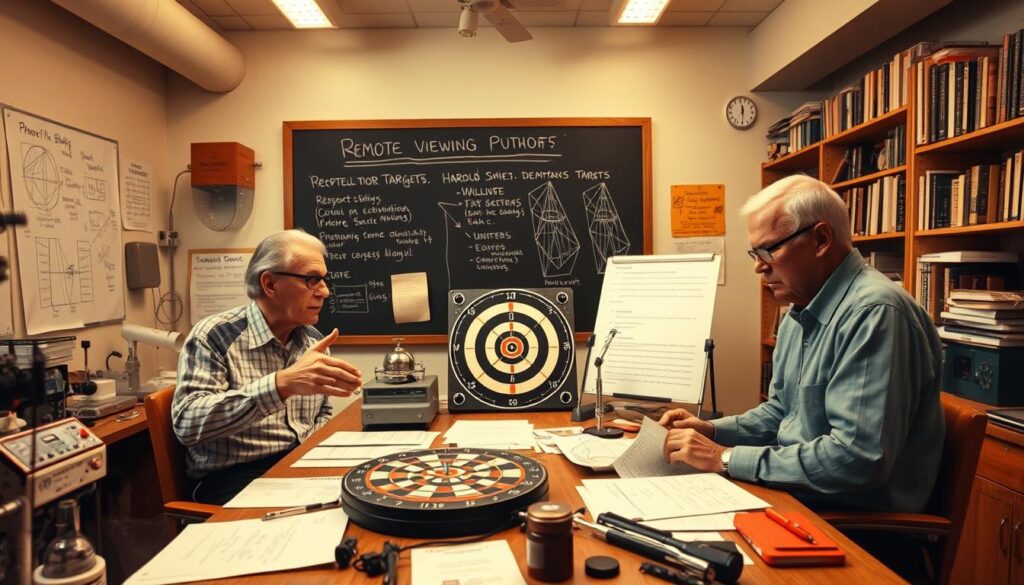
In 1972 the Stanford Research Institute launched a formal program to test whether human perception could gather useful information about distant sites. The project sought to move anecdote into measurable research.
A New York visit by Ingo Swann inspired Hal Puthoff to begin systematic work. That encounter led to a structured protocol at SRI that aimed for clear, repeatable results.
The intelligence agency funded the effort, which ran for many years. Researchers wanted to see if viewing could yield data that conventional methods missed.
Over two decades the team refined procedures, controlled variables, and improved scoring to reach statistical strength. These efforts made the research institute project one of the most cited in the field.
- Significance: The collaboration remains central to how the phenomena were studied.
- Outcome: Documentation helps explain how the program collected otherwise inaccessible information.
Scientific Foundations and Laboratory Protocols
Early experiments emphasized strict controls to separate true perception from chance. At the research institute, scholars began with Zener cards to measure information transfer while using sensory shielding.
Zener Cards and Early Testing
J.B. Rhine’s Zener-card approach provided a simple, repeatable test that helped quantify hits and misses. That method made it easier to score basic experiments and compare subjects over time.
The Shift to National Geographic Images
To avoid decline effects from repeated card guessing, the program moved to varied National Geographic images as targets. These images expanded the range of descriptors a viewer could give and improved the quality of data.
Quantifying Success with Fuzzy Set Analysis
Fuzzy set scoring and checklists helped translate descriptive sessions into numeric results. A 30-point checklist, inspired by other labs, standardized how each experiment’s success was judged.
- Protocol controls: shielding, randomized targets, and strict experimenter rules preserved data integrity.
- Subjects and scoring: each person followed guidelines so the channel and transfer claims could be tested fairly.
The Role of Ingo Swann in Early Experiments
Ingo Swann’s demonstrations in 1972 gave laboratory work a clear, tangible turning point. His sessions convinced Hal Puthoff to move from curiosity to a formal program at the Stanford Research Institute.
Swann described the interior of a shielded magnetometer while it sat unseen. That accurate description supplied the first compelling piece of information that suggested the phenomenon could be tested under lab conditions.
The early experiments with Swann helped the research team set strict parameters. Researchers defined controls, scoring methods, and target types that later guided long-term research.
Importantly, Swann showed that viewing could apply to technical targets, not just simple scenes. His work expanded the scope of the program and helped recruit other subjects for controlled experiments.
Swann’s role was essential: his demonstrations supplied initial evidence, shaped protocol, and launched a sustained research effort at the research institute.

Exploring Coordinate Remote Viewing Techniques
Using map coordinates let the experimenters separate a site from any nearby person or cue. This shift created a clearer test of perception that relied only on location data.
Defining the Scanate Protocol
Scanate used latitude and longitude to point a subject toward a distant place. The approach removed a physical beacon and reduced sensory contamination.

Developed by ingo swann, the protocol asked viewers to describe a coordinate that they had never seen. These experiments tested whether accurate information could come from pure coordinates alone.
- The Scanate protocol allowed the program to use only map points as a cue.
- Sessions proved a viewer could report features of a remote target without a beacon person.
- Researchers could expand targets worldwide, increasing the scope of the work.
Outcomes showed the experiment process was not limited by physical distance. Coordinate-based viewing offered a new method for intelligence collection and inspired later field work.
Analyzing the Semipalatinsk Operational Assignment
In 1974 an operational task sent a practiced viewer to describe a highly guarded Soviet research complex.
The intelligence agency assigned Pat Price to the Semipalatinsk site. As a remote viewer, he sketched buildings, internal layouts, and activity at the target.
Price singled out a unique gantry crane on tracks. Later satellite imagery confirmed the crane, validating the experiment and giving the program usable data.
Why this mattered: the results showed the method could supply actionable information on sensitive targets. The team compared descriptions to ground truth to rate accuracy.
| Year | Target Site | Key Detail Reported | Verification |
|---|---|---|---|
| 1974 | Semipalatinsk | Gantry crane on rails; building layout; internal activity | Satellite imagery confirmed crane and structures |
| 1974 | Semipalatinsk | Personnel movement and equipment | Correlated with later intelligence reports |
| 1974 | Semipalatinsk | Actionable descriptions for analysts | Used as part of operational toolkit |
The Semipalatinsk example became a key part of the program’s case history. It proved a viewer could supply precise information about a distant building or thing. For more context on related methods, see remote viewing research.
Pat Price and the Rinconada Park Discovery
A 1974 experiment had Pat Price describe an old swimming complex in Palo Alto with unexpected historical accuracy.
Price, a practiced viewer in the program, sketched the Rinconada Park pool and grounds. He named a precise location for water tanks that no longer existed in 1974 but had stood there in 1913.
The session read like retro-cognition. Monitors compared his notes to archived maps and found the tank placement matched early records.
This example showed that a viewer could access information tied to a different time at the same site. The building and surrounding features were described in detail that convinced program analysts of the data’s value.
The Rinconada case became a clear example used to argue the phenomenon could reach past states of a target. Researchers noted the result as a test point for how perception might include temporal layers.

| Aspect | Price’s Report | Verification |
|---|---|---|
| Target | Rinconada Park swimming complex | Palo Alto municipal records |
| Key detail | Location of water tanks (1913) | Historic maps and plans matched |
| Significance | Evidence of time-shifted perception | Program monitors accepted data |
For readers curious about related psychic claims and evaluation methods, see a discussion of clairvoyant abilities.
Precognitive Successes in Intelligence Gathering
Some operational sessions produced forward-looking reports that agencies found useful. These cases moved the program from laboratory curiosity to practical support for analysts.
The Soviet Submarine Prediction
In 1979 a noted remote viewer provided specific details about a large Soviet submarine under construction. Joe McMoneagle’s report described size and launch activity. Later satellite imagery confirmed the claim, giving the experiment credibility with defense analysts.
Locating Hostages in Lebanon
Years later, viewing helped track hostages. The Defense Intelligence Agency used these results to narrow search areas for Col. William Higgins in 1988.
By focusing on a single site, a viewer could sketch the interior of a building and note activities inside. That level of detail gave analysts usable information and fed into broader defense intelligence work.

These examples show the program could, at times, channel data about future events. While controversial, the results became part of the intelligence agency’s toolbox for hard-to-reach targets.
- 1979: submarine prediction later verified by satellite.
- 1988: Defense Intelligence Agency used viewing to locate hostages.
- Operational value: targeting sites and buildings produced actionable data.
The Significance of the Jupiter Ring Observation
One early observation reached beyond Earth and drew fresh attention from scientists and analysts alike.
Ingo Swann conducted a remote viewing experiment that described rings around Jupiter before the NASA Pioneer 10 flyby. The note about a faint ring feature met skepticism at first.
The Pioneer 10 images later confirmed a tenuous ring-like structure. This confirmation turned the report into a striking example of the program’s potential.
Why it mattered: the case showed a human mind could report on a distant site millions of miles away. It suggested perception might be non-local and prompted renewed interest in the experiment methods.
The Jupiter episode became a landmark example used by analysts to argue that carefully controlled viewing sessions could sometimes produce useful, verifiable information about an astronomical target.

Replicating Results Across Independent Laboratories
Several research teams set out to test the original protocol to see if the effect would appear beyond one lab.
The Princeton Engineering Anomalies Research (PEAR) program replicated key findings in 1982. Their work used the same strict controls, randomized targets, and sensory shielding used at the research institute.

Independent confirmation
Independent labs, including teams in New York, ran similar experiments with new groups of subjects. Each person who took part added data that strengthened the case for consistent perception effects.
The protocols reduced the chance of artifactual matching and protected the channel between subject and site. That careful design helped show that information transfer was unlikely to be random.
“Replication across locations turned a single program’s reports into a field-wide line of inquiry.”
These replicated results gave analysts at an intelligence agency and the defense intelligence agency reason to treat the phenomena seriously. For a deeper review of methodology and background, see the science behind remote viewing.
Quantum Physics and the Nonlocal Universe
Quantum theory invites a fresh lens on how the world connects across distance. It shows that particles can act as if linked no matter how far apart they are. That idea gives a theoretical frame for unusual reports from laboratory work.
The program’s experiments suggested consciousness can cross ordinary limits of space and time. Those lab results do not prove everything, but they do align with nonlocal effects in physics. This offers a bridge between observation and theory.

By seeing the universe as an interconnected whole, researchers can better describe the nature of information flow. The idea of a single field of awareness links scientific reports to older teachings that separation is an illusion.
Some analysts speak of the light of consciousness as a metaphor for this link. For a short look at how such claims are evaluated, see a discussion of clairvoyant abilities and science.
- Nonlocal physics supplies a plausible frame for surprising lab data.
- Viewing the cosmos as unified helps explain distant correlations.
- Both modern theory and ancient wisdom suggest limits of separation.
Challenges and Criticisms in Parapsychology
Skepticism followed early successes, with many scientists questioning how data were gathered and scored.
Critics argue that some experiments lacked blind controls or had scoring methods that invited bias. Such concerns focus on study design, not always on the raw observations themselves.
Researchers in Palo Alto and other centers responded by tightening protocols. They improved randomization, added independent raters, and documented each session more clearly to protect the integrity of the data.
The debate calls for balance: open-minded exploration alongside healthy skepticism. That combination pushes better methods and clearer reporting in the field.
Over time the program evolved. By refining procedures and expanding sample sizes, teams produced more robust analyses that helped the wider scientific community reassess earlier results.

- Methodological critique led to stronger controls.
- Transparent scoring improved cross-lab comparisons.
- Ongoing debate has driven higher-quality research.
The Evolution of Consciousness and Human Potential
Careful research over decades hints that our sense of self may not end at the skin. This view places the program as a step in how human awareness can expand.
By expanding perception, people can move past conditioned habits and notice a more spacious way of seeing. Simple practices that quiet inner chatter help make that shift feel natural.
The work suggests the nature of the mind is not always tied to the body. Some sessions described access to events across time, which raises questions about how perception links to reality.

“If we treat consciousness as a field, the possibilities for growth and understanding widen.”
- Practical result: the research offered techniques to train attention.
- Long view: the program points toward larger human potential.
- Implication: the mind may be able to report on a distant thing or moment.
| Aspect | Evidence | Long-term Implication |
|---|---|---|
| Training | Repeated sessions and protocols | Greater skill in focused perception |
| Temporal reach | Descriptions matching past or future features | Reframes how time factors into knowing |
| Philosophy | Wider theories of consciousness (noted by russell targ) | New paths for human development |
Future Directions for Psychic Research
The next phase of research must bridge past experiments with modern neuroscience and data methods.
Integrating results into cognitive models will help scientists test how subtle information reaches awareness. New experiment designs should pair rigorous controls with brain imaging and big-data analysis.
Practical tests can focus on improving accuracy for real-world uses, from search and rescue to archival recovery. Teams should publish methods and raw data so other labs can verify outcomes.

Building on the program’s groundwork, future work can map which practices sharpen perception. Replication across universities will boost credibility and refine training protocols.
“A science that values transparency will find the clearest path to understanding human potential.”
- Design experiments that combine behavioral tests with neural measures.
- Share data openly to speed independent verification.
- Explore applied uses while keeping strict controls.
For those interested in formal training or certification, see psychic certification courses for programs that emphasize rigor and practice.
Conclusion
The program left a clear trail of verified results that moved the topic from anecdote toward measurable science. Careful protocols and repeatable sessions gave analysts data they could test and compare.
These experiments provide important evidence that human perception can, at times, reach beyond ordinary limits of space and time. Such findings invite a fresh look at how consciousness might be nonlocal.
The legacy of this work keeps inspiring new researchers to refine methods and pair them with modern tools. We have only begun to explore what attention and practice can reveal.
For a concise overview of related abilities and training, see this psychic powers overview.