

Curious about using the mind to influence objects? This guide sets friendly, realistic expectations and explains what scientists mean when they test claims of unseen movement. We focus on attention, observation, and safe practices rather than promising supernatural results.
We’ll cover common terms, history, and why the idea still fascinates people across the world. You’ll learn how psychology, illusions, and experimental design can explain apparent movement without touch. Major scientific reviews note a lack of reliable evidence and problems with controls, and we respect that.
This introduction outlines practical steps for improving focus, breath work, and journaling to track chance and patterns. Expect a grounded path that explores attention and perception, shows how entertainment and technology shape the idea of power, and offers safe exercises that build awareness, not claims of magical ability.
Key Takeaways
- We explore focus and observation, not claims of real powers.
- Scientific panels found no reliable evidence for moving things without contact.
- Practical practices aim to improve attention and awareness.
- Entertainment and technology shape how the idea appears in media.
- Expect clear definitions, science findings, and safe exercises.
What Is Telekinesis? A Friendly Beginner’s Definition
Simply put, the idea says a person’s thoughts might make objects shift without physical contact. Telekinesis is the term often used to describe that claimed ability.

In everyday speech, people say “move objects with your mind” as a quick label for the concept. That phrase is a cultural shorthand, not a scientific description.
Telekinesis vs. “moving objects with your mind” in plain terms
The basic claim: mental activity causes motion in an object without touch. Dictionaries define it as producing movement at a distance.
Core idea: influence without physical contact
Scientists frame the idea as influencing a physical system without known force transfer. Research notes there is no reliable evidence so far because controls and repeatability are missing.
“Motion without contact is the phrase many dictionaries use.”
- Fiction mixes words like powers, manipulation, and psychic ability.
- For beginners, focus on observation and ruling out air, static, or vibration.
telekinesis
People use this term to label supposed mind-driven movement of physical items. The word is also called psychokinesis in many texts, and Merriam-Webster defines it as the production of motion in an object without contact.
Modern research treats the claim skeptically. Major reviews call it a form of pseudoscience because repeatable evidence and strong controls are missing. That does not stop fiction from presenting it as an impressive ability.
For beginners, keep the definition simple: a claimed mental manipulation that causes observable movement without physical touch. Understanding that phrase helps you spot when a report departs from testable physics.

| View | Focus | Typical claim |
|---|---|---|
| Dictionary | Definition | Motion of an object without contact |
| Science | Evidence | Not supported; lacks repeatability |
| Fiction | Storytelling | Mind-based powers and dramatic effects |
“Mind-driven motion sounds intuitive, but intuition is not proof.”
Telekinesis vs. Psychokinesis: What’s the Difference?
Two related terms describe the same broad idea, yet they highlight different aspects of claimed mental influence.
Psychokinesis is often defined as mind-driven effects on a system. It emphasizes the role of mental faculties in producing measurable change.
Telekinesis typically frames the claim around moving objects or manipulating matter and energy at a distance.

Psychokinesis as mind-driven effects
Some sources draw a subtle line: psychokinesis refers to a mental force that affects outcomes. That could mean nudging a random generator or causing tiny shifts in a physical setup.
Where the terms overlap in everyday and fiction use
In practice, people and stories use the words interchangeably. Fiction often blends abilities and powers, calling the same onscreen act either term based on lore.
Science treats both with skepticism because repeatable evidence and clear mechanisms are missing. Ask what form the claim takes: visible motion, subtle influence, or another effect. That helps clarify how you would test it.
“Different labels don’t change the need for robust, repeatable evidence.”
- Telepathy is separate: it concerns mind-to-mind communication, not moving things.
- References to psychics or espers are cultural labels, not proof of a working phenomenon.
- For learners, focus on testable methods and controls, not just the name used.
For more context on common claims and testing approaches, see telekinesis and related discussions.
Etymology and Meaning: From Ancient Greek to Modern Dictionary
The word has roots in Ancient Greek that literally point to motion at a distance.

Tele- means “far off” and -kinesis means “motion.” Put together, the term describes movement seen from a distance.
The Greek roots tele “far off” and kinesis “motion”
Tele + kinesis gives a clear image: remote motion or distant manipulation. The first known use dates to about 1890, when the term entered English usage to label that idea.
Current dictionary definitions used today
Merriam-Webster and other references define it as the production of motion in objects without contact. Encyclopedic sources add that experiments have lacked strong controls and repeatability. That context matters for judging claims of existence.
“The etymology makes the concept easy to spot in stories and tests.”
- The word’s literal sense explains why it appears across the world in fiction.
- Energy and power are often used metaphorically unless tied to measurements.
- The number of cultural references does not prove real-world existence.
| Aspect | Meaning | Notes |
|---|---|---|
| Root | tele (far), kinesis (motion) | Literal: motion at a distance |
| Dictionary | Motion of objects without contact | Common across modern sources |
| History | First English use ~1890 | Reflects 19th-century interest |
| Science | Claims need repeatable proof | Tests have not shown reliable results |
Understanding the roots helps you spot shifts in meaning and keeps the core idea in view as you read later sections on testing and media portrayal of this ability.
The Scientific Consensus Today
Major reviews and expert panels have looked at a large number of tests and found no reliable proof that claimed mind-driven motion is real. The U.S. National Research Council (1988) concluded there is no scientific justification for such phenomena after weighing the best available evidence.

What major reviews conclude
The National Academy of Sciences panel (1984) criticized many macro-claims as open to deception and found micro-studies often departed from good scientific practice. Scientists like Carl Sagan and Richard Feynman urged caution when data are weak.
Why repeatability and controls matter
Repeatable results across labs, times, and people are the gold standard. Simple, sensitive tests (balances, precise meters, electrical circuits) would show an effect if it existed, said Felix Planer. Small biases, drafts, or experimenter influence can explain many apparent results.
Prize challenges and the state of evidence
Longstanding prize offers—such as the James Randi Educational Foundation challenge—required controlled protocols. No claimant passed under agreed conditions. That persistent failure, plus failed replications and statistical issues, shapes the current consensus: the burden of proof remains on claimants.
“Extraordinary claims require extraordinary proof.”
- Major panels report no reliable, repeatable evidence for telekinesis or psychokinesis.
- Careful experiments and prize tests have not produced convincing effects.
- Questions invoking quantum explanations still need measured, reproducible results.
Physics Perspective: Why Telekinesis Conflicts with Known Laws
A claim that thoughts push things must answer basic conservation rules and show measurable forces. Physicists ask for repeatable, quantitative effects before changing core theory.
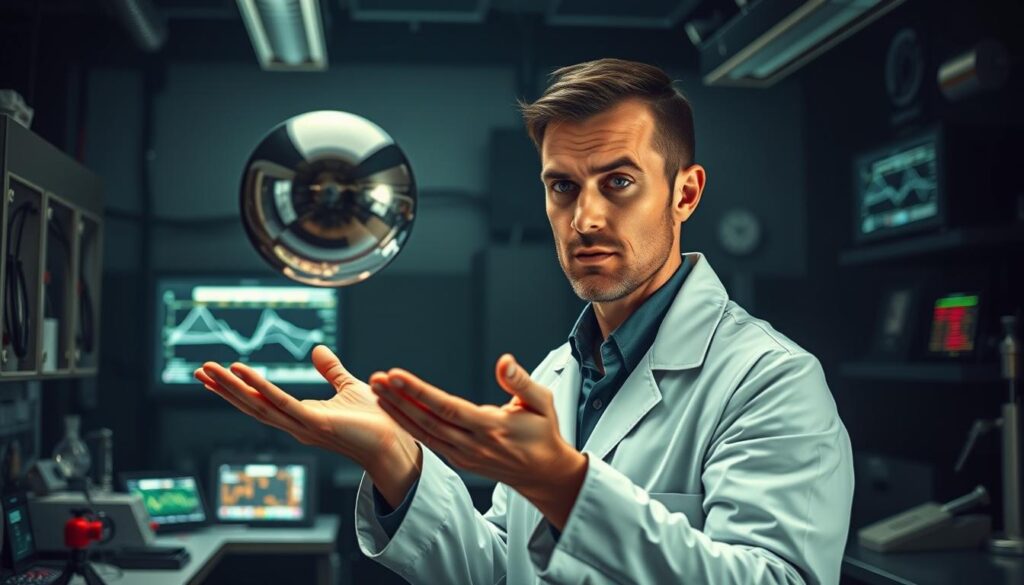
Conservation, thermodynamics, and inverse-square considerations
Moving an object without contact implies a transfer of force and energy. Known forces follow conservation of momentum and energy and typically show inverse-square behavior with distance.
To move matter beyond electromagnetic binding would need large, detectable energy. That should appear in instruments and across repeated tests.
“Extraordinary claims require extraordinary proof” in practice
Mario Bunge and others note that direct mind-to-matter manipulation would undermine trust in measurements unless tightly defined.
“Extraordinary claims require extraordinary proof.”
- If a new force existed, controlled experiments would reveal it consistently, not as statistical noise.
- Quantum explanations do not evade conservation laws; they still demand mechanisms that predict outcomes.
- The absence of detected fields or continuous effects supports skepticism until clear, repeatable demonstrations appear.
For a practical look at testing claims and common pitfalls, see how to move things with your.
Cognitive Biases and Why We Think It Works
Our minds are wired to spot patterns, and that wiring can make random events feel meaningful.
Illusion of control and clustering
Illusion of control makes a person feel they influenced an outcome. This can happen with a roll of the dice or a wobble of small objects.
Clustering illusions lead observers to see streaks in small samples. A run of sixes feels like proof, even when the number matches chance.

Confirmation bias in witnessing and memory
Confirmation bias nudges memory toward hits and away from misses. In classic studies, recording errors matched expectations: believers and disbelievers logged outcomes differently.
Wiseman and Morris (1995) found that some subjects misremember ambiguous demonstrations as genuine. Daniel Wegner described how apparent mental causation springs from timing: when thoughts precede an event, we often infer cause.
“People infer they caused events when thoughts precede outcomes.”
Practical step: keep careful logs, use blinded recording, and compare results to chance. Awareness of bias helps you view claimed telekinesis with curiosity and clearer judgment.
For experimental context and common pitfalls see psychokinetic studies and notes.
How Magicians and Media Fake It
Stagecraft and editing explain many startling demonstrations that look like mind-powered effects. Live performers use classic routines and small devices to suggest an object moved on its own.

Classic methods behind spoon bending and levitation illusions
Common magic methods include pre-bent pieces, switches, hidden pressure, and misdirection. A bent spoon may be gimmicked or warmed and flexed off-camera.
Levitation often relies on threads, magnets, or a concealed support. Suggestion and timing make people believe a key or spoon keeps bending after the performer stops touching it.
Project Alpha and lessons for careful testing
Project Alpha (1979–1981) at Washington University showed how two teen subjects who were skilled magicians fooled researchers. The episode taught a hard lesson: labs must include controls that anticipate sleight of hand and room tampering.
“Invite professional magicians to design controls and watch the room closely.”
- Film and television add cuts, angles, and CGI to amplify effects.
- Small tech—threads, magnets, gimmicked props—can move objects undetected.
- Good experiments block switch methods and document the entire room.
| Trick type | How it’s done | Test control |
|---|---|---|
| Spoon bending | Pre-score, heat, or swap with pre-bent item | Use sealed objects, continuous video, and blind observers |
| Levitation | Threads, wires, or magnetic supports | Inspect rigging, sweep for magnets, and isolate the room |
| Camera magic | Edits, angles, CGI, and practical effects | Compare live demo to recorded footage and use multiple camera angles |
| Suggestion effects | Verbal cues and attention control | Use naive crowds, blind protocols, and independent scoring |
Bottom line: understanding these methods keeps curiosity alive while guarding against false conclusions. For more on claims and testing, see what are PK abilities.
Telekinesis in Pop Culture: From Jean Grey to Star Wars
Pop culture turns imagined mental feats into vivid set pieces that shape how people picture psychic ability.

Comic books, films, and TV lean on visual shorthand to show inner power. Marvel’s Jean Grey stands out for planet-shaking displays and complex drama. Jean Grey appears in comics and movies as a benchmark for raw, tragic ability.
Superheroes and espers: Marvel, DC, and anime icons
Writers pair telepathy with telekinesis to raise stakes. Anime and games use psychokinesis as a gameplay mechanic, letting players push or lift objects in combat.
Film and TV moments that shaped public imagination
Classic scenes—from Carrie’s climactic rage to The Matrix’s bullet-time—teach audiences what a cinematic power looks like. Stranger Things makes a young character’s quiet focus feel dangerous and real on screen.
Video games and the language of “psychic ability”
Games translate unseen force into rules: range, cooldowns, and strength. That helps fans discuss scaling from small nudges to city-level effects.
“Enjoy the spectacle while keeping a friendly, critical lens on what’s possible outside the screen.”
| Franchise | Medium | Iconic moment | How it’s staged |
|---|---|---|---|
| Jean Grey / X-Men | Comics / Movie | Phoenix-level destruction | Visual effects, montage, dramatic acting |
| Star Wars | Film | Force push / object levitation | Wirework, CGI, sound design |
| Carrie | Movie | Telekinetic prom chaos | Practical effects, camera cuts, timing |
| Stranger Things | Television | Eleven moves objects remotely | Close-ups, acting, subtle props |
Levels and Abilities in Fictional Worlds
Fictional worlds often sort mind-based skill into tiers so readers see clear growth and stakes. These ladders help writers balance scenes and set expectations for what a character can try.

Common tiers as storytelling devices
Stories label ranks from basic nudges to absolute manipulation. A basic level might show gentle movement of a small object. Higher tiers add multi-object control, shielding, or reality-scale effects.
Range, force, and precision: scaling power
Authors measure four axes: range (how far), force (how strong), precision (how exact), and degree (how consistent). Some tales value delicate placement over raw might. Others use raw force for dramatic conflict.
- Tier names: Basic, Advanced, Expert, Master, Ultimate, Absolute — labels vary by story.
- Fan benchmarks: Characters like Jean Grey often mark the top end in discussions.
- Narrative role: Tiers signal growth, balance teams, and raise stakes.
“These systems are tools for craft, not scientific categories.”
Takeaway: enjoy the classification as a creative language that clarifies feats in fiction, while remembering it does not reflect real-world training or evidence.
Beginner Mindset: Safe, Grounded Practice Goals
Start with a calm, curious mindset that treats practice as attention training rather than proof of powers. This keeps expectations aligned with present-day science and makes sessions useful regardless of outcome.

Focus, relaxation, and attention training
Use breathwork and short mindfulness routines to quiet the mind. Ten minutes of steady breathing helps you notice small changes without rushing to explain them.
Keep your hands relaxed and still near any objects. A steady hand and neutral posture reduce accidental air movement or contact that could be misread as an effect.
Setting expectations in the present day
Be clear: you are improving concentration and observation, not claiming a new physical ability. Respect reason and evidence; investigate environmental causes first if something seems striking.
- Log sessions: note what you expected and what actually occurred.
- Limit session time to avoid fatigue and keep practice sustainable.
- Give value to patience, body awareness, and thoughtful skepticism—skills that help people in daily life.
“Approach practice as training your attention and curiosity, not as proof of extraordinary claims.”
For practical testing tips and safe steps you can try at home, see this short guide on focused practice: focused practice and testing.
Step-by-Step “Experiments” for Focus and Observation
Try simple, controlled tasks that train attention and reveal how expectation shapes what you see. These short exercises are designed as sensitivity and observation drills, not proof of paranormal force. Keep an open, skeptical mindset and record everything.

Dice and number-focus activities
Pick a single die and a quiet room. Before each roll, predict a number and write it down. Then roll, record the result, and repeat for many trials.
Historical dice experiments show recording bias: beliefs often shape how subjects log outcomes. Comparing predictions to actual rolls teaches how randomness feels and how easily the mind sees false patterns.
Lightweight “psi wheel” as a sensitivity exercise
Use a small paper or foil wheel on a pointed pin under a clear cover. Place it away from vents, windows, and heat sources.
Keep your hands and face several inches away to avoid convection currents. If the wheel moves, repeat the run with changed room conditions to rule out drafts, temperature shifts, or subtle vibrations.
Journaling outcomes to learn about randomness
Log start and stop times, room conditions, perceived effects, and likely physical causes. Note whether a plausible force (air, static, or touch) could explain any motion of an object.
Over many sessions, compare results. You’ll learn how expectation biases observers and why careful documentation matters. The goal is to sharpen observation, not to move objects.
| Exercise | Setup | What to log |
|---|---|---|
| Dice prediction | Single die, flat surface, quiet room | Predicted number, roll result, time, notes on distractions |
| Psi wheel sensitivity | Wheel under clear cover, isolated from vents | Any spin, room temp, vents on/off, hand distance |
| Repeat testing | Same setup, then altered conditions | Compare trials, note consistent vs. changeable effects |
“Documenting conditions and repeating tests is the best way to separate expectation from real-world causes.”
Energy, Breath, and Visualization Techniques
Start sessions by settling the body so attention can rest on small details without distraction.

Breathwork for calm and focused visualization
Begin with a simple rhythm: inhale slowly for three counts, exhale for five. Repeat for a few minutes to lower heart rate and quiet the mind.
Visualization helps concentration. Picture a still object and a quiet room. Use this as a drill for attention, not proof of any external force.
Body stillness and hand positioning to reduce inadvertent motion
Plant your feet, relax shoulders, and keep one hand resting gently on your lap to limit tremors. Keep your hands a safe distance from light objects so breath or sighs do not move them.
Treat “energy” as a metaphor for focused attention. Check for drafts with a tissue before tests. Keep sessions short, log each run, and repeat the same comfortable form so you can compare results over time.
“Use these methods to train attention and safe observation rather than to claim physical effects.”
Common Mistakes, Myths, and Media Tropes
What appears to be mind-driven movement often traces back to simple physical or production factors. This short section helps you spot common errors and media tricks that make ordinary motion look mysterious.

Mistaking drafts, static, or micro-movements for force
Very light objects are easy to misread. A table vibration, static cling, or a tiny draft can nudge a cup or paper and seem like something more.
People also shift posture or exhale without noticing. These small actions supply the push that makes balanced items tilt.
How camera angles and edits amplify effects
Film and television use cuts, close-ups, and timing to hide rigging and create seamless illusions. A single edit can remove the moment a thread is attached.
Modern technology—from practical rigs to CGI—lets creators stage scenes that feel persuasive but are designed, not measured.
- Magic methods: invisible threads, magnets, and gimmicked props move things convincingly in live shows.
- Environmental causes: temperature gradients, static buildup, and floor vibration often explain surprising motion.
- Practical check: ask what the camera does not show and how a skilled magician might reproduce the moment.
“Enjoy impressive scenes as art, while keeping a healthy distinction between entertainment and evidence.”
| Source of illusion | How it looks | Control to test |
|---|---|---|
| Drafts / convection | Slow, steady drift of light objects | Close vents, repeat test with a tissue to detect air flow |
| Camera edits / cuts | Sudden change that hides a setup step | Use continuous footage and multiple angles |
| Stage methods | Objects move without visible contact | Inspect props for threads, magnets, or swaps |
| Static / temperature | Objects cling, jump, or spin unexpectedly | Control humidity, check surface charge, and repeat |
Practical tip: log conditions and repeat experiments in varied setups. Reproducible results that survive controls are the only reliable way to move from wonder to evidence.
Ethics, Safety, and Respectful Exploration
Curiosity should be paired with care: how you test matters for people and property.

Why skepticism and curiosity can coexist
Be open, but ask for good reason. Scientific panels and prize challenges have repeatedly stressed the need for solid methods and repeatable results. That record does not end curiosity; it shapes how we investigate.
Skepticism is a method, not a dismissal. It asks for clear steps, controls, and honest reporting. Curiosity drives careful tests, and skepticism protects against self-deception.
“Extraordinary claims need clear, repeatable evidence.”
Respecting science, people, and property
Treat practice as a short course in attention and ethics rather than a hunt for hidden powers.
- Respect other people’s time and space; avoid risky setups that could damage property or create misunderstandings.
- Log conditions, controls, and outcomes. If you share videos or notes, be transparent about what you did and did not control.
- Ask for replications and clear protocols when someone claims an ability or force beyond common explanation.
- Use practice to build patience, careful observation, and honest reporting—not to stage misleading demonstrations.
Takeaway: ethical exploration supports wonder without overstating the existence of a new force. Stay curious, act with reason, and respect the world and people around you.
Conclusion
To finish, consider how careful observation and honest methods help separate striking stories from verifiable results. This guide showed what telekinesis means, how labs test claims, and why many reports trace to bias or stagecraft.
Key takeaways: modern reviews find no reliable evidence for psychokinesis. Physics sets high hurdles for any claim of manipulation or new forces. Pop culture and media craft make stories of powers feel immediate and emotional.
Your practice still matters: breathwork and focused attention build real abilities like patience and sharper perception. Keep respect for evidence, people, and property, and share findings openly. If future technology or research changes the picture, solid replication and clear protocols will reveal it in time and to the world.
For a short look at related topics and careful exploration of psychic claims, see psychic superpowers.