

This short guide clarifies the term and scope of intuitive work in plain language.
Both labels describe practices that access information beyond ordinary senses. One tends to weave insights across time to suggest outcomes, while the other presents clear mind’s-eye images about the present.
People often seek these abilities for practical life choices — relationships, careers, or emotional events. A medium fits in the same world by relaying messages from those who have passed, not by directing spirits.
This article will help you decide who to consult based on the clarity you want. We use real examples and a friendly, nonjudgmental tone to make the core difference easy to spot.
For a related look at how a medium differs, see psychic vs medium.
Key Takeaways
- These practices share an intuitive base but serve different needs.
- One offers cross‑time synthesis; the other gives vivid present images.
- Seekers ask for help with real‑world life and events.
- Mediums connect the living and the deceased, not control spirits.
- Use this guide to pick the right approach for the clarity you want.
Understanding the terms today: what people mean by psychic, clairvoyant, and medium
In everyday language, these terms point to different methods for accessing unseen information.
Psychic is often used for an individual who perceives subtle information beyond the five senses. They may rely on intuition, telepathy, or precognition and sometimes use tools like tarot or astrology to structure a reading.
Clairvoyant describes someone who receives clear vision‑style impressions. Images, symbols, or short scenes appear in the mind’s eye and offer specific, visual details that can be interpreted for present situations.
Medium refers to a practitioner who connects living clients with those who have passed. Their work focuses on relaying messages that bring comfort or closure through direct communication or channeling.

“These roles overlap—many individuals blend more than one type of perception in their work.”
- Terms vary by community, but the main distinction is how information is received and delivered.
- No single type is better; choose based on the kind of insight you want now.
- For a deeper look at related skills, see psychic superpowers.
What is a psychic? Abilities, information sources, and how psychics work
Some intuitive practitioners describe their skill as tuning into a person’s energy to gather practical information. This focus guides a reading toward useful outcomes for everyday life.
Core abilities include intuition, sensing emotional patterns, and perceiving an individual’s aura or energy field. The aura is often described as a multilayered magnetic field that reflects feelings, thoughts, and behavioral tendencies.
Core skills and energetic perception
Practitioners develop the ability to read emotional and situational patterns. They synthesize impressions tied to past events and present choices to suggest likely futures.
Common tools used in a session
Many readers use tools to structure a message. Typical tools include tarot cards, astrology charts, crystals, and pendulums.
Tools help organize the information, but the primary perception usually comes from the reader’s inner sense. Sessions can be tool‑assisted or purely intuitive.

Scope of insight and practical outcomes
A reading aims to give actionable clarity for relationships, career moves, timing of events, and life purpose. Some practitioners describe tuning into vibrational patterns tied to people and places to reveal dynamics or likely trajectories.
“Many readers report connecting across past, present, and possible futures to help clients make clearer choices.”
- Focus: information that arises through intuition and subtle energetic perception.
- Outcome: guidance oriented to real-life decisions and timing around important events.
- Collaboration: sessions work best with open questions that allow connections across time frames.
| Aspect | What it shows | How it helps |
|---|---|---|
| Aura/energy field | Emotional and rational layers | Clarifies motives and triggers |
| Tarot/cards | Symbolic story points | Structures a reading and suggests steps |
| Astrology charts | Timing and cycles | Highlights favorable periods for action |
| Crystals & pendulums | Focus and yes/no signals | Supports specific, short answers |
For a closer look at practitioners who blend methods, see a short guide to psychic clairvoyants.
What is a clairvoyant? “Clear seeing,” images, and visual messages
Visual impressions can appear suddenly as images, symbols, or brief movie‑like sequences.
Definition: A clairvoyant is someone whose primary abilities focus on images that form in the mind’s eye. These may be snapshots, symbols, or flowing scenes that a reader decodes into useful meaning.
These images often feel precise and spontaneous. A practitioner may report names, places, colors, or symbolic motifs that map directly to a client’s situation.

How sight-based impressions form
Many descriptions compare the experience to a mental movie. Scenes can relate to the present, but some readers also see past events or possible futures depending on their other abilities.
When other senses join the vision
Although sight dominates, sounds, a sudden phrase, or a subtle physical feeling often accompany the images. These extra cues sharpen interpretation and help tie images to concrete messages.
“Clear seeing gives tangible imagery that a client can hold onto when making decisions.”
- Clarity: images give concrete anchors for guidance.
- Process: the reader describes visuals, then links them to practical steps.
- Fit: this work suits people who prefer concrete imagery to guide action.
For more on practitioners who specialize in this style, see a dedicated guide to clairvoyant work.
Psychic vs clairvoyant: the key differences that matter
What really matters is how practitioners gather information and the lens they use to interpret it.
Methods compared: broad intuitive reading vs visual impressions
Psychic readings tend to weave multiple data points into one coherent message. They often blend intuition with structured tools like tarot or astrology to guide choices.
Clairvoyant work centers on clear mental pictures. These direct images become the main material a reader interprets for immediate clarity.
Time focus: predicting future events vs interpreting present images
One approach commonly explores timelines and likely trajectories to help with planning and timing. The other emphasizes present symbols that reveal core issues now.
Where they overlap: mediumship, spirit messages, and shared abilities
Many practitioners blend methods. Some psychics or mediums report receiving vision-style impressions, and some clairvoyants widen into broader intuitive sensing.
“When spirits are part of a session, the focus shifts toward relaying messages and validating connections.”
- Use a timeline lens for decisions under time pressure.
- Choose image-led work to decode recurring symbols.
- Ask about methods beforehand so expectations match the reader’s style and others in the session.

Mediumship explained: connecting the living with the spirit world
Mediumship focuses on creating a respectful bridge between those who remain and those who have passed.
Define mediumship: A medium practices a focused method that links the living with deceased individuals. The aim is to share verifiable details and heartfelt messages that comfort and clarify.
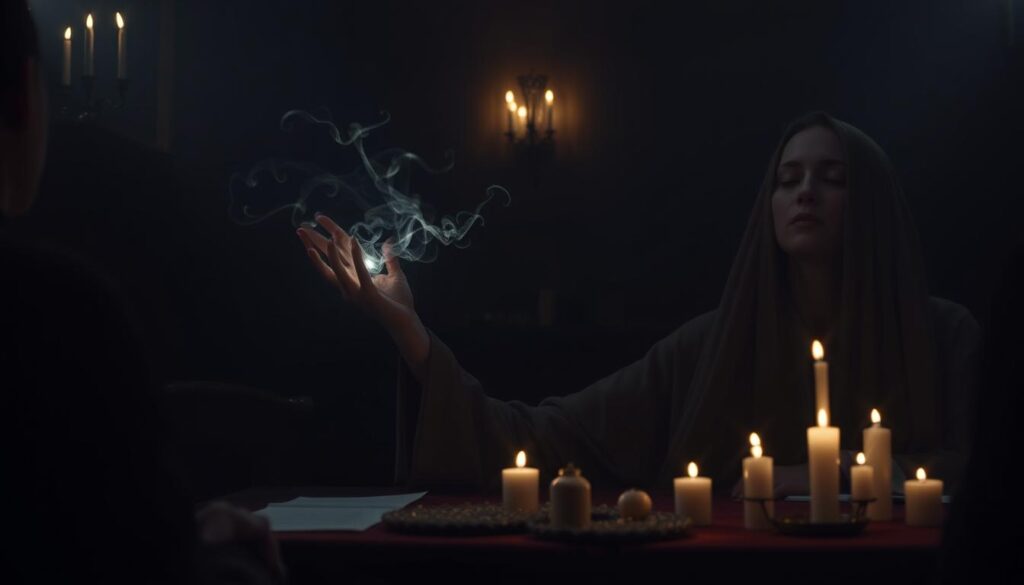
What a medium does: relaying messages from a loved one and spirit guides
In-session, a medium establishes a connection and offers evidence such as names, dates, or personality traits. These specifics help confirm a real link and support healing.
Many mediums use a mix of clairvoyant images and broader abilities to validate identity. A psychic medium may hear phrases, see scenes, or sense emotions to add context.
“The role is to convey what comes through, not to influence or command spirits.”
- Mediumship prioritizes respectful communication and clear validation.
- Ethical boundaries matter: mediums do not control spirits, only facilitate messages.
- People seek this work for closure, reassurance, and continued bonds with a loved one.
| Feature | What to expect | How it helps |
|---|---|---|
| Evidence | Names, nicknames, events | Confirms identity and builds trust |
| Medium methods | Visuals, phrases, emotional impressions | Strengthens validation and context |
| Outcome | Comfort, closure, guidance | Supports grief work and clarity |
Approach mediumship with patience and an open heart. Accurate mediums often deliver concrete details that resonate, and the flow of information can vary from visit to visit.
Note: Many readers consider mediumship a gift that helps the living heal and reconnect.
Tools and techniques: when practitioners may use cards, charts, or none at all
Tools can act as a roadmap, or a reader may simply let images and messages guide the work.

With tools: cards, tarot, numerology, and charts
Many readers use tools to organize impressions. During a psychic reading, tarot spreads, numerology blueprints, or astrology charts help structure a narrative.
Card methods like cartomancy and tarology use different decks and layouts. A Lenormand grid or the Tarot de Marseille can highlight cause, effect, and timing.
Practitioners may choose a technique when a question has many variables. For example, tarot is useful for decisions with several options. Numerology helps with timing and cycles.
Without tools: clear seeing, hand-based work, and spirit links
Some psychics prefer to work by hand with minimal props. Others rely on direct images or real-time spirit communication, especially a medium focused on evidential details.
Choice depends on skills and comfort. The method should match the client’s needs and the reader’s strengths.
“Whether tools are present or not, the aim is clarity and practical next steps.”
- Ask upfront about methods so the session fits how you process insight.
- Expect tools to frame meaning; expect tool-free work to deliver vivid images or direct messages.
- Many practitioners blend approaches to increase clarity for a given question.
Choosing the right practitioner in the United States
The first step is deciding whether you need timelines, messages from a loved one, or vivid visual detail.
Quick guide: Choose a psychic for broad life guidance and likely timelines. Pick a medium or a psychic medium when you want contact with someone who has passed. Select a clairvoyant for image-led detail about a current situation.
Before booking, review specialization and recent reviews. Ask a practitioner what methods they may use, how they explain information during a reading, and what kind of evidence they provide when working with spirit connection.

Match the person’s communication style to your needs. Some people prefer visuals, others want structured spreads or direct conversation. For life planning and important events, many psychics or psychic mediums use tarot or charts to handle layered questions.
“The right practitioner is the one whose method resonates and supports your situation now.”
- Set an intention and prepare a few open questions to guide the session.
- Start with a shorter session to test fit before booking longer time.
- Check credentials, ask about skills and method, and confirm how information is shared.
For more on booking and what to expect in a session, see psychic readings.
Conclusion
At the end of the day, each intuitive approach turns subtle signals into useful steps for life.
Psychic work often maps likely trajectories and may use cards or charts to structure a reading. Clairvoyance brings clear images to the mind‘s eye and gives visual anchors for decisions.
A medium practices mediumship to relay messages from spirits or a loved one to the living. Many psychics and a psychic medium blend methods—images, evidential details, and tool‑based structure can appear in one session.
Choose the person whose style fits you. Small recognitions—a name, a hand‑feeling, or a clear image—often validate a message. Match expectations, stay open, and pick the approach that best translates insight into your next right step in this world.
For more on tuning intuition in practice, see psychic intuition.