
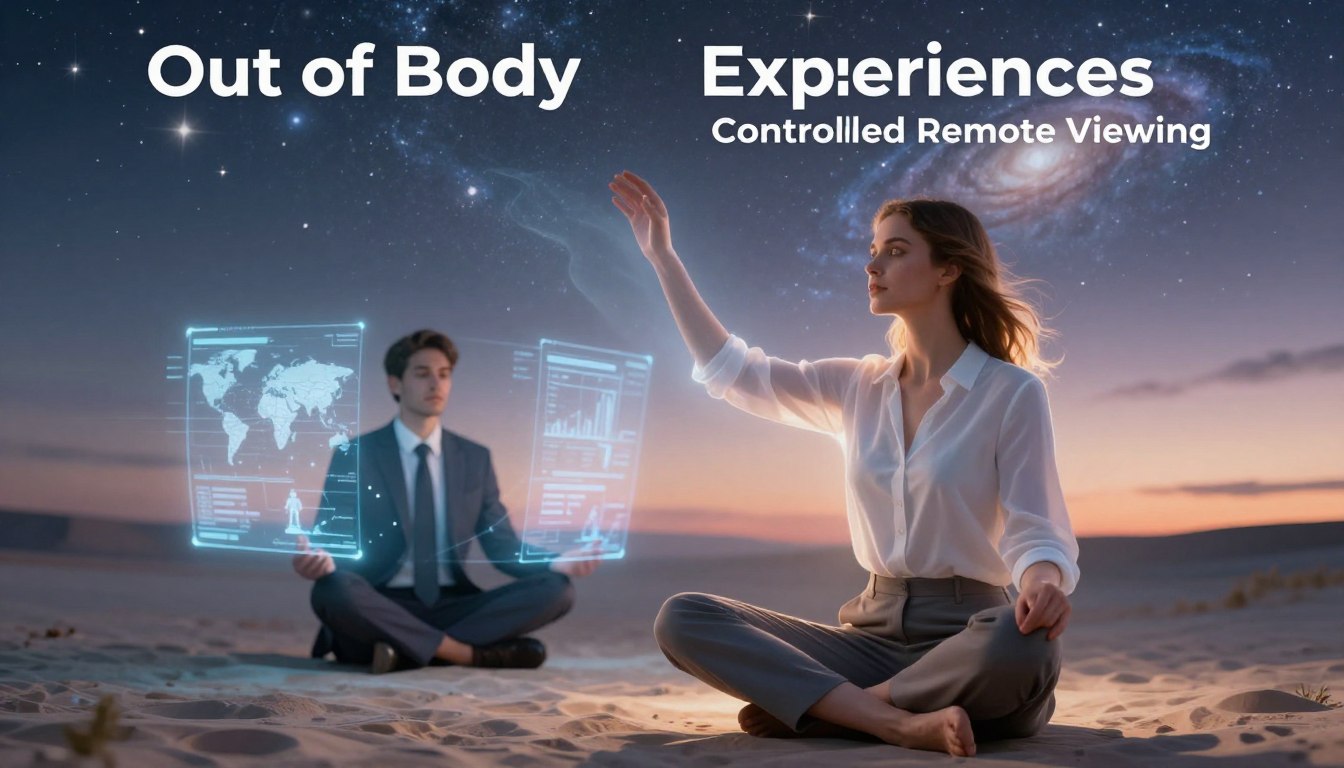
Many seekers mix up key terms when exploring how awareness can move beyond the physical form. This introduction clears the main difference between an out of body experience and structured remote viewing. Each path offers a distinct route to perception and insight.
An out of body experience happens when awareness shifts away from the physical frame, often during sleep or deep meditation. Astral projection is a named form of that journey. In contrast, remote viewing is a focused method to perceive distant targets while the self remains in place.
Understanding these terms matters for anyone who wants to map human consciousness. Whether you favor projection or systematized viewing, each practice teaches that you are more than your physical shell. This brief guide sets the stage for a clear, friendly comparison ahead.
Key Takeaways
- These two paths are often confused but are fundamentally different.
- An out of body experience usually involves leaving the physical frame.
- Astral projection is a specific kind of journey within that realm.
- Remote viewing uses focused perception without leaving the body.
- Both routes expand understanding of consciousness and self.
Defining the Nature of Consciousness
Robert A. Monroe framed consciousness as a dynamic dial: where focus tuned what a person perceived. His Phasing Model compared awareness to a radio spectrum, not a fixed inner item.
Monroe proposed that consciousness was a field shaped by attention. In this view, focused awareness determined how the physical body was experienced and which station felt primary.
That idea replaced the archaic belief that a nonphysical soul lived as a separate part inside the flesh. Modern models treated consciousness as the fundamental building block of reality, helping explain how we sense the world.
The subjective quality of an experience often blurred when philosophy struggled to explain movement through linear time. Seeing awareness as a spectrum made it clear that the physical body was just one station on a larger dial.
For further reading on related perceptual models and skill claims, see clairvoyant abilities.
Understanding Out of Body Experiences
Many people report vivid shifts in awareness that feel like stepping into another layer of reality. These episodes let a person sense a separate location while the physical body rests. Studying these events reveals consistent characteristics that help researchers and practitioners describe what happens.

The Astral Plane
Astral projection is a deliberate journey into a plane shaped by thought and energy. Landscapes there bend with the mind, and guides or symbols may appear to aid healing. People often describe flying, floating, or moving through vivid scenes that feel as real as the waking world.
Spontaneous vs. Induced States
Some events arise spontaneously during shock, trauma, or deep sleep. Those spontaneous moments often leave a person disoriented. Other states are induced through meditation and skillful practice.
- Spontaneous episodes can be sudden and confusing.
- Induced projection is practiced and repeatable.
- Both types offer insight into consciousness and self-healing.
For related psychic skills like telekinesis, practitioners compare methods to refine focus and intention.
The Mechanics of Controlled Remote Viewing
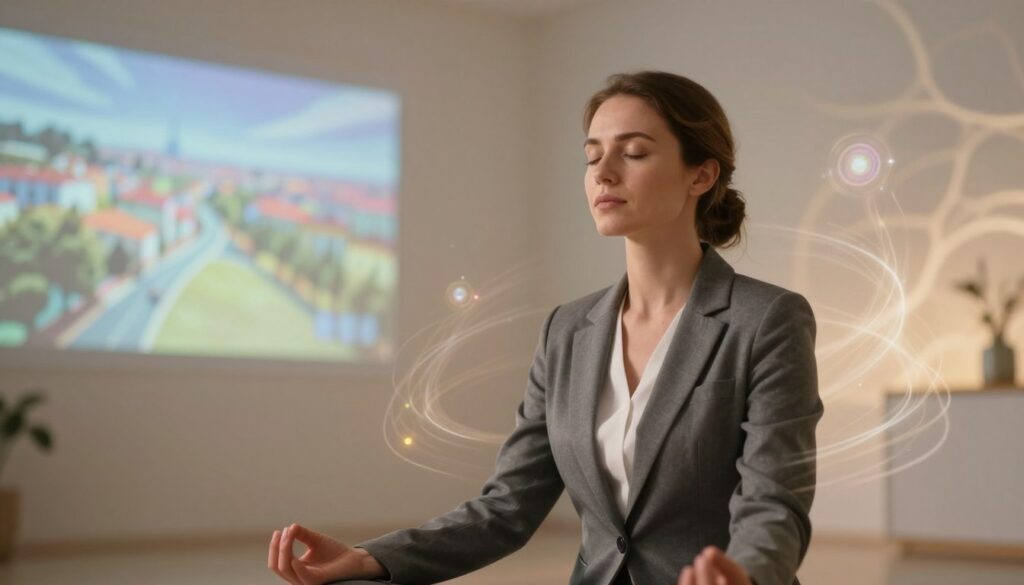
Controlled protocols guide a trained person to gather details about a distant target while remaining fully present in the physical body. The process emphasizes disciplined steps that protect results from imagination and bias.
Structured Protocols and Methodology
The methodology asks a viewer to quiet the mind and note raw impressions. Those impressions often arrive as images, sensory hits, or simple words tied to a target.
Practitioners keep a picture-in-picture perspective to monitor their awareness and the information stream. They record sketches and notes, then compare those data to the actual location or object later.
- Stepwise process: tasking, relaxation, perception, recording.
- Strict protocols reduce imagination and improve data quality.
- Research has shown repeatable results where trained teams described a target location accurately.
By focusing attention on a single target, the trained mind can access nonordinary perception and yield usable images and facts about an object or event separated by distance.
Comparing Out of Body Experiences Versus Controlled Remote Viewing
One path asks the mind to travel into another realm, while the other trains attention to describe a specific target from here.
An astral projection-style journey can place awareness in a different location or layer of reality, giving rich, scene-like reports and personal meaning.
By contrast, remote viewing keeps the practitioner anchored in the physical body and focuses on gathering clear information about a target. The method values protocol and repeatable notes over narrative travel.

Both phenomena challenge how we think about time and consciousness. One yields immersive perception; the other delivers task-driven data that can be checked against a real-world target. Each approach has unique characteristics and strengths.
- Intent differs: journeying vs. information gathering.
- Location shifts in projection; the viewer remains present when doing remote work.
- Usefulness: projection can heal and inspire; viewing can produce verifiable facts.
Comparing these methods gives a clearer picture of how perception expands. For related skill discussions, see psychic superpowers.
The Role of Intent and Focus
A clear aim acts like a compass for consciousness, steering each session toward meaning or data. Your intent acts as the steering mechanism for awareness. It decides whether you drift into a landscape or hold steady for a task.

Robert A. Monroe stressed that where you place focused awareness is where energy flows. That alignment shapes the quality of any practice and the resulting experience.
Keeping a firm sense of self helps prevent getting lost in vast states. A stable identity anchors perception and reduces the disorienting feeling that sometimes appears during deep practice.
With a clear goal, attention narrows. The mind stops wandering and can either explore subtle dimensions or gather precise data. Managing focus is a learned skill that improves with each session.
- Set a specific aim before you begin.
- Practice steady attention to direct energy where you want it.
- Use short, repeatable routines to strengthen focus over time.
Scientific and Practical Applications
Decades of applied work show that disciplined perception can produce verifiable results in the field. Labs and practitioners have turned trained awareness into methods that deliver useful information for real projects.

Intelligence Gathering
Since the 1970s and 1980s, programs have used trained teams to gather data about distant targets. These efforts taught methods to reduce bias and improve accuracy.
Results include detailed sketches, sensory hits, and actionable information that helped analysts confirm a target or object.
Archaeological Investigations
Researchers have applied focused perception to locate buried places and hidden sites. Teams report discovering promising locations when traditional surveys found nothing.
Institutions like the Monroe Institute integrated projection and sensing into training, helping people produce repeatable leads for field follow-up.
Research and Data Collection
Modern programs mix protocol, precise technique, and frequency work to scaffold the self during sessions. Patty Ray Avalon and colleagues have refined these methods in the OBE Spectrum program.
Virtual retreats—like the February 2024 event—show how training and gamma-state scaffolding help people gather images and data safely. When rigor and intent combine, the practice yields usable research results.
- Practical use: intelligence tasks and archaeological scouting.
- Training: standardized technique for consistent data.
- Support: frequency scaffolding keeps the person stable during work.
Exploring the Spectrum of Non-Ordinary States
Consciousness can shift along a range of states, from lucid dreaming and sleep-induced shifts to disciplined projection and trained remote viewing practice.

Researchers treat these states as a continuous data stream. That idea helps people learn how to tune attention and gather images, facts, or feelings on demand.
Meditation and deep relaxation act as reliable entry tools. They quiet the mind and loosen ties to the physical body so perception can widen.
“Studying this spectrum shows we can hold presence here while sensing a distant target, effectively multi-tasking consciousness.”
- Range: lucid dreams, sleep shifts, projection, and task-focused remote viewing.
- Use: perception yields images, descriptive data, and verifiable results.
- Benefit: sustained practice often produces personal growth and clearer research outcomes.
When people train attention, they learn that reality is flexible and that bodies are not the sole limit of what we can know.
Overcoming Barriers to Practice
Belief limits shape practice more than lack of will or instruction. Many barriers are mental. They stop a person before the first clear lift or meaningful result.
Managing limiting beliefs means shifting from pressure to patience. Carl Rogers said we are always becoming. That idea helps when results lag during a new process.
Let go of strict expectations. New neural links form slowly, often during rest or short sleep cycles. Several people report their first classic OBE after returning home from a course.
Practical steps to reduce fear
- Release the need for a specific outcome to ease tension.
- Focus on steady routine and simple technique practice.
- Record small wins; each feeling of progress matters.

| Barrier | Strategy | Likely Results |
|---|---|---|
| Performance pressure | Short, repeatable routines | Reduced anxiety, clearer impressions |
| Fixed beliefs | Adopt growth mindset | More attempts, higher skill |
| Unfamiliar setting | Practice at home | Comfort yields stronger sessions |
Even when a week of training yields no classic body experience, the practice itself moves you forward. For related skill work, see how to move things with your.
Conclusion
This article draws a clear line between immersive astral journeys and task-driven perception methods.
We explored the key difference and showed how each path helps expand consciousness. The immersive route, like astral projection, gives scene-rich, personal accounts. The task-led approach yields precise data and verifiable information.
Practice during the transition into sleep can reveal a first classic body experience or produce reliable facts. When trained people use strict protocol, remote viewing often delivers measurable results.
Both phenomena widen what we call reality. Keep exploring, test methods carefully, and read more about related skills like clairvoyant abilities.