

This introduction maps the key differences between spontaneous extrasensory perception and the formal protocols that aimed to make those talents measurable. It highlights the life and work of a pioneer born in Telluride, Colorado, on September 14, 1933, who coined the term now linked to structured psychic testing.
We explore how innate gifts and repeatable methods became distinct threads in Cold War research. The CIA funded studies to see if private experiences could become a reliable part of intelligence work.
While many people show basic psychic abilities, the protocols developed by the pioneer sought to standardize those hits into a step-by-step process. This section sets the stage for a closer look at method, history, and the human side of controversial research.
Key Takeaways
- The article compares spontaneous perception with structured protocols.
- It reviews the life and contributions of Ingo Swann to psychic research.
- Understanding these differences helps explain Cold War investigations.
- Swann’s methods aimed to make abilities testable and repeatable.
- Learn more about psychic research and related ideas at psychic superpowers.
Understanding the Origins of Remote Viewing
Personal accounts of seeing beyond the immediate surroundings motivated a push to make such impressions measurable. Early life episodes shaped both language and method. A boy from Telluride born in 1933 reported out-of-body events at the age of three. Those moments guided a lifelong interest in perception and consciousness.

Early Life and Influences
As a youth he noticed colorful auras and later moved to New York. There he volunteered at the American Society for Psychical Research. Researchers began to record his reports and compare them with physical facts.
The Birth of a Term
He coined the phrase “remote viewing” to describe the claimed ability to gather information about distant persons, places, or events across time and space.
“My first clear impressions started as simple sensations around objects and bodies, then broadened into larger experiences.”
| Era | Key Event | Impact |
|---|---|---|
| Childhood | Out-of-body episodes | Inspired study of perception |
| Young adult | Research in New York | Formal documentation began |
| 1970s | Public prominence | Influenced intelligence world |
Defining Ingo Swann Natural ESP vs Controlled Remote Viewing
The pioneer separated chance extrasensory flashes from a formal process that trains the mind to report target details.
In his view, one type of perception arrives unpredictably and depends on individual psychic abilities. The other is a deliberate training method that aims to bypass the physical senses to gather non-local information.
Key differences include:
- Spontaneous impressions are episodic; the taught form is repeatable and structured.
- The trained viewer learns to quiet analytical thought so raw perception can emerge.
- Practice refines accuracy, turning an occasional hit into a testable process.
Researchers value this distinction because it frames how consciousness interacts with blocked or distant targets. By treating viewing as a skill, trainers taught techniques to reduce sensory leakage and bias.

“The goal is to describe targets without relying on signals from the physical senses.”
The Role of the Stanford Research Institute
Researchers at a prominent California lab designed experiments to see if human awareness could serve strategic needs.
The Stanford Research Institute became the main U.S. site for examining claims about psychic espionage during the Cold War. Physicists Russell Targ and Harold Puthoff led careful tests that drew steady attention from intelligence agencies.

The Stargate Project Context
The experiments at the institute later fed into the Stargate Project, a classified program that ultimately received about $20 million over two decades.
The goal was simple: decide if perception beyond ordinary senses had true value for national security. Key participants, including Ingo Swann, demonstrated abilities that surprised many researchers and officials around the world.
“By the program’s peak, documented sessions challenged conventional views of perception.”
| Focus | Lead | Impact |
|---|---|---|
| Psychic espionage tests | Russell Targ | Directed intelligence interest |
| Protocol development | Harold Puthoff | Basis for later study |
| Program funding | U.S. agencies | ~$20 million over 20 years |
Legacy: The research institute’s work is still part of debates in the field. The Stargate Project left a complex record that links laboratory study to the priorities of intelligence in a tense age.
Distinguishing Psychic Abilities from Trained Protocols
Trained protocols turn sporadic impressions into repeatable reports that labs can test. This contrast matters when teams measure how well a person gathers information under controlled conditions.
Unlike spontaneous psychics, trained practitioners follow set steps. Those rules aim to block the physical senses and keep the mind from analyzing early impressions.
The process asks the viewer to relax thought and accept raw impressions. Quieting the mind reduces bias and lowers the chance of mixing memory or guesswork into results.

Researchers often compare trained participants with others who have no prior practice. These experiments show that practice and age can improve focus and consistency over time.
“When you remove the noise, the underlying signal becomes clearer.”
Protocols are designed to limit personal belief influence. That helps teams treat reports as data rather than opinion.
| Aspect | Spontaneous Psychics | Trained Protocols |
|---|---|---|
| Consistency | Often variable | More stable across sessions |
| Role of physical senses | May blend with impressions | Explicitly ignored |
| Reliability for experiments | Harder to verify | Designed for repeatable results |
| Effect of practice/age | Limited improvement | Improves with experience |
The Mechanics of Coordinate Remote Viewing
The method breaks perception into discrete steps so a viewer can record impressions without premature analysis.

The Six Stage System
Coordinate Remote Viewing relies on a six-stage system developed to separate signal from noise. Each stage opens perception gradually, from initial spatial cues to detailed verbal and sketch data.
Stage by stage, the viewer keeps the mind calm and the body grounded. This prevents analytic overlay and preserves raw impressions.
Objectification of Data
Objectifying data means recording what appears in real time. Practitioners use pen and paper to capture sketches, single words, and quick notes.
- The use of coordinates lets the viewer remote view a specific location in space and time without prior context.
- Researchers such as Russell Targ and teams in New York stressed that fast documentation prevents loss of information during sessions.
- Experiments showed the process can be taught and that results improve as stages build on earlier work.
“The structured approach protects fleeting impressions and turns them into testable data.”
Managing Mental Noise and Analytical Overlay

Mental noise happens when the mind fills gaps with memories, expectations, or quick labels. This tendency creates analytical overlay, which can turn a subtle impression into a confident but wrong guess.
To control that interference, practitioners train to record impressions in real time. The simple act of writing or sketching preserves raw information before the mind applies logic.
Viewers learn to check the body and the mind for signs of bias. By noting internal experiences, they can separate memory-based impressions from fresh data about a target.
The process demands constant awareness. A high level of consciousness helps keep analysis at bay and lets the session explore space and time with less distortion.
“Describe what appears; do not name the place or force a story.”
Practical steps include short silence, fast notes, and a habit of returning to first impressions. These rules shorten the gap between perception and recording and improve accuracy over repeated sessions.
For guidance on sharpening inner attention, see intuition development.
The Importance of Blind Protocols in Research
Proper controls ensure that reports reflect perception, not prior knowledge or subtle cues. In formal studies, blind protocols protect the data and keep sessions unbiased.
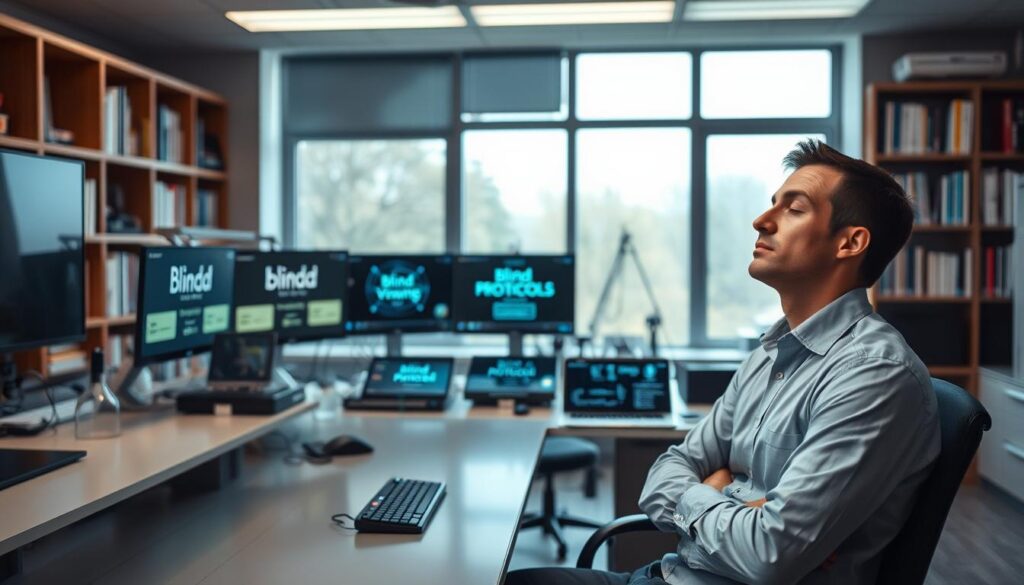
Single-blind tests keep the participant unaware of the task. This prevents remote viewers from being influenced by what they think the target might be.
Single Blind vs Double Blind Methods
Double-blind designs raise the bar: the monitor also does not know the target’s nature. That extra layer stops cues from others and keeps the process pure.
- Tasking numbers are used so viewers receive only a code. This makes the session objective and repeatable.
- Information recorded by viewers is later matched to the actual target to measure accuracy and draw solid results.
- Experts such as Paul Smith stressed these methods as essential for valid experiments that stand up to scrutiny.
Without strict blind protocols, experiments cannot rule out coincidence or guessing. Rigorous controls let researchers evaluate the nature of reported impressions and the method’s true value.
“Blind tasking is the simplest way to keep belief and suggestion from shaping outcomes.”
For a related discussion on clairvoyant claims and how they’re tested, see clairvoyant abilities real or fake.
Real World Applications and Psychic Espionage
During the Cold War, agencies tested whether trained people could supply usable information for intelligence work.

The practice known as psychic espionage placed selected operatives on tasks to describe distant targets across time. Key figures like ingo swann and russell targ helped show that such methods might yield actionable leads.
Supporters point to cases where remote viewing produced useful clues for search efforts and security planners.
The International Remote Viewing Association still studies applications today. Teams explore crime-solving, missing persons, and other modern uses for the method.
“Proponents argue the results changed outcomes in specific cases, even if debate continues.”
| Era | Application | Reported Impact |
|---|---|---|
| Cold War | Strategic intelligence | Operational leads for agencies |
| Post-Cold War | Crime and searches | Case clues and tips |
| Present | Research and training | Method refinement |
Whether judged skeptically or embraced, the age of psychic espionage remains a notable chapter in the world of intelligence. For related discussion on clairvoyant forecasts, see clairvoyant predictions.
Scientific Validation and Statistical Analysis
Statistical studies have repeatedly found that performance in formal experiments exceeds what chance alone would predict. Large analyses show results that are unlikely under random models. This has led some researchers to conclude that the effect is real.

Noted analysts such as Jessica Utts argued that standard scientific criteria support the existence of psi-like functioning. Replications in different labs around the world strengthened that claim.
Researchers emphasize the process as much as outcomes. By studying protocols, the scientific teams learn how consciousness interacts with a blind target. The form of many studies uses large trials with independent scoring and careful record keeping.
- Independent analysis often finds results above chance.
- Careful protocols reduce bias and improve reliability.
- Many others remain skeptical, yet consistent data keeps the debate active.
“Focusing on process helps turn anecdote into measurable information.”
Implication: These findings suggest abilities may be widespread and can improve with training. Continued rigorous experiments will shape how the study of perception moves forward.
Notable Experiments with Jupiter and Magnetometers
A small group of experiments linked focused intention to measurable instrument changes and planetary descriptions.

The Jupiter Session
In 1973 a celebrated session asked a trained subject to remote view Jupiter. The participant sketched and described atmospheric features and large storm bands.
Later probes — including Voyager and Galileo — confirmed many of those details. Researchers called the match striking because the information arrived before probe data existed.
Magnetometer Testing
On June 6, 1972, a test at the Stanford Research Institute measured whether focused consciousness could influence a magnetometer.
The device showed noticeable deviations during the session. Investigators such as Russell Targ recorded real-time results and debated possible explanations.
Why it matters: These experiments tied mental reports to physical readouts. They remain among the most cited studies in the field and prompted more study worldwide.
“The findings challenged assumptions about how mind and instruments might interact.”
- 1972 magnetometer test registered deviations during focused effort.
- 1973 planetary session described objects later validated by space missions.
- Stanford research institute teams documented results in real time for analysis.
The Paradox of Uncertainty in Perception
Paradoxically, doubt often marks the clearest contact with a distant target.
When a person feels unsure, the mind often resists filling gaps with quick stories. That resistance reduces analytical noise and can preserve raw perception.
Experienced remote viewers learn to trust ambiguity. A vague impression may indicate that consciousness is picking up real information across space and time.

Staying open to odd or nonsensical experiences is part of the process. The need for certainty pushes the mind to guess, and those guesses usually blur the signal.
“The less you try to force a story, the truer the details often become.”
| Sign | What It Means | How to Respond |
|---|---|---|
| Hesitation | Possible contact with target | Record impressions, avoid labels |
| Vague imagery | Raw perception not yet parsed | Sketch and note sensations |
| Sudden certainty | Likely analytical overlay | Flag and verify later |
Understanding this paradox helps anyone trying to improve their ability to gather reliable data. For background on extra-sensory frameworks and practice, visit extra-sensory perception.
Ethical Considerations in Psychic Research
When research touches privacy or intelligence uses, clear rules and consent are essential.
Protecting participant rights must come first. Studies that probe the mind or the body require full informed consent and clear limits on data use.
Teams should guard privacy and avoid intrusive tasks that mimic surveillance. Using psychic abilities for covert monitoring raises serious legal and moral questions.

The International Remote community and related groups have published guidelines to promote safe practice and transparency.
Good governance means independent oversight, clear reporting standards, and mechanisms for participants to withdraw without penalty.
Ongoing dialogue keeps the field accountable. By addressing consent, privacy, and potential misuse, researchers can explore questions about perception while respecting human dignity.
For practical guidance on protocols and ethical standards see remote viewing guidelines.
Conclusion
Careful record keeping and repeated trials transformed curious reports into measurable data. This shift shaped how the field was studied and taught.
Ingo Swann left a lasting mark on protocol design, and researchers such as Russell Targ helped bring those methods into formal programs like the Stargate Project. Their work kept debate alive while building a practical toolkit.
Teachers and advocates, including Paul Smith, preserved the training tradition and helped pass techniques to new students. For an overview of related ideas and practice, see psychic powers.
Keep an open but balanced mind when exploring this history. The evidence raised questions then, and it still invites careful study today.