

This introduction outlines why magnetic shifts matter for sensing and data collection. Past lab trials reported that environmental magnetic fluctuations can alter instrument noise and human reports. We examine how teams measured those changes in controlled settings and how results shaped later work.
We trace research history, from early experiments to modern replication efforts. Researchers tested signal integrity, timing, and subjective reports under varied magnetic conditions. This helps explain links between field activity and human perception.
Our review synthesizes diverse studies to give a clear, evidence-based picture. Readers in the United States will find practical notes for lab setups and data checks. The goal is concise clarity so you can judge claims and design better tests.
Key Takeaways
- Historic trials explored magnetic variation and measurement noise in lab conditions.
- Controlled studies help separate biological responses from instrument errors.
- Clear protocols improve repeatability and trust in results.
- Understanding magnetic activity aids both scientific and practical use cases.
- Careful review helps researchers plan stronger experiments and safeguards.
Understanding the Geomagnetic Environment
Earth’s magnetic field sets the stage for many measurements. Researchers map local variations to spot anomalies that can skew results.
Maps and surveys help reveal small changes in field intensity and direction. Those shifts matter when sensors or teams need stable baselines for comparison.
Scientists also use magnetic data to locate underground structures and to study plate motion. Such work links regional surveys with global models that track long-term change.
For practical checks, teams follow a short checklist:
- Record baseline magnetic field at multiple points.
- Compare readings with regional magnetometer stations.
- Log orientation and intensity before each test run.

| Feature | Typical Cause | Measurement Tip |
|---|---|---|
| Local anomaly | Buried metal or geology | Grid survey with handheld magnetometer |
| Diurnal drift | Solar-driven ionospheric change | Time-stamped baseline logging |
| Orientation variance | Topography and equipment setup | Standardize sensor alignment |
| Regional shifts | Plate motion, long-term trends | Compare with national geomagnetic models |
The Impact of Geomagnetic Fields on Remote Viewing Accuracy
Field teams noted that short-term magnetic variation often coincided with altered signal phase and reduced hits.

Defining Accuracy Metrics
Accuracy here combines count of valid observations, phase stability, and signal-to-noise ratio.
Measurements use time-stamped baselines, Larmor frequency checks, and repeat trials to set thresholds.
For sodium layers, the gyromagnetic ratio (699,812 Hz G-1) helps predict Larmor precession at 85–100 km altitude.
Historical Research Context
Early studies logged how changes in local field levels matched observer success rates.
Authors later argued that receiver performance links tightly to baseline stability during each cycle.
- Phase analysis revealed ionosphere-driven shifts in signal timing.
- Position and range often explained variations in number of successful observations.
- Careful data logging improved repeatability across study periods.
| Metric | Historic Trend | Practical Check | Typical Result |
|---|---|---|---|
| Phase stability | Varies with ionosphere activity | Cross-check with Larmor frequency | Improved when baselines held |
| Observation count | Linked to local level changes | Log start/end time and position | Higher under stable conditions |
| Receiver performance | Sensitive to rapid swings | Shielding and alignment | Consistent when field steady |
| Signal SNR | Degrades during strong activity | Increase integration time | Recoverable with processing |
Principles of Mesospheric Magnetometry
Measuring Larmor precession in mesospheric sodium reveals local magnetic structures within the ionospheric dynamo.
Mesospheric magnetometry relies on optical pumping of ground-state sodium near 85–100 km. Researchers use a laser to drive a known frequency, then observe precession using the gyromagnetic ratio (699,812 Hz G-1). These measurements produce altitude-specific information about ambient magnetic field strength.

By tracking Larmor frequency shifts, scientists map local current structures and small-scale magnetic variations. This technique gives a direct response to mapping needs within the ionosphere and helps characterize regional space weather.
- Optical pumping yields precise observations of sodium-layer behavior.
- Accuracy depends on laser modulation, collision range, and signal processing.
- Advanced analysis turns raw returns into usable magnetic information.
“Larmor-based readings let teams see currents that other instruments miss.”
Combined, these observations create a practical tool for research and for operational monitoring of upper-atmosphere magnetic structures.
Laser Excitation and Atomic Sodium Layers
Astronomers generate artificial stars by stimulating mesospheric sodium, which raises photon returns and enables sharper images during ground tests. This approach uses high-power lasers to excite atoms near 85–100 km and create a stable reference light source.

Optimizing Photon Flux
The ESO WLGSU deployed a 20W Raman-fiber-amplified laser as a continuous-wave source. Operators modulate that beam so the collected data aligns with the Larmor precession frequency.
Teams monitor the number of returned photons during each observation period. Tracking this metric helps the system compensate for atmospheric turbulence and keeps correction loops stable.
By tuning laser modulation frequency, researchers can improve sodium-layer response and boost signal strength. This adjustment often yields an increase in usable photons per cycle.
- Continuous-wave Raman-fiber lasers synchronize signal modulation with atomic precession.
- Real-time data logging preserves system performance across each period.
- Optimizing modulation raises return flux and shortens correction time.
Analyzing Magneto-Optical Resonances
Laboratory resonance traces make visible tiny shifts in atomic spin as frequency and field change.
Analysts watch sodium polarization as it precesses at Larmor frequency inside a local magnetic field.
Signals form sharp resonance curves that reveal local fields and small-scale structures.
Using a lock-in amplifier, teams measure phase variations.
Those phase traces function as direct indicators of ambient strength and direction.
- Resonance curves map altitude-dependent response during long runs.
- Phase shifts expose subtle variations that raw power traces miss.
- Careful analysis improves confidence in final results.

For a broader view on related sensing claims, see clairvoyant abilities.
This method gives a clear response to detecting tiny magnetic changes during extended observation periods.
GNSS Signal Integrity and Magnetic Interference
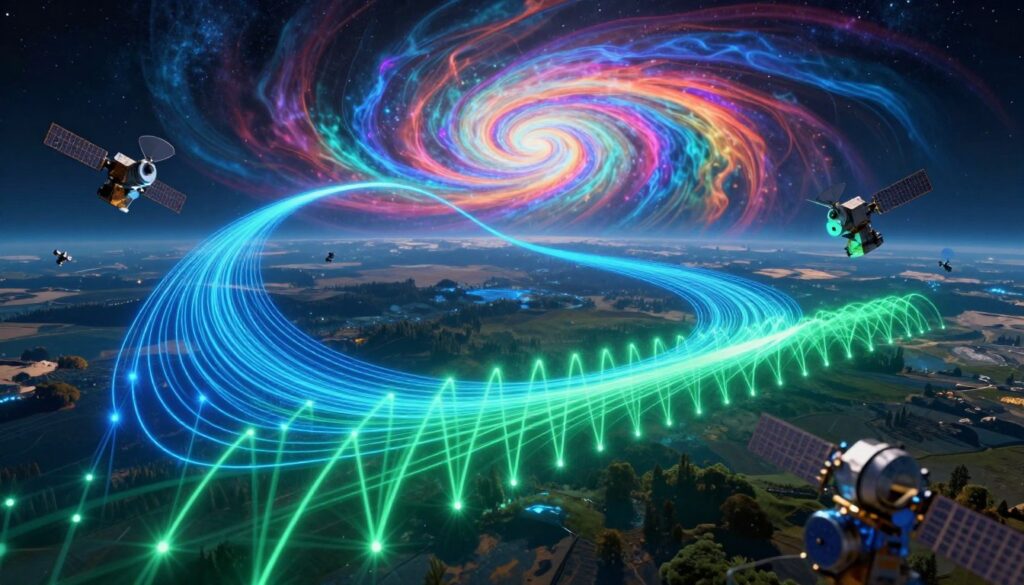
Long-range GNSS transmissions can suffer quick phase shifts when local magnetic levels change near receivers. These shifts alter timing and raise the number of position errors during an observation period.
Metallic Structure Interference
Large steel structures and buried metal create localized magnetic changes that bend signal paths. Receivers near such structures often record increased noise and reduced signal performance.
Authors in this study noted that receiver performance depends heavily on ionosphere conditions plus nearby magnetic levels. Practical checks include relocation tests and shielded mounting to reduce errors.
Signal Delay Factors
Phase analysis helps quantify time delays introduced by varying fields along the signal path. By tracking phase and frequency shifts, teams can separate ionospheric bending from local structure effects.
Key steps for operators:
- Log phase and frequency during each cycle.
- Compare position results with baseline measurements.
- Flag periods with large variations for post-processing.
“Observations during high solar activity show clear increases in time delay and range variation.”
The Role of Ionospheric Scintillation
Ionospheric scintillation creates rapid, small-scale flicker in radio links at polar and equatorial latitudes.
Plasma irregularities bend signal paths and distort phase. This causes rapid phase variations that can degrade navigation and timing systems. Operators see short fades, sudden phase jumps, and bursty noise during active periods.
Analysis shows that space weather events trigger a strong response in the ionosphere. During a solar cycle, higher activity raises the chance of severe scintillation. That raises error rates for GNSS and other signals.
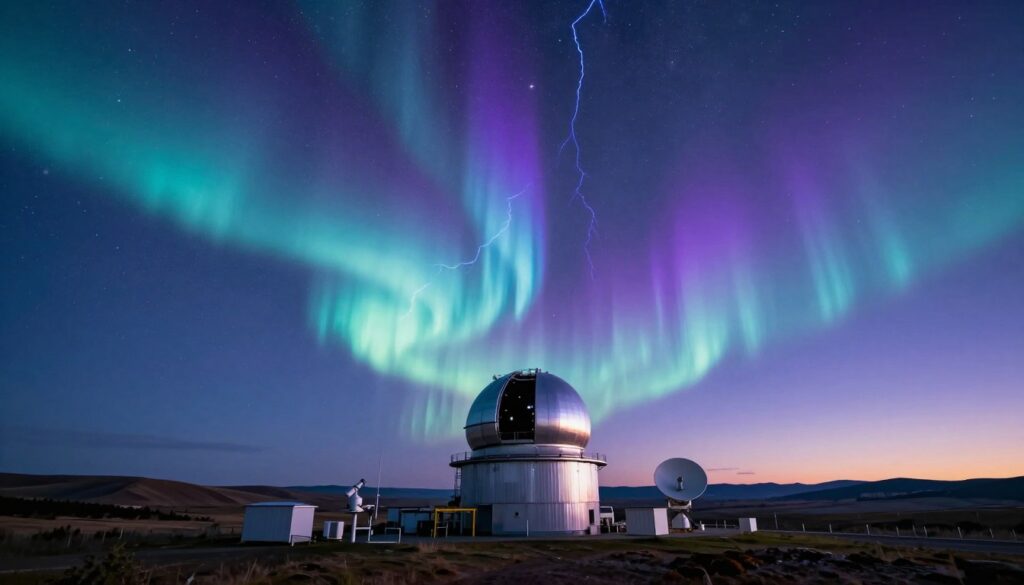
Researchers assess scintillation activity with phase monitoring, statistical analysis, and local surveys. Practical steps include logging start/end times, flagging noisy cycles, and applying post-processing corrections.
- Key checks: phase stability, signal fade rate, latitude trend.
- Mitigation: relocate receivers, increase integration, use robust filters.
| Condition | Typical Effect | Metric | Action |
|---|---|---|---|
| Equatorial spread F | Large phase jitter | S4 index, phase RMS | Use dual-frequency receivers |
| Polar patches | Rapid fades | Loss of lock events | Shield antennas, increase logging |
| Solar maximum | Higher event rate | Event frequency per cycle | Plan observations around forecasts |
“Accounting for scintillation keeps long-term datasets usable and reduces phase-related errors.”
For related sensing concepts and energy techniques, see energy manipulation methods.
Geomagnetic Storms and Navigation Performance
Major solar events can shift local magnetic field by up to 30,000 nT, producing fast changes that harm navigation performance.
Quick variations in ambient field often cause receivers to lose signal lock. That loss appears as gaps in position fixes and noisy readings.
Observers note an increase in electron density gradients during storms. Those gradients scramble signals from space and lower receiver performance.
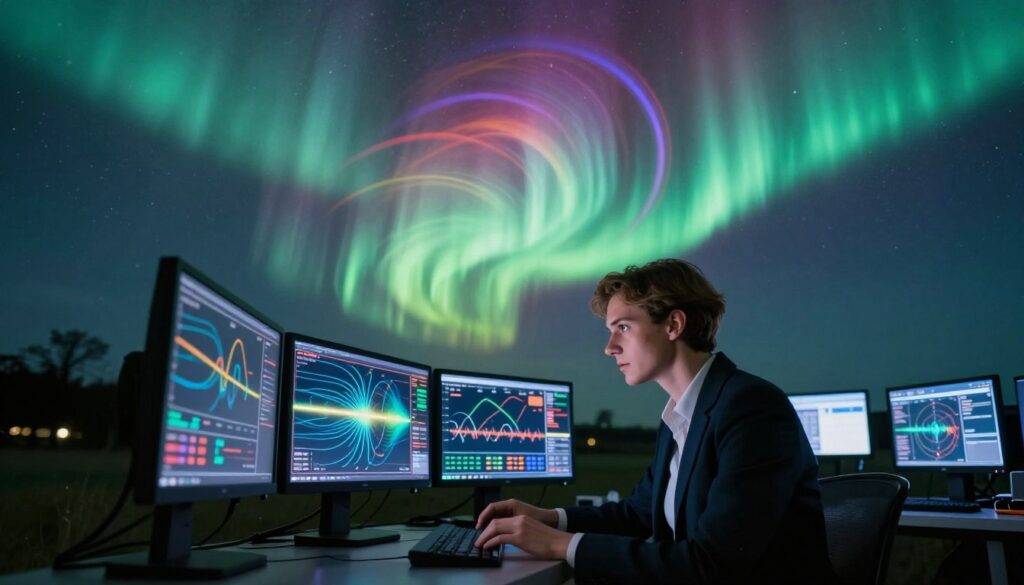
Analysis shows the worst effects at high latitude, where magnetic fields respond strongly to solar wind. Position errors grow there more than at mid latitudes.
- Storms can create sudden changes that break tracking loops.
- Receiver design must tolerate rapid variations in signal strength and phase.
- Operational plans should include forecasts and fallback navigation modes.
“Design systems to maintain a stable position during intense activity; redundancy matters.”
Tracking Loop Jitter and Phase Lock Loops
Tracking loop jitter reveals how well a receiver keeps phase lock during rapid ionospheric shifts. This brief section reviews metrics and practical checks for heavy scintillation periods.

Performance Under Heavy Scintillation
Tracking loop jitter is a key metric that shows changes in phase stability over time. When scintillation rises, the number of cycle slips can increase and cause a drop in receiver performance.
Operators log phase traces and simple data stamps to link slips with signal frequency and latitude. That analysis helps identify when a system will lose position fixes.
Results from field runs show clear trends: slip counts rise during active periods, and performance falls faster at high latitude. Maintaining a steady phase lock reduces errors and keeps navigation reliable.
- Check: record phase and frequency each cycle.
- Tune: adjust loop bandwidth to match signal variation levels.
- Flag: mark noisy periods for post-processing analysis.
“Small phase variations in short time windows can lead to large position errors if not tracked.”
Ray Tracing and Signal Propagation Analysis
Ray tracing reveals how layered ionospheric structure bends satellite signals before they reach ground receivers.
Jones 3-D Ray Tracing Program models radio wave paths through varying plasma and magnetic geometry. Simulations show horizontal gradient and magnetic interaction can shift signal phase and alter range estimates.
Model runs help teams predict when phase will jump during each cycle. That analysis yields usable data for correcting position solutions when activity rises at high latitude.

Results demonstrate frequency-dependent bending and small time delays that change measured position. By mapping likely paths, operators increase receiver performance and reduce number of lost fixes.
“Ray tracing pinpoints corridors where plasma gradients produce the largest phase shifts.”
This article also links modeling to practical surveying tactics and offers a nod toward broader sensing topics like clairvoyant abilities. Such simulation-driven corrections improve navigation during solar storms and other challenging periods.
Environmental Factors in Land Surveying
Local site conditions can sway survey readings more than many teams expect.

Metallic structures and buried materials create local magnetic variation that alters GNSS-based measurements. This study shows how nearby steel, pipes, and reinforced concrete change signal paths and raise noise during a typical work period.
Surveyors who track time-stamped data and repeat observations reduce errors. Logging start and end times for each cycle helps link position shifts to on-site activity.
- Run baseline checks away from large metal before each observation.
- Record short, repeat measurements to spot sudden variations.
- Use shielded mounts or relocate a few meters to test receiver response.
| Environmental Factor | Typical Effect | Practical Mitigation |
|---|---|---|
| Nearby steel structure | Phase jitter and biased position | Move antenna, resurvey, log data |
| Buried utilities | Local variation in readings | Grid check with handheld magnetometer |
| Heavy equipment activity | Transient signals and noise spikes | Time observations for low activity period |
This article offers concise analysis so survey teams can adjust methods and improve final results. Accounting for site changes keeps receiver output reliable and boosts confidence in field measurements.
Challenges in High Latitude Observations
Polar campaigns face frequent signal churn as space weather stirs high-latitude ionospheric layers.
Rapid phase variations are common during storm activity and can degrade receiver performance within a single cycle.
The ionosphere plays a major role in signal disruption. Sudden plasma patches cause phase jumps and range errors.
Teams must run focused analysis of receiver response to these conditions. That helps keep position results usable.

“Plan extra logging and redundant checks when operating near the poles.”
| Challenge | Typical effect | Practical check |
|---|---|---|
| Scintillation bursts | Phase jitter, loss of lock | Increase integration, flag cycles |
| Storm-driven swings | Rapid position drift | Use dual-frequency receivers, add redundancy |
| Local variability | Short-term observation noise | Repeat measurements, compare baselines |
For wider context and related sensing topics, see extra sensory perception.
Technological Advancements in Signal Monitoring
Recent upgrades in instrument chains let teams log rapid phase shifts with finer time stamps. New receivers pair faster sampling with smarter processing for better phase tracking.

Advanced data pipelines run real-time analysis that flags noisy cycles and marks suspect measurements. Authors report that these methods improve position solutions by accounting for ionosphere variations during high activity.
Key gains include improved signal filtering, adaptive loop tuning, and fused sensor inputs. Such features boost receiver performance and reduce lost fixes at high latitude.
- Faster sampling: catches short phase jumps missed earlier.
- Adaptive filters: preserve signal quality during bursts.
- Integrated telemetry: merges phase, frequency, position data for richer information.
These findings guide future system design and support robust navigation under intense space weather. For related remote methods, see remote energy healing.
“Better monitoring turns rapid variations into actionable data for navigation teams.”
Mitigating Magnetic Field Disruptions
Field teams rely on layered defenses to guard instruments against rapid variation that can reduce position quality.

Start with site checks. Move away from large metal and log baseline measurements before each cycle. Small relocations often cut local noise and raise signal stability.
Use adaptive signal processing to filter out transient noise and to track phase drifts in real time. Monitor the number of cycle slips and flag suspect periods for post-run correction.
- Hardware: shield mounts, grounded mounts, and redundant antennas to limit structure-driven variation.
- Software: adaptive filters, loop bandwidth tuning, and real-time slip counters to boost receiver performance.
- Procedures: timestamped logging, repeat measurements, and planned observations around active space forecasts.
Regular analysis of measurements helps teams tune systems and reduce the range of degraded observations during high activity. For a practical sidebar on related mental techniques, see mind movement guide.
“Mitigation combines good site work, smarter filtering, and ongoing analysis to keep position fixes usable.”
Future Directions in Geomagnetic Research
Future work must gather continuous observations across a full solar cycle to reveal slow trends that short tests miss.

Long-term research will focus on how space weather alters global navigation systems over time.
Teams plan multi-site campaigns that collect uniform data and time-stamped observations. This will link ionospheric response to specific cycle phases and improve study design.
Researchers will also build tools to monitor receiver health in real time. Better telemetry helps spot slips and preserve performance during intense activity.
- Gather continuous data across a full solar cycle to spot patterns.
- Standardize observations so study results merge cleanly.
- Develop diagnostics that test receiver response during bursts.
Findings from these efforts will supply information for system upgrades, help improve position solutions, and guide future analysis. Continued research promises more robust systems and clearer guidance for operators in the United States and beyond.
Conclusion
To wrap up, this brief conclusion pulls together key time-stamped data and notes about magnetic fields that matter for field work.
Research here shows that careful logging and repeat observations help preserve data quality. Simple checks improve long-run results and reduce surprises during active periods.
Teams can tune receiver settings so signal tracking stays steady through each cycle. Small hardware fixes and site moves also reduce local magnetic field noise.
Regular response monitoring, swift analysis, and clear procedures protect position solutions and overall performance. Continued study will refine systems and methods.
For related practical skills, see psychic powers. Keep testing, keep logging, and aim for steady accuracy in every run.