

Welcome to a friendly, research-grounded Ultimate Guide on how magic worked in antiquity. We will explore how people used words, images, and ritual actions as tools for protection, healing, and forecasting. This guide stays practical and clear.
Across ancient Egypt, Mesopotamia, Greece, and Rome, daily life blended religion, early science, and ritual practice. Material finds—amulets, incantation bowls, and curse tablets—offer concrete example snapshots. Literary texts help us read the methods and meanings behind each act.
We will move through societies, showing how people used spoken formulas, written texts, and objects to engage superhuman powers. The guide will also clarify terms like spells, curses, and rituals, and where they overlap in real contexts.
Keep an open mind as we trace uses from birth rites to funerary care and legal contests. For wider context on related supernatural abilities, see supernatural abilities.
Key Takeaways
- Magic acted as everyday technology for protection, healing, and success.
- Artifacts and texts combine to show methods and social uses.
- Terms like spells and curses often overlap in practice.
- Greeks Romans and Near Eastern examples reveal varied techniques.
- Study focuses on lived practice, not testing efficacy.
What We Mean by Magic and Ritual in the Ancient World
In many communities, words and objects worked alongside observation and craft to solve health, legal, and household problems. Here we define terms and show how ritual life blended with religion and early science.
Religion, science, and overlapping practices
Magic in context names a set of practices that use words, names, materials, and actions to enlist superhuman powers for concrete ends.
Medical papyri and Mesopotamian omen tablets pair diagnosis with incantation. That shows healing mixed empirical care and voiced formulae. Greeks and Romans often labeled other groups’ rites as “magic,” revealing shifting boundaries.
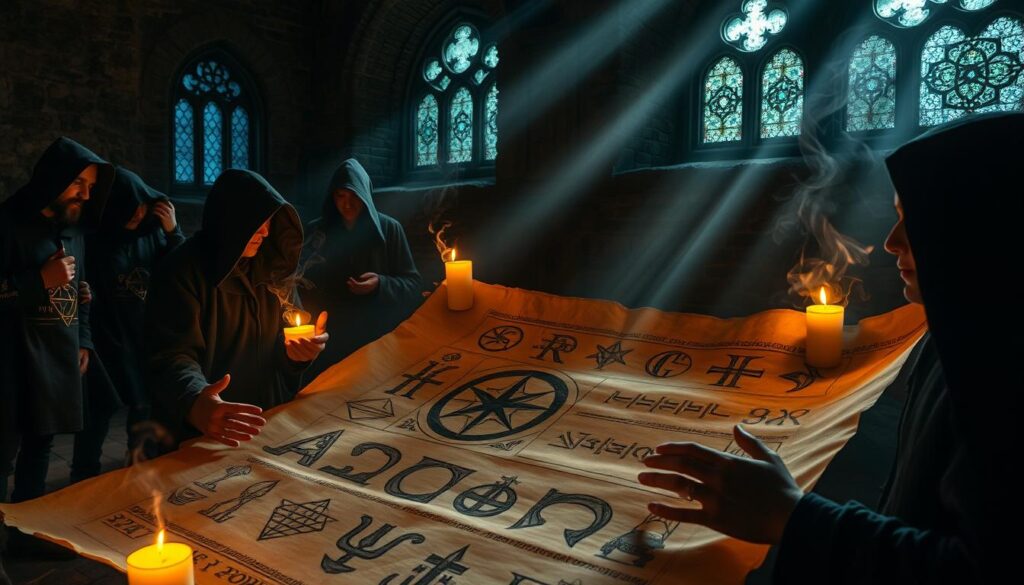
From birth to death: rites in daily life
Rituals marked life stages: protection in pregnancy, remedies for disease, erotic charms, and funerary care. In late antiquity, incantation bowls sat by thresholds to trap demons.
“Names and a spoken word could open doors to help or harm.”
Women and men both used and suffered ritual actions. Tablets and texts codified techniques and aims, giving us a clear window into how people in bce settings tried to control outcomes.
ancient spells
Many practitioners believed that certain syllables and names did real work when voiced correctly. Short formulas, unique signs, and clear steps made a written or spoken act effective in healing, protection, or harm.

Symbolic words, names, and voces magicae
Names and vocal signs carried authority. Sacred names and voces magicae were inscribed on tablets and papyri to summon gods or deter spirits.
Charakteres and rare letter-forms often appear on curse tablets. Mesopotamian tablets (ca. 1800 BCE) mix omens and prescriptions, showing incantation beside remedy.
Incantation, gesture, and material aids
A complete incantation combined invocation, command formulas, and conditional phrases with drawn signs.
Ritual work included gestures, timing, and materials—herbs, bandages, amulets. An Egyptian example shows wedjat eye ratios guiding dosing and spells spoken over bandages.
Horus Cippi water was empowered to heal. Written texts and household compendia standardized steps so that both healing and curse formulas could be repeated reliably.
For comparison with other techniques, see related practices like telekinesis.
Protection and Healing: Amulets, Words, and Water
Communities used images, liquids, and words to create everyday shields against disease and misfortune.
Apotropaic images and amulets bore fearsome faces—Gorgon heads on shields, Pazuzu and Humbaba figures, Sekhmet and Taweret icons—to channel protective powers and deter illness.
The wedjat eye appears as both symbol and small amulet. Craftsmen calibrated its proportions for dosing and care, a visual cue that linked image to medical practice.

Incantation bowls as home security
Buried upside down at thresholds, incantation bowls acted like an early alarm. Spiral inscriptions and trapped figures functioned as a continuous deterrent to hostile spirits.
Ritual water and healing rites
Horus Cippi vessels were poured to empower water for cures. At Asklepios sanctuaries, patients slept for divine dreams, then left votive offerings of healed feet, hands, or the head as thanks—one clear example of ritual care.
Body-centered votives and cures
Physician-priests recited formulas over bandages while herbal poultices took symbolic measures. The body served as both target and medium, where touch, inscription, and nearby sacred liquids made divine powers practical.
“Protective images and ritual acts formed a coherent system of risk management and care.”
Curses and Curse Tablets: Binding Rivals, Lovers, and Opponents
Binding rituals used tangible steps to push conflict into ritual channels. Practitioners engraved intentions on lead sheets, added voces magicae and strange characters, and then prepared the object for deposition.

Defixiones on lead
Typical practice: inscribe on lead, fold or roll the tablet, pierce it with a nail, and drop it into a grave, well, or fountain. Over 1,600 tablets survive from ca. 500 BCE onward, many aimed to let chthonic powers carry out the binding.
Court case bindings
In classical Athens, many tablets sought to silence rivals. Formulas named opponents and targeted body parts—tongue to block speech, hands to stop action—so testimony and craft would fail in court.
Erotic effigies and material signs
Love magic often used dolls, hair, or nail clippings to focus intent. The Louvre effigy—wrapped in lead and pierced with pins—shows how a woman’s body parts were specified to compel desire.
Animals and objects
The Agora chicken pot (ca. 300 BCE) held head and feet and bore dozens of names. Iron spikes, bound roosters, and nailed effigies amplified force by linking the object to a target.
“Burials of those who died untimely or by violence were prized sites—they connected the ritual to restless power in the ground.”
Tablet inscriptions often mix incantation lines, deity names (Hekate, Artemis, Hermes), and lists of targeted faculties. These practices formed a consistent social toolkit: ritual methods that aimed to sway outcomes when stakes were high.
For a look at legal burden and symbolic weight, see a related discussion on the ten of wands for metaphorical context: ten of wands.
Across Ancient Greece and Rome: Practices, People, and Places
Across regions from Attica to the Thames, ritual items and inscriptions reveal shared techniques and local twists. Archaeology and literary texts together map how communities adapted common methods for local needs.

Greeks and Romans in late antiquity: from Attica to Roman Britain and Egypt
Curse tablets and votive caches appear from Roman Britain to Egypt and the Black Sea. A striking example: over 520 tablets from Attica, many from the 4th century bce, show dense urban practice.
Depositions in graves, wells, and shrines form a shared spatial logic. Lead tablets were common, while wax, clay, or wire effigies appear in literary and archaeological records.
Who cast spells? Everyday people, ritual practitioners, and professional magicians
People ranged from anxious petitioners to hired specialists. Plato notes wax figures at crossroads; Apuleius lists lettered plaques and corpse parts that underline the theatrical side of magic.
Both amateurs and professionals wrote tablets. Some scripts show practiced hands and workshop production. Number and scale matter: caches, multi-name pots, and serial depositions point to organized ritual campaigns.
“Texts and objects give complementary views: one describes, the other shows enacted practice.”
- Shared toolkit: lead tablets, effigies, named formulas.
- Local variation: pantheons, deposition sites, and symbols differ by region.
- Social drivers: legal conflict, love, and competition spurred many curses.
Jewish Traditions of Magic: The Tree of Knowledge and Practical Kabbalah
A single 16th‑century codex ties together ritual practice, experiment, and prayer in a surprisingly systematic way. Elisha ben Gad’s Ets ha‑Daʿat collects roughly 125 entries that blend names, procedures, and hands‑on remedies.
The book divides into four parts: divine names, “Other Side” entities, remedies based on nature and experiment, and miscellaneous operations. It reads like a practical handbook for daily need.
Signature entries include an abracadabra fever amulet, a travel‑shortening charm invoking angelic names and precise timing, and a Judeo‑Italian incantation against burns addressed directly to Fire.
A striking entry uses inscription on the body to induce milk for a woman—showing how skin served as a ritual surface and how healing could overlap with writing and touch.
Divine names and scripted incantation lines were treated as performative. The codex gives rules for the writing, pronunciation, and repetition of each word, with set time and number for recitations.
One courtroom charm even uses a hoopoe’s tongue to secure persuasive force, echoing legal ritual tactics found elsewhere in the Mediterranean.
This collection balances herbal and experimental remedies with sacred‑name invocation, demonstrating continuity and local innovation in late medieval ritual practice.

For readers curious about related practices and personal aptitude, try a quick psychic abilities test.
Divination and Seeing the Future: Stars, Birds, and Entrails
Divination turned uncertain futures into actionable counsel by decoding signs in sky, flight, and organ. Trained readers used ritual steps and strict timing to turn chance into a guided choice. These practices helped householders and magistrates weigh risk before important moves.

Astrology and augury in public life
Astrologers offered charts that could sway policy, but Rome policed them. Emperors sometimes expelled astrologers tied to political plots, showing how potent predictions could be.
Haruspicy and omen reading
Haruspices read livers and entrails across a long timeline (Babylonians as early as 19th century bce; Etruscans 8th–3rd century bce; Romans). The body was treated as a cosmic map; each mark could inform a campaign or festival time.
“Experts translated signs; their authority rested on training, ritual form, and controlled time.”
| Method | Typical Tool | Common Use |
|---|---|---|
| Astrology | Charts, planetary tables | Predictions for rulers and families |
| Augury | Bird watches, sacred chickens | Deciding battles and foundations (example: Romulus/Remus) |
| Haruspicy | Entrails, liver models | Immediate tactical and ritual decisions |
Oracles like the Pythia at Delphi gave cryptic counsel via controlled temple ritual and near-incantation utterances. In one notable case, augury and omen-reading redirected a military decision, showing ritual foresight’s civic weight.
Contrast: tablets and lead-inscribed curse objects aimed to coerce outcomes; divination instead sought alignment with the gods and the soul of communal order. For further reading on forecasting practices, see psychic predictions.
Death, Souls, and the Afterlife: Rituals That Endure
Rituals for the dead tied preservation, protective objects, and written directions into a single program of care. These practices aimed to secure identity after death and guide the soul through otherworldly gates.
Egyptian funerary craft preserved the body through mummification and stored organs in four canopic jars—Hapy (lungs), Duamutef (stomach), Imsety (liver), and Qebehsenuef (intestines). Amulets were placed over key body parts to guard the head, heart, and senses.

Book of the Dead and a spell example
The Book of the Dead offered curated lines to open doors and plead with Osiris for a favorable judgment. One vignette invokes the reanimation of the soul and safe passage past gatekeepers, naming thresholds and required words.
Mystery cults and guiding tablets
In Greek and Roman rites, initiates received gold tablets with passwords and directions for the underworld. These funerary tablets functioned to inform and protect—distinct from a curse, though graves sometimes attracted binding rites.
- Water libations and purification complemented embalming.
- Protection of head and organs showed beliefs about breath, memory, and perception.
- Across the bce world and later centuries, these afterlife technologies kept core goals: protection and guidance.
“Funerary measures united material care and spoken instruction so the dead might live again in the next world.”
For related ritual contexts, see a wider discussion on ancient aliens.
Conclusion
What links a healing libation, a courtroom curse, and a votive tablet is a shared technique of focused action. Across time, communities used rituals and written names to manage risk, health, love, and justice.
Constructive examples—Asklepios cures and Egyptian funerary lines—sit beside adversarial cases like court curses and erotic bindings. Tablets on lead were rolled, nailed, and sunk into the ground to call underworld powers in specific cases.
Names, a precise way of speaking, and staged work with materials and place made intent legible. The heart of the system was a belief that careful speech and acts could shape outcomes for a person, a household, or a city.
For a modern comparison of ritual skill and personal aptitude, see this short guide to psychic superpowers.