

Answer in brief: Michel de Nostredame was born in Saint-Rémy-de-Provence in December 1503 (records give the 14th or 21st) and died in Salon-de-Provence on July 1 or 2, 1566. These years frame a life that moved from provincial childhood to service at the royal court.
We will trace his life as a physician and apothecary who later gained fame for almanacs and the 1555 collection Les Prophéties. Readers will see how his medical work, court ties with Catherine de’ Medici and role as Counselor and Physician-in-Ordinary to Charles IX shaped his public standing.
This section explains key milestones, the social and medical context of his age, and how his quatrains were produced and read by a wider world. Expect a balanced view that separates popular claims from documented sources and shows how a real person left a lasting reputation and ongoing interest in his predictions.
Key Takeaways
- Birth in December 1503 and death in July 1566 anchor his timeline.
- He worked as a physician, apothecary, and published almanacs before Les Prophéties (1555).
- Royal patrons and court posts boosted his profile as a french astrologer.
- Quatrains drew on earlier sources; scholarly debate shapes his modern reputation.
- Understanding his years helps place famous lines within Renaissance politics, plague, and faith.

The Years Nostradamus Lived: 1503 to 1566
A concise timeline ties place, health, and publications to the wider story of his life. Records list two possible December birth dates in 1503 (the 14th or 21st), a common ambiguity in sixteenth-century parish registers.
Birthplace: Saint-Rémy-de-Provence marked his early years among local people and provincial learning. Later life moved him to Salon-de-Provence, where the final days unfolded.
Education and career moments included study at the University of Avignon until the plague closed it, then entry to the University of Montpellier and a controversial expulsion tied to prior apothecary practice.

Key dates and health
He published an annual almanac from 1550 and released his famous book of quatrains, Les Prophéties, in 1555. These events sit squarely in the middle of his years and shaped his public reputation.
Death is recorded as July 1 or 2, 1566, at about age 62. His final year featured severe gout that progressed to edema; he drew up a will in late June 1566.
| Year | Place | Event | Notes |
|---|---|---|---|
| 1503 | Saint-Rémy-de-Provence | Birth (Dec 14 or 21) | Parish records vary by date |
| 1550–1555 | Provence & cities | Almanacs published; Les Prophéties (1555) | Book of quatrains grouped in Centuries |
| University years | Avignon / Montpellier | Studies, plague closure, expulsion | Apothecary background caused controversy |
| 1566 | Salon-de-Provence | Death (July 1 or 2) | Gout → edema; will made in late June |
These years intersected with turbulent religious and political events across France, which shaped audience interest in prophecies and the reception of his quatrains. For readers curious about later interpretations and modern readings, explore further resources like a professional reading at spiritual consultations.
Family Roots and Early Life in Provence
Born into a busy Provençal household, Michel grew up amid faith, trade, and medical influence.
Converted heritage and Catholic upbringing
His father, Jaume (Jacques) de Nostredame, descended from a Jewish family that converted to Catholicism around 1459–60 and adopted the name Nostredame.
This conversion and a Catholic baptism placed the household within the region’s complex religious fabric. That mix affected social standing and access to schooling.
Parents, siblings and household life
His mother, Reynière, was the granddaughter of Pierre de Saint-Rémy, a physician. That medical link helped shape early opportunities.
Michel had many brothers — Jean (c.1507–1577), Pierre, Hector, Louis, Bertrand, Jean II (b.1522), and Antoine (b.1523) — a network of people who supported daily life and learning.
He was baptized Michel and raised Catholic in Saint-Rémy-de-Provence. He later had two children in his first marriage and more with Anne Ponsarde. His famous portrait was painted by his son César, showing how family ties endured.
| Relative | Relation | Note |
|---|---|---|
| Jaume (Jacques) | Father | Descended from converted Jewish line; adopted Nostredame |
| Reynière | Mother | Granddaughter of physician Pierre de Saint-Rémy |
| Jean, Pierre, Hector… | Siblings | Large household; supported education and trade |
| César | Son | Later painted a portrait that appears in records |
Roots in Saint-Rémy, family ties, and local commerce helped shape his early life. These ties also paved the path to formal studies and a public career. For modern readers curious about lineage and star lore, see a related profile at Sirian starseed profile.
Education and the Making of a Physician
Early schooling and epidemics shaped the path that pushed him from classrooms to the herb garden.
At about age 14 he began the trivium at Avignon but left when the university closed during a plague. This sudden stop shows how disease shaped opportunities in those years.
He then spent several years traveling and learning herbal remedies. Work as an apothecary put him in direct contact with patients and built a practical reputation for treating common ills.
From apothecary to formal study
In 1529 he enrolled at the University of Montpellier seeking a medical degree. University rules banned prior manual practice by apothecaries, and records (Register S 2 folio 87) show his expulsion soon after.
Controversy and lasting name
Publishers later used the title “Doctor” beside his name, though the university did not confirm a doctorate. The surviving expulsion record clarifies this gap between claim and certification.
Practical roots of a physician
Despite the setback, his hands-on work in herbs and local care made him an effective physician. Field experience, not just books, shaped his approach to medicine and influenced later writings on plague remedies and forecasts.
| Phase | Age / Years | Role | Outcome |
|---|---|---|---|
| Avignon studies | about 14 | Student | Interrupted by plague |
| Apothecary period | 1520s (several years) | Herbalist & practitioner | Built local reputation |
| University entry | 1529 | Candidate for degree | Expelled (Register S 2 folio 87) |
| Aftermath | Later years | Practicing physician & author | Effective healer; disputed title |
Plague Years: Practice, Remedies, and Loss
Personal loss during the early 1530s pushed his medical work into the harsh reality of epidemic care. These years mixed private grief with steady public service and shaped how he treated sick people.

Marriage, two children, and the tragedy of the 1530s
He married in Agen around 1531. By 1534 his wife and two children were gone, likely victims of plague.
The death of close family turned study into urgent practice. That grief seems to have driven him into wider travel treating the ill across towns.
Herbal remedies, “rose pills,” and public health practices
In the field he blended simple medicines and hygiene advice. His so-called rose pills and insistence on clean water and washing reflected practical medicine of the day.
Those routines do not match modern standards, yet they offered real help and comfort to many people.
Epidemic work and a turning point in the year 1547
He worked alongside physician Louis Serre during the 1545 Marseille outbreak and later handled epidemics in Salon-de-Provence and Aix. Such experience built local trust and a reputation for steady practice.
In 1547 he remarried Anne Ponsarde and began a larger household. Repeated encounters with sickness and death gave his later writings a sober tone that underpinned both his medical and prophetic work.
| Year | Place | Event | Impact |
|---|---|---|---|
| c.1531 | Agen | Marriage | Start of family life |
| 1534 | Various towns | Wife and two children die | Personal tragedy; spurred epidemic work |
| 1545 | Marseille | Assisted Louis Serre | Built regional reputation as physician |
| 1547 | Salon-de-Provence | Remarriage to Anne Ponsarde | Expanded household; continued practice |
How this shaped later life: Hands-on care among the sick made his voice in almanacs and prophecies feel rooted in real-world experience. The work of these years readies the reader for his shift into printed predictions and broader public influence.
From Medicine to Astrology: Almanacs and a Rising Name
Printed almanacs turned private practice into a public trade in forecasts and counsel.
In 1550 he issued his first almanac, Latinizing his surname to give his publications a distinct name. The sheet offered calendars, weather notes, and quick prognostications that reached many readers across social ranks.

Launching the 1550 almanac and annual prognostications
The 1550 almanac launched a new phase. He then issued annual booklets filled with thousands of short forecasts that tied everyday events to the coming year.
Clients, horoscopes, and the role of an astrologer
Nobles and other prominent people sought horoscopes and personal advice. As an astrologer he often relied on clients’ supplied birth details, which sometimes led to simple computational errors common in the period.
“Printed pages made prediction public and portable.”
The repeat editions fed a steady rise in reputation. These almanacs framed local concerns and larger events, setting the stage for his later, more ambitious prophecies and the famous book of quatrains.
For a related modern perspective, see an angel number reading.
Les Prophéties: Quatrains, Books, and Predictions
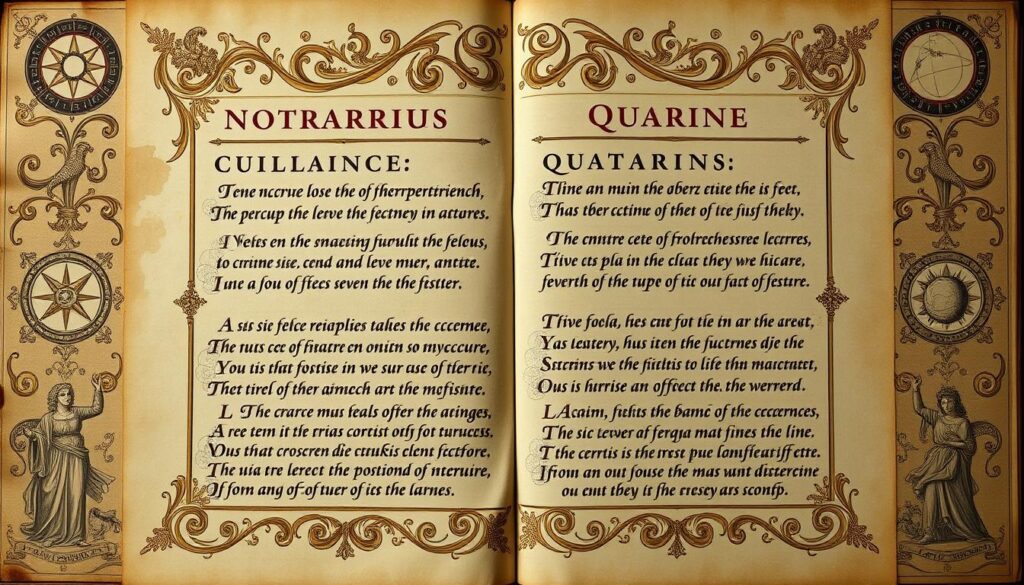
In 1555 a compact volume of rhymed quatrains reached print and soon sparked debate across Europe. The first edition contained 353 short poems. Later installments expanded the work into nine centuries of roughly 100 verses each and one of 42, producing a long, folded record of poetic prophecies.
The 1555 publication and the structure of the Centuries
The book organized quatrains into grouped sets that feel like a map across time. Surviving copies vary: printers changed spelling, punctuation, and order. Notably, the last 58 quatrains of Century VII are missing from many editions, a gap that fuels questions.
Historical and literary sources behind the verses
Modern scholars trace language and images to Livy, Suetonius, Plutarch, Froissart, the Mirabilis Liber, and writers such as Richard Roussat. Borrowing and paraphrase were normal then; bibliomancy and classical echoes shaped much of the material.
How vagueness fueled fame and debate
Mixed languages, Virgilianized syntax, and deliberate obscurity made the book feel timeless to readers around the world. That opacity allowed others to read later events into short lines, so claims that “nostradamus predicted” specific incidents remain contested.
“The text resists single, firm readings, and this is why it still invites interpretation.”
Readers seeking modern readings can compare historical analysis with a professional interpretation of related psychic predictions.
When Did Nostradamus Live: Key Events that Shaped His Predictions
A period of war, plague, and court intrigue supplied the images and fears behind his prophecies.

Religious conflict, court patronage, and imprisonment
Reformation-era conflict made public statements risky and gave raw material for many verses. Religious wars and outbreaks framed anxiety across France.
Court favor helped. Catherine de’ Medici read his 1555 almanacs and summoned him to Paris. That patronage turned local work into national influence and tied his prediction role to policy.
Publishing carried danger. He faced inquisitorial scrutiny in 1538 and was briefly jailed at Marignane in late 1561 for a 1562 almanac issued without a bishop’s permission.
Notable attributions: Henry II, London, and later readings
Later readers linked his centuries to events such as Henry II’s death (1559), London’s regicide (1649), and the Great Fire (1666). Scholars note these are retrospective fits, not direct matches.
“Ambiguous lines allowed others to map later events onto short verses.”
| Event | Year | Context |
|---|---|---|
| Inquisition scrutiny | 1538 | Examined writings in Agen |
| Court summons | 1555–1560s | Catherine de’ Medici read almanacs; royal favor |
| Imprisonment over publication | 1561 | Released after dispute over ecclesiastical permission |
As an astrologer and informal astrologer at court, he blended medical advice and celestial readings for nobles. The time and years he lived offered images others later read as fulfilled lines in the world of public belief.
For a related perspective, see a concise pleiades profile.
At Court: Catherine de’ Medici, Reputation, and Influence
A single almanac pulled him from provincial practice into the glare of Parisian power.
After Catherine de’ Medici read his 1555 almanacs, she summoned him to Paris to explain threats hinted at in the pages. The visit marked a clear rise in his public standing and linked his name to court events.
Summoned to Paris and horoscopes for royal children
Casting horoscopes for royal children meant more than charts: it mixed health advice, timing of events, and ideas about destiny. As an astrologer and practical physician, he advised on births, health, and auspicious moments.
Counselor and Physician-in-Ordinary to Charles IX
By his final years he held the office of Counselor and Physician-in-Ordinary to Charles IX. That dual role let him move between medical wards and private audiences with powerful people.
Court patronage amplified his prophecies. Ambiguous lines from his almanacs and quatrains gained prestige when read in royal salons. Those associations helped readers credit him with insight across the year and through later events.
“Proximity to power turned printed sheets into political conversation.”
This courtly phase explains much of his public reputation and sets the scene for his final years and the debates that followed.
Final Years, Death, and How Scholars View His Work Today
His last months combined worsening illness with legal care. By June 1566 severe gout had progressed to edema, and he drew up a will in late June. He reportedly told a secretary he would be dead by sunrise and was found dead on July 1 or 2.
Health, papers, and the close of a life
The age and years of his end reflect a person worn by practice and travel. He remained a working physician and writer to the last, balancing remedies and notes for clients.
Scholars, believers, and cultural cycles
Scholars stress that his work borrows from classical and medieval sources and that many quatrains are vague. That vagueness lets others map later events onto short verses.
- Believers treat him as a prophet; critics cite paraphrase and retrospective fits.
- After big news around the world, the book and its lines often resurface in public interest.
- Ultimately, medicine, literature, and cultural conflict shaped a legacy larger than any single prediction.
“He was a practicing physician and author whose life closed in Salon-de-Provence, a person whose texts continue to invite debate.”
Conclusion
, The span from December 1503 to July 1566 frames a life rooted in plague care and public practice. His years as a physician and court adviser shaped tone and content across a busy life.
He issued almanacs and the 1555 book of quatrains, texts whose prophecies and predictions mix practical remedies with poetic phrasing. That mix let readers map later events onto short lines, keeping the work alive in the world.
Use this context when you see bold claims about a particular death or dramatic forecast. A balanced view honors his medical record and the text’s opaque style, while reminding us why curiosity about the future persists today.