
This guide opens with a clear answer to the question many ask: the core lines that shaped his reputation and how his verses get grouped. Readers will find a concise view of the book’s layout and the themes that link certain stanzas to major events.
Approach the verses as crafted poetry, full of symbolism rather than exact timelines. That way, you can see how the same words invite readings across different time periods and explain part of the enduring mystery.
We will outline key themes tied to war, plague, and natural disaster, and show how scholars and fans draw connections to the broader history and the modern world. This intro previews sections on the author’s life, book structure, famous attributions, and readings tied to America.
Read on for a friendly tour that balances careful information with open questions. The goal is to give you the context and tools to judge each claim and enjoy the verse as literary material.
Key Takeaways
- Clear framing: Learn how his quatrains are organized and studied.
- Symbolic reading: Treat the lines as poetic, not a literal map of the future.
- Flexible interpretation: Same lines can fit different events and eras.
- Context matters: Historical background helps explain common attributions.
- Guide layout: Upcoming sections cover life, format, famous cases, and American links.
Who Nostradamus Was: Physician, Astrologer, and Author of Les Prophéties
A blend of scholar and hands-on healer, Michel de Nostradame moved from apothecary work into formal medicine amid devastating outbreaks. He was born in Saint-Rémy-de-Provence in 1503 and studied languages, math, and classical lore with his grandfather.

At 14 he entered the University of Avignon but left when the bubonic plague struck. He then traveled as an apothecary, testing herbal remedies and practical cures.
From apothecary to licensed physician
By 1525 he had a medical license from Montpellier and Latinized his name to Nostradamus. As a physician, he favored hygiene, fresh air, and food changes over harsh treatments.
How background shaped his writings
Early exposure to Hebrew rites and astrology gave him tools to mix medical notes with sky-based readings. That mix helped his reputation rise across France and Italy during the plague years.
“He combined practical medicine with learned study, shaped by personal loss and public service.”
| Role | Key Action | Impact |
|---|---|---|
| Apothecary | Tested herbal remedies | Local trust and treatments |
| Physician | Promoted hygiene and rose pill | Improved survival in some towns |
| Scholar | Studied languages and astrology | Shaped later writings |
Personal death in his family, likely from plague, deepened his outlook. This man combined care, learning, and observation—and that mix shows up across his later writings.
Inside the Book: How the Quatrains, Centuries, and Verses Are Structured
A careful look at the book shows how compact quatrains stack into centuries, forming a structure that favors metaphor over dates. Les Prophéties (1555) gathers four-line stanzas into grouped sets that invite layered reading.
Centuries and quatrains explained
Les Prophéties is arranged in “Centuries,” each containing many quatrains. These short verses read like one riddle after another and ask readers to connect images across years and regions.
Language, symbolism, and translation challenges
The original blend of period French, classical references, and astrological hints makes translation tricky. Small changes in words can shift meaning, so modern renderings vary.

Why names, places, and dates are elusive
Names and dates rarely appear. That deliberate vagueness helps each verse map onto different episodes across time.
- Structure: Centuries organize compact four-line verses into a loose sequence.
- Style: Metaphor and celestial images reflect the author’s astrologer viewpoint.
- Variation: Copies and translations over the years introduced wording differences.
For readers wanting deeper study, a recommended resource on symbolic numbering and linked themes appears in a helpful guide to related topics: best book on angel numbers.
Historic Highlights: A List of Famous Nostradamus Prophecies Interpreted After the Fact
Historic readings often tie single quatrains to major events, showing how flexible poetic language invites multiple interpretations.
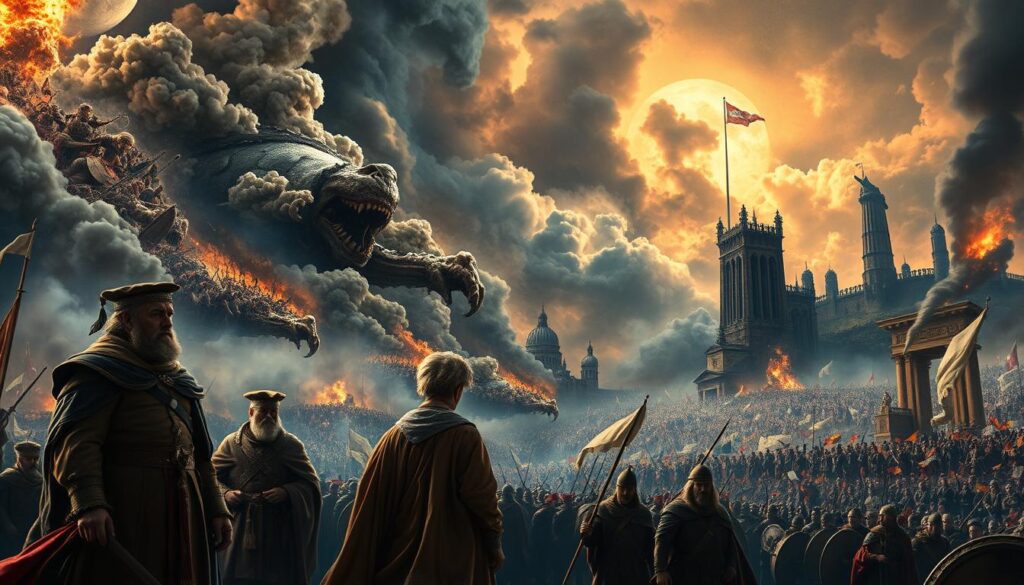
Fire and cities: Readers often point to one or more quatrains that seem to match the Great Fire of London and other urban infernos. Language about flames sweeping crowded streets fits later accounts of city destruction.
War and the rise of leaders
Interpretations tied to Napoleon and the two world wars lean on verses describing the sudden rise of powerful leaders and mass conflict. Fans map short lines about battle and conquest onto famous years in history.
Plague, death, and the course of history
Because he served as a physician during plague outbreaks in France and Italy, people read echoes of death and disease in the quatrains. Those images connect medical experience to broader social change.
“Iron birds” and “great fire”
Modern readers link phrases like “iron birds” and “great fire” to aerial bombardments and the atomic age. These are examples of older words applied to newer technology.
Kings, terror, and upheaval
Some cite particular verses that show a king amid terror and revolt, using them to illustrate revolutions and regime change. Over the years, names and places get matched retrospectively, but these remain interpretive readings, not documented forecasts.
“The poems’ vagueness means one verse can serve many moments in the past.”
- Fans link verses to city fires and other urban disasters.
- Lines about leaders get tied to Napoleon and major wars.
- Medical background explains frequent reads of plague and death.
- Imagery is often reinterpreted to fit later technology and conflict.
For more context on how readers assign modern meaning to old texts, see this short guide on psychic interpretations.
What Were Nostradamus Predictions People Cite for the Modern World
Modern readers often point to a few quatrains as mirrors for current crises in Europe and beyond.

Long wars and strained armies are a common reading. Analysts quote lines about exhausted troops and empty coffers to discuss budgets, morale, and resource shifts in wartime.
Long wars and exhausted armies
Some modern interpreters use the verse,
“Through long war all the army exhausted, so that they do not find money for the soldiers. Instead of gold or silver, they will come to coin leather, Gallic brass, and the crescent sign of the Moon,”
to highlight how prolonged conflict can drain nations.
Fire from the sky and water rising
Other lines about fiery sky events get tied to asteroids or human-made disaster, while mentions of water and floods are read as alarms about climate-driven sea rise and extreme storms.
- Resource strain: Readers link the coin and leather image to scarcity and shifting alliances.
- Cosmic or human fire: Phrases about fire map to both natural impacts and wartime technology.
- Water risks: Floods and rising seas are read as warnings for the course of our climate choices.
Debate remains whether these verses signal an end era or a cautionary prophecy about the future. For background on related modern readings, see a short Sirian starseed overview.
America in the Quatrains: Readings About a Land Across the Sea
Many readers point to lines about a distant shore and apply them to a rising continental power across the ocean. These readings tie several short quatrains to events in a modern American context.

Civil unrest and division: “brother against brother” in a new age
Brother against brother images get read as civil strain and political polarization in a new age. Interpreters link the verse to protests, factional fights, and social upheaval.
Wars abroad and the eagle: interpretations of global military actions
The eagle motif helps connect the writings to military action. Some see these lines as commentary on limited war, larger wars, and the rise of global influence.
Fires in the West and waters rising: natural disasters and environmental warnings
“Fires in the West” often map to large wildfires and heat waves. Mentions of water and floods are read as warnings about coastal storms and rising seas.
“These interpretations are speculative, yet they show how poetry lets readers place their own world into the verses.”
| Theme | Common Reading | Modern example |
|---|---|---|
| Civil division | Brother vs. brother | Protests and partisan conflict |
| Military action | Eagle symbol | Overseas campaigns and alliances |
| Environmental risk | Fires and water | Wildfires, storms, coastal flooding |
For a related view on symbolic readings, see a focused Knight interpretation that explores how single images get tied to larger events.
Why Interpretations Differ: Symbols, Translation, and the Mystery of Time
Loose images, shifting language, and centuries of copying mean a single line can point to very different events across history.

How vague wording invites multiple prophecies in one verse
The quatrains use symbolic phrasing that lets readers map scenes to their own era. A metaphor can echo across time and feel immediate to a new audience.
Translation choices change the way a phrase reads. Small word swaps can shift tone, place, or actors in the text. That leads others to different conclusions.
Copy variations and editorial edits in the writings reinforce this effect. Over the centuries, editors altered line breaks, punctuation, and wording that shape later interpretation.
- Symbolic phrasing makes one verse read like many prophecies.
- Translators decide nuance; the same line can look new today.
- Copy changes and editorial use encourage alternate meanings for others.
“Treat the quatrains as layered poetry rather than fixed forecasts.”
Keep this information in mind when you evaluate a dramatic prediction. For related context on reading symbolic material, see this guide to supernatural abilities.
How the Prophecies Shaped Culture: Influence Across Centuries
From salons to newsrooms, the verses reemerge each time an age feels fragile and searching.
Les Prophéties (1555) inspired waves of debate and storytelling that shaped public life for more than a century. The book moves between academic study and popular retellings.
During wars, during plague, and after disasters, broadcasters and authors pull lines from the writings to help explain events. That practice keeps the verses in circulation.
Scholars track how interpretation changes with each new age. As interest rises, readers revisit the book and reshape its place in cultural history.
“People turn to the quatrains when they need a narrative to make sense of sudden change.”
- Appears whenever history feels turbulent.
- Becomes part of media coverage and books.
- Helps frame conversations about the future and the course of life.
Conclusion
When read with care, the quatrains offer prompts for reflection rather than a calendar of events.
In short, the most lasting predictions, show patterns in human behavior across time and across each century rather than fixed dates. They invite readers to bring their own moment to the text.
The prophecies still spark debate because they feel timeless. Each year adds fresh context from the past, and that living dialogue keeps these writings part of public conversation.
Look to the future with humility: treat prophecy as a prompt to think, not a verdict on war, death, or the end of an era. For related guidance, consider a short session on psychic readings to explore modern meaning.
One clear takeaway: read carefully, question confidently, and place each claim in historical context.