
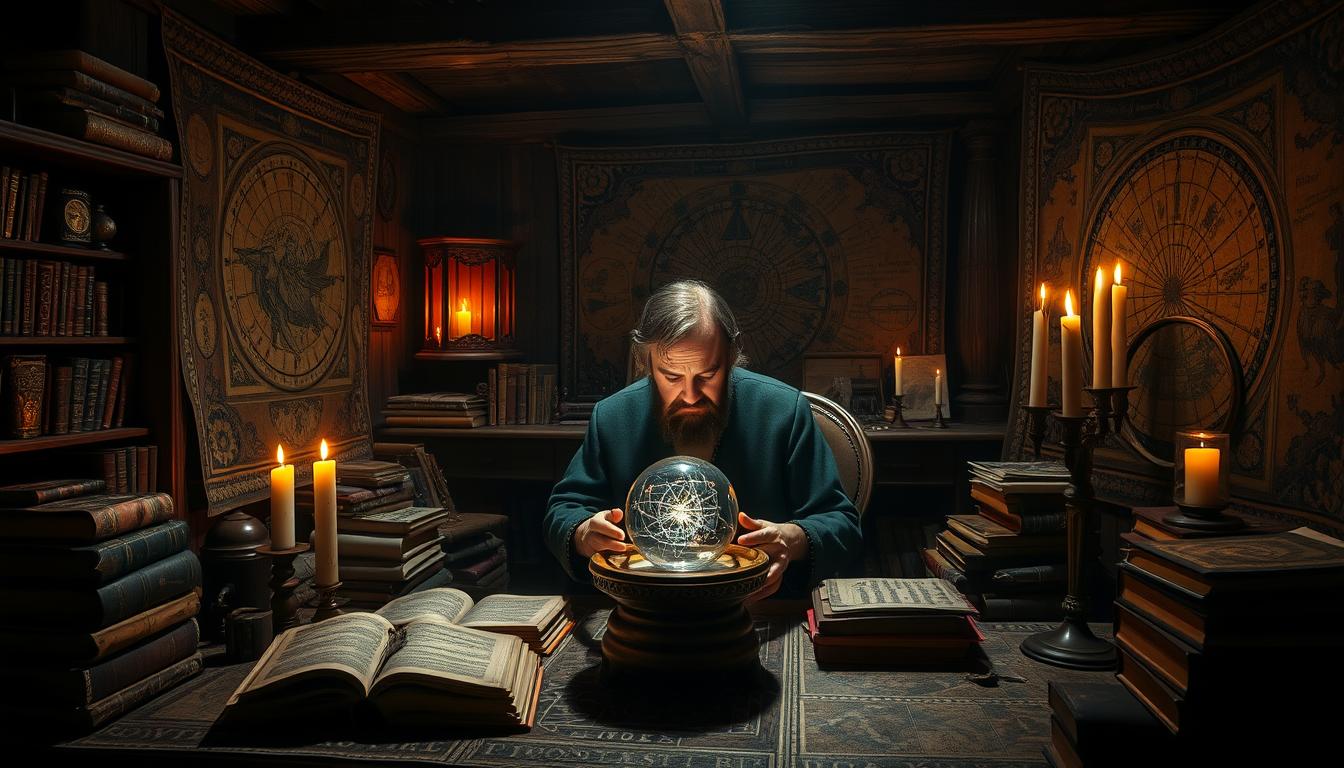
What made a 16th‑century apothecary write lines that still haunt the world? This section opens the question and shows that his fame mixes poetry, early science, and the ways readers read vague quatrains.
The Prophecies were written as short poems organized into groups called Centuries, a filing system rather than literal years. He worked nights in an attic in Salon, France, taking notes and sketches before shaping them into verse.
His popular almanacs in the 1550s and the reaction after King Henry II’s 1559 death helped his name spread. We’ll trace the attic routine, the move from notes to prophecies, and why ambiguity in the lines lets many events be tied to the text.
This article will place his work in Renaissance history and show practical steps for reading and weighing claims. For contextual examples of modern claims and links to common readings, see psychic predictions.
Key Takeaways
- Nostradamus wrote quatrains grouped into Centuries as a filing method.
- His routine blended meditation, notes, and poetic shaping in an attic setting.
- Ambiguity and translation helped the prophecies travel through years.
- Fame grew from almanacs and high‑profile events like 1559.
- The article offers a friendly, practical guide to assess claims tied to his name.
Why This Matters: Understanding Nostradamus’s Prophecies in Historical Context
History shows that Renaissance France blurred lines between medicine, astrology, and alchemy. When plague and politics pressed hard, people turned to both physicians and prognosticators for guidance.
In this era, learned practitioners wrote almanacs and gave counsel to courts and towns. Cheap booklets and court consultations fed a steady rise in public interest. Wars, famine, and religious strife made signs and omens feel urgent.

People read verses for reassurance across difficult years. A prophet could be a trusted physician‑astrologer, not an isolated seer. Michel Nostradame worked as a healer, wrote almanacs in the 1550s, and moved naturally between practice and publicity.
Informational intent: what readers can learn
Readers should expect to learn how the texts were written, organized, and circulated. This section aims to connect historical method to modern reading habits.
- Context for why prognostications mattered during war and plague.
- Practical ways to assess interpretations without seeking a final map of future events.
Who Was Michel de Nostradame: Physician, Apothecary, and Astrologer
Michel de Nostradame was born in Saint‑Rémy‑de‑Provence in 1503. His family had converted to Catholicism after Provence joined France. Early study in Latin, Greek, Hebrew, and medicine gave him a wide education for the era.
University life was disrupted by plague. Avignon closed while he studied, and that upheaval pushed him into hands‑on care. He traveled through towns treating plague victims, emphasizing clean water and hygiene and offering rose pills as one remedy.
As a practicing physician and apothecary, his practical fixes won public trust. Yet professional rules mattered: he was expelled from Montpellier for apothecary work. That clash shows the boundary between learned medicine and hands‑on remedies.
In 1538 he faced a heresy charge for criticizing a religious statue and was acquitted. Later, his almanacs in the 1550s and powerful patrons such as Catherine de Medici raised his name across the world of courts and common readers.
- Lifetime note: his career ran from plague wards to published calendars.
- Fact: he died on July 1, 1566, likely of gout — a human end, not legend.
- Any single prediction tied to him must be weighed against his full life and surviving documents.

Inside the Attic: The Method Behind the Predictions
Evenings in a small Salon attic became the laboratory for words and visions. This quiet work mixed study, charts, prayer, and focused meditation. The man at the table treated the space as a workshop for thought and composition.
Meditation and prayerful focus
Prayer and calm prepared him to receive vivid impressions. He used a contemplative attitude to invite images that felt meaningful and urgent.
Notes, sketches, and verse
Impressions were captured as quick notes and small sketches before being shaped into lines of verse. That draft stage turned raw images into a single four-line quatrain.

- The attic routine blends study and meditation in a practical kind of craft.
- Multiple versions show the editorial work behind each prophecy.
- Deliberate vagueness often emerged during revision to make a line travel through time.
“Vision alone is not text; the attic turned feeling into readable form.”
Remember: the finished prediction is both an inspired moment and a series of composition choices. That mix of sincerity and strategy matters when you read any single quatrains.
How Did Nostradamus Predict: The Tools and Techniques He Used
Charting the heavens was routine for learned healers, and that practice fed both treatments and forecasts. As a physician, a man of the period learned to turn star charts into practical decisions about timing care.
Astrology as a diagnostic and calendrical tool
Astrology served like a medical calendar. Doctors timed remedies and surgeries by planetary positions. That same skill let a practitioner offer short public predictions and wider prognostications.

Blending period science with esoteric practice
Almanacs mixed dates, star notes, and practical advice. They forecast weather and near‑term events readers cared about. During plague years, timing mattered and the almanac form spread authority.
The habit of finding patterns in charts translated naturally into writing quatrains. That way of working linked clinical tools to public predictions. Claims about what nostradamus predict grew from chart reading, symbolism, and cautious wording rather than guaranteed accuracy.
Quatrains Explained: Form, Language, and Symbolism
Each quatrain works like a tiny snapshot, a compact unit meant to suggest more than it states.
Structure and rhyme
Definition: a quatrain is four lines of poetry, often with rhymes between lines 1 and 3, and 2 and 4.
This tight frame gives each short poem a clear rhythm and a sense of finality.
Standalone design and book order
Most quatrains were written to be read alone, which explains why order in the book feels scattered rather than chronological.
That lack of linear order makes each stanza a separate unit and reduces the risk of direct accusations against the author.
Language, invention, and deliberate obscurity
He mixed French, Provençal, Italian, Latin, and sometimes invented words to veil meaning.
This linguistic blend created flexible phrasing that could be read in many ways across time and place.
Exceptions and symbolism
A notable exception occurs when themes continue across several quatrains; these serial poems break the standalone rule for emphasis.
Ambiguity became a feature, not a flaw. The compact lines invite interpretation, so readers project events onto suggestive imagery.
“The power of each quatrain lies in its brevity — a fragment that asks for connection.”
- Quatrains give the text durable reach across a century and beyond.
- The rough rhyme and shifting language balance protection and publication.
- Treat the collection as curated fragments whose authority grows from symbolism rather than precise timeline.
For related symbolic readings and context, see this short guide to tarot imagery and interpretation: The Chariot.
Centuries, Not Years: Organizing 942 Prophecies
The books group brief poems into labeled collections, not into timelines you can read like a diary. That arrangement makes the work easier to reference but harder to treat as a strict chronology.
Structure and count. The set holds 942 quatrains divided into ten intended centuries — each century was meant to be a group of 100 items. The actual number in print varies, and the missing entries matter.
Reading the notation. Citations use Roman numerals for the century and Arabic for the quatrain. For example, C II-45 points to Century two, quatrain forty-five. Knowing this number format helps you verify quotes across editions.
Order and exception. The sequence is not chronological; topics appear scattered. A key exception is Century 7, which contains only about half the expected entries. No single explanation settles that gap.
Use the standard citation format in discussions to avoid confusion. Treat each quatrain as a separate unit. This system keeps the collection navigable while resisting a linear timeline.
From Almanacs to The Prophecies: How He Published His Work
He began publishing short, practical calendars in 1549 that combined seasonal notes with brief forecasts. These almanacs mixed simple weather guidance with warnings about likely events for the coming year.

Year after year the pamphlets appeared, and steady publication built trust. As a trained physician, his voice carried practical authority. Readers in town squares and court circles relied on the same pages for planting dates and local news.
Weather, events, and annual prognostications
Almanacs served as yearly guides that addressed immediate concerns like storms and eclipses. Recurring themes—floods, unrest, strange skies—matched what readers feared and remembered across years.
The move from almanacs to a formal book of quatrains came when short forecasts grew into broader statements. Les Prophéties grouped those quatrains into a loose century structure so large ideas could sit beside brief forecasts.
| Feature | Almanacs | The Prophéties |
|---|---|---|
| Timing | Immediate: this year | Broad: across ages |
| Content | Weather and events | Symbolic quatrains |
| Audience | Households and markets | Readers, nobles, courts |
Think of the publishing path as a continuum: annual almanacs built an audience that then received the longer-form prophecies. For curious readers of related material, see a modern, cultural angle on ancient theories via ancient theories.
Reading the Lines: A How-To on Interpreting Nostradamus Today
Begin by treating each quatrain as a tiny case file: citation first, claim second. Always locate the century and number (for example, C II-45) before judging an assertion. Precise notation stops misattribution and keeps the debate honest.
Time, names, and numbers: what to look for—and what to doubt
Names in translation are often guesses. A single shifted word can turn a general image into a supposed reference to a public name. Time cues may be symbolic rather than literal; treat exact dating claims with restraint.
Translation traps: how wording shifts change meaning
Compare multiple translations and, when possible, check a facsimile to see if later editors added glosses. Translation layers and mixed languages create room for interpretation. That gap is where modern readers and promoters supply specifics.
Case studies often cited
- Henry II’s jousting death (1559) — linked to a quatrain by later readers.
- Lines read as Parliament executing Charles I (1649).
- “Thrice twenty and six” tied to the Great Fire of London (1666).
“Locate the text, read it fully, then ask what the stanza actually says before you accept a connection.”
Practical steps: verify the citation, read the full quatrain and nearby verses, compare translations, and watch for reader bias. These moves help separate what nostradamus predicted from later claims about the future and famous events. For further reading on modern interpretive habits, see this short guide: best book on angel numbers.
Accuracy, Bias, and Myth: Separating History from Hype
Vagueness in the verses often acts like a safety net, letting a single stanza seem to match many events across time.
That style is a key fact: flowery language shields subjects and the author from direct challenge. The result is multiple “hits” from a single line, an illusion of precision that spreads through readers and markets.
Why vagueness enables multiple “hits” across centuries
Broad wording invites others to attach recent facts to old lines. People cherry‑pick matches and ignore misses. This bias makes apparent accuracy a social product, not only a textual one.
How politics and propaganda leveraged the prophecies
Political actors have long bent these verses for their ends. Joseph Goebbels used ambiguous lines during war to sow doubt and boost morale. A doomsday phrase tied to July 1999 helped fuel Y2K fears one year before the date.
“Understanding who benefits from a reading is as important as the text itself.”
- An exception exists when wording seems unusually specific, but translation can amplify that precision.
- The author was a physician and public figure; that authority aided the text’s rise in the wider world.
- This work has been repackaged by others for publicity and power.
In short, check the original wording, ask what facts follow, and weigh motive. That is the best defense against hype and repeated claims about what nostradamus predicted.
Applying Critical Thinking: A Practical Guide for Modern Readers
A clear first step is to locate the quatrain’s citation—Century in Roman numerals and its number. That notation (for example, C II-45) anchors any claim and stops loose quotations from floating online.

Weighing sources and checking context
Follow this simple way to vet a claim today:
- Find the citation and read the original quatrain before commentary.
- Compare multiple translations and note where wording diverges; people and others may introduce bias.
- Check the order and adjacency to see if nearby stanzas change meaning or reveal a serial set.
Trust reputable editions. Seek scholarly notes that document sources instead of meme‑level summaries. Catalog each claim by number so discussions stay verifiable.
- Treat centuries as groups, not precise dates; be skeptical of timing claims without internal clues.
- Watch for overreach: modern terms absent from the text or unreferenced “lost” quatrains.
“Label open readings as interpretation, not fact.”
When debating with others, ask for the citation, the translation used, and whether alternatives were considered. These habits let readers enjoy the mystery without being misled and point you to reliable resources like psychic techniques for related methods of source checking.
Conclusion
Readers return to the quatrains because the lines invite new meanings as the world turns. The form of the book and its compact language let each stanza be reread for signs about the future without demanding a single answer.
That openness explains why the nostradamus prophecies endure centuries after the man‘s death. Responsible reading looks for citation, context, and clear wording rather than chasing dramatic claims about the end.
Use source checking and compare translations. Treat intrigue as a prompt for study, not a substitute for evidence. If you want a modern take, try a reading or resource here: psychic readings.
Finally, remember this: a careful eye trained on language, form, and context makes it easier to separate lasting insight from wishful thinking across a lifetime of debate.