

In December 1971, a bold term surfaced during an experiment at the American Society for Psychical Research. Ingo Swann suggested calling it remote viewing, and that idea sparked decades of debate.
This introduction outlines a concise review of that era. We trace how a practice gained attention during Cold War intelligence work and how many researchers tested its claims.
Readers will find a clear timeline and profiles of key investigators. We also cover how techniques evolved and why critics pressed for rigorous tests.
Expect balanced analysis that explains historical facts, shows differing viewpoints, and highlights major studies from past time periods in the United States.
Key Takeaways
- Term first used in December 1971 at a U.S. research meeting.
- Practice drew major interest during Cold War intelligence efforts.
- Several teams spent decades testing claims with mixed results.
- Techniques changed over time as researchers sought better controls.
- Article offers a balanced, evidence-focused historical overview.
Understanding the Science Behind Ingo Swann Remote Viewing Method
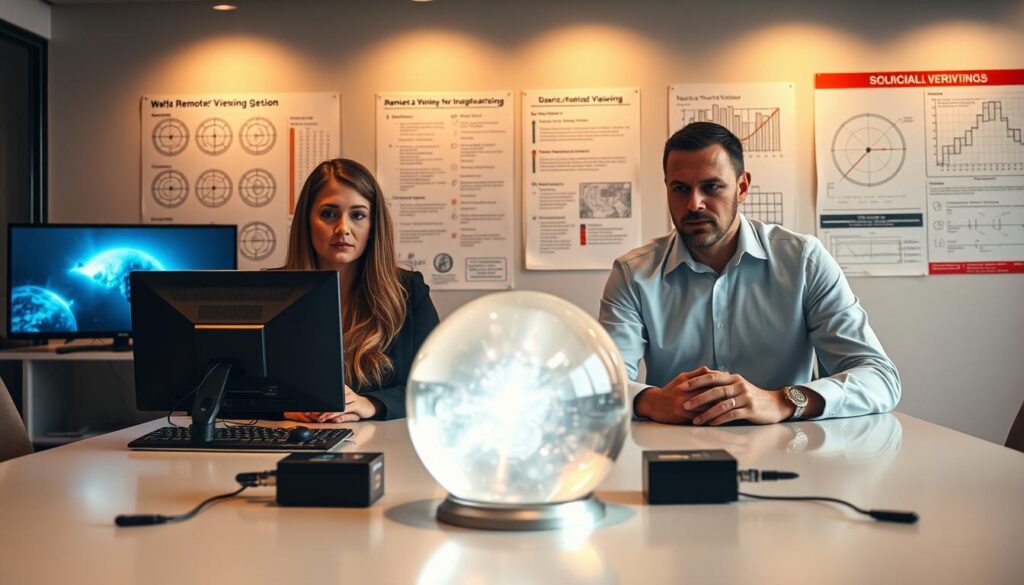
A 1972 experiment reported an abrupt magnetometer shift when a subject concentrated on a sealed device. Physicist Harold Puthoff noted the meter jump as the volunteer focused attention on a shielded vacuum container.
Early tests emphasized how a person’s mind appeared to interact with instruments. Observers documented results that challenged normal expectations and sparked intense debate in research circles.
Supporters argued these phenomena showed possible psychic abilities that might have practical uses. Critics pointed to bias, experimental flaws, and the need for tighter controls before accepting such claims.
- 1972: reported magnetic change during focused perception.
- Witnessed by established researchers, which raised interest.
- Debate centered on reproducibility and data integrity.
| Year | Observation | Discussion Point |
|---|---|---|
| 1972 | Magnetometer spike during focused attention | Possible mind-instrument interaction |
| 1970s | Multiple lab notes and eyewitness reports | Calls for replication and stricter controls |
| Present | Ongoing analysis of past results | Continued debate over validity |
For readers curious about related claims of human potential, see psychic superpowers.
Origins of Remote Viewing in the Cold War Era
Cold War tensions pushed certain labs to test claims that people could access distant information without instruments.
Early Parapsychology Research
Interest in psychic claims predates modern labs. In the nineteenth century, figures such as Michael Faraday and William Crookes ran controlled trials on gifted individuals.
Those early tests shaped protocols and inspired later teams. Later researchers borrowed methods and aimed for better controls and repeatable results.
Stanford Research Institute Foundations
During the 1970s, the stanford research institute became a hub for focused study. Physicists Russell Targ and Harold Puthoff led work at an Electronics and Bioengineering lab.
That research institute provided space for a physicist to probe boundaries of consciousness and human life. Over decades, their information helped form a new framework that tried to separate this approach from clairvoyance.
- Cold War funding encouraged riskier inquiry.
- Counterculture influenced openness to novel ideas.
Core Principles and Techniques of the Swann Approach
Laboratory teams adopted clear protocols that guided a person through focused perception and reporting.
The Process of Mental Perception
Ingo Swann developed techniques that asked a subject to fix attention on a distant target. This process relied on mental imagery and stepwise notes.
Researchers at the Stanford Research Institute, including Russell Targ, documented how subjects described objects or light patterns hidden from view. Sessions used strict controls to limit cues.

- Focused attention: a person narrows the mind to a single location.
- Standard prompts: consistent scripts helped subjects report impressions.
- Neutral reporting: protocols reduced researcher influence on descriptions.
- Target features: subjects often sketched shapes, textures, or light.
By following these steps, the research institute aimed to make reports comparable and testable. For a closer look at historical protocols, see remote viewing protocols.
The Stargate Project and Government Intelligence Applications

From 1975 to 1995, a classified U.S. program spent about $20 million exploring whether trained people could provide useful intelligence.
The Defense Intelligence Agency managed this program. Its goal was to test remote viewing for gathering information on foreign locations and targets.
Every person involved kept strict secrecy. Officials treated reports as sensitive because they dealt with alleged psychic abilities and national security.
Researchers often found that descriptions were vague. Verifying many claims proved difficult, and usable results were rare.
Over time, criticism grew about inconsistent outcomes. That criticism and limited operational value led to the project’s end in 1995.
Still, the effort remains an important part of U.S. research history into paranormal phenomena and how government programs evaluate unconventional ideas.
Evaluating the Statistical Evidence and Research Findings
Statistical reviews of past programs reveal a mix of intriguing numbers and persistent doubts.

American Institutes for Research review
In 1995, the CIA hired the American Institutes for Research to audit archived work from a long-running program.
AIR concluded that no usable intelligence information emerged from that project. Reports had interesting patterns, but none met operational standards for reliable leads.
PEAR Laboratory contributions
By 1989, the PEAR laboratory reported 336 formal trials and a composite z-score of 6.355. Some researchers, such as Jessica Utts, argued these figures suggested an effect beyond chance.
Others, like Ray Hyman, countered that methodological flaws weakened the evidence. Critics pointed to weak controls, possible cueing, and selective reporting in certain cases.
- Mixed expert views: statistical signals vs. procedural concerns.
- Subjects: occasional above-chance results did appear.
- Overall: independent reviewers found the data insufficient for confident operational use.
Careful analysis shows valuable lessons for future research in perception and how people report subtle impressions under strict testing.
Critical Perspectives from the Scientific Community
Several well-known analysts contend that reported hits often vanish under strict replication. Critics such as Martin Gardner and Michael Shermer called many claims pseudoscientific.

Prominent skeptics note that peer teams rarely reproduce positive results. Ray Hyman argued that findings have not been confirmed by independent groups across multiple labs.
Key concerns center on weak controls, sensory leakage, and lack of a working theory in physics or consciousness that could explain the phenomena.
- Community consensus: most scientists reject remote viewing due to missing reproducible evidence.
- Critics: many experiments fail to respect basic causal or physical principles.
- Researchers: without a positive theory, studies remain inconclusive and open to statistical anomalies.
For readers seeking related analysis of clairvoyant claims and how researchers assess such material, see clairvoyant research.
The Role of Sensory Cues and Experimental Flaws
Careful review shows many lab notes hid clues that guided guesses more than genuine perception. Audits and repeat checks found that some reports contained contextual hints that a person could use to match a target without travel.

Sensory Leakage and Data Contamination
David Marks and Richard Kammann showed transcripts often held identifying details. Marks matched targets with 100 percent accuracy using only those clues.
Result: many experiments at the stanford research institute were compromised. That contamination made data unreliable for objective analysis.
The Problem of Subjective Bias
Researchers and subjects sometimes read reports with expectations. Those expectations nudged descriptions and influenced final reports.
Over time, small edits and background notes shifted how a person interpreted impressions. Those changes inflated perceived success and weakened evidence.
Challenges to Replication
When outside teams tried to repeat results, outcomes often fell to chance. Altered reports and inconsistent controls in a program made replication unlikely.
- Many experiments contained sensory cues that leaked location or object details.
- Investigators found report edits that matched known background information.
- Because of these flaws, the wider community remained skeptical of claimed abilities.
| Issue | Impact | Evidence |
|---|---|---|
| Transcript clues | High false-positive rate | Marks & Kammann matching study |
| Report edits | Biased verification | Stargate archival reviews |
| Weak controls | Poor replication | Independent lab failures over decades |
For balanced analysis of related claims, see clairvoyant abilities real or fake.
Lasting Impact on Consciousness Studies
Many scholars now treat mid‑20th century perception trials as a lesson in experimental rigor.
That legacy lives on in how researchers design new tests of human awareness. Debates about those early experiments pushed teams to adopt clearer protocols and stronger controls.
While results from those studies often fell short of firm proof, they kept interest alive in whether minds can access distant information. This curiosity helped form modern ideas in consciousness and life research.
Today, labs use past cases as a checklist for what to avoid. Peer review, preregistration, and blind scoring are now common. These steps grew from lessons learned in prior work.
- Legacy: A reminder to uphold strict standards.
- Debate: Ongoing discussion about experimental design.
- Interest: Continued study of unusual phenomena and human potential.
| Area | Lesson | Impact on Research |
|---|---|---|
| Protocol | Need for blinding | Reduced bias in trials |
| Reporting | Complete archives | Better reproducibility |
| Analysis | Statistical rigor | Clearer interpretation of results |
Conclusion
Historical records show a mix of intriguing data and persistent methodological gaps. Over time, government-funded work, including a well-known project, produced many reports and rich archives but few reliable results.
While remote viewing drew intense interest, careful review suggests much apparent success came from flawed protocols and cueing rather than solid evidence. Chance and poor controls often explain positive outcomes.
That program left useful raw data for future research and a clear lesson: strict methods matter. For readers who want further reading on related claims, see a concise guide to psychic powers.