
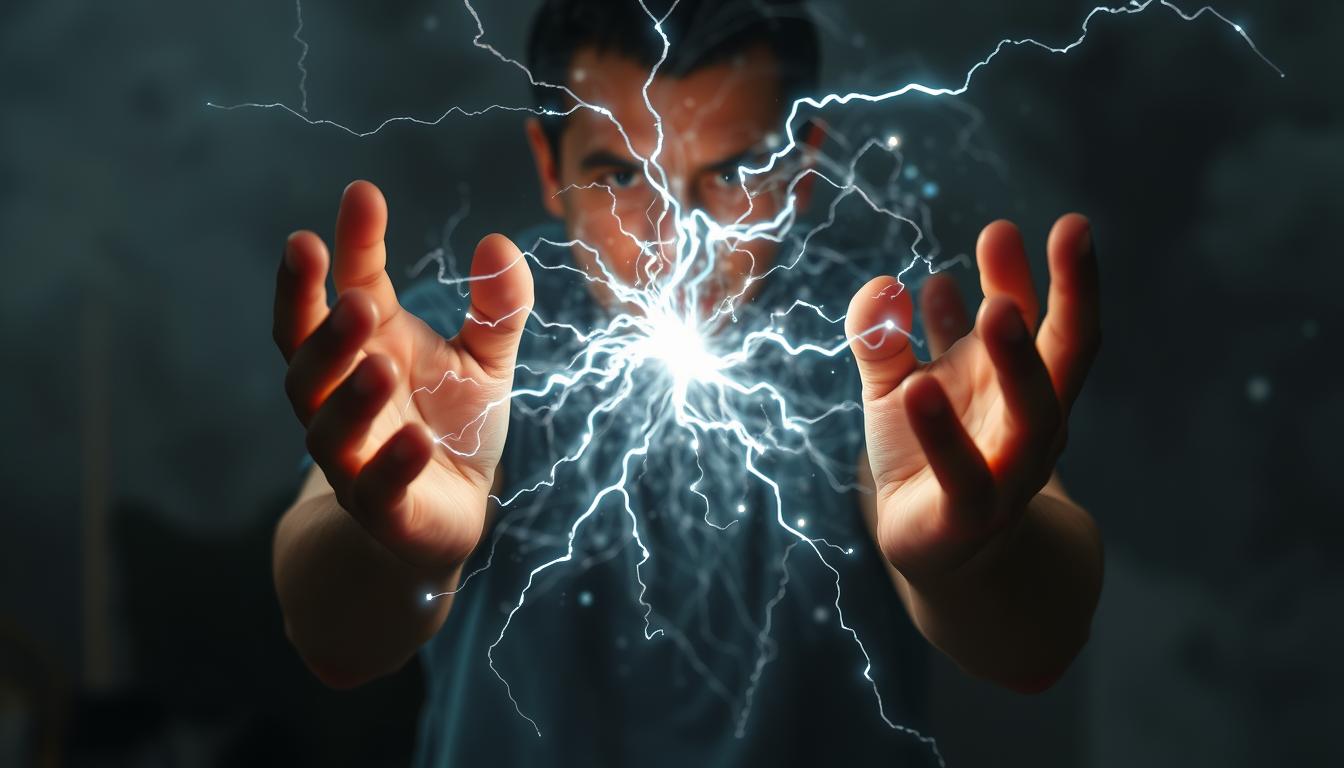
Have you ever wished you could move objects with just your thoughts? This idea, often called telekinesis, has fascinated people for centuries. It suggests the mind can influence physical matter without any touch. From ancient myths to modern sci-fi, this concept sparks curiosity.
Many cultures and stories, like Stranger Things or Star Wars, highlight this ability. Yet, science remains skeptical. Researchers argue it defies known laws of physics, like energy conservation. Still, the debate continues between believers and skeptics.
The term comes from Greek—“tēle” (far) and “kínēsis” (motion). While some claim real-world examples, most evidence points to tricks or natural causes. Whether real or imagined, telekinesis challenges our understanding of the mind’s potential.
Key Takeaways
- Telekinesis is the alleged ability to move objects using only the mind.
- It appears in pop culture, from movies to folklore, fueling widespread interest.
- Science labels it as pseudoscience due to lack of reliable proof.
- Historical claims often involve fraud, like famous hoaxes by spiritualists.
- The concept clashes with physics principles, such as energy conservation.
Telekinesis Meaning and Definition
From Greek origins to modern debates, the concept sparks curiosity. The term blends tēle (“far”) and kínēsis (“motion”), suggesting action at a distance. Merriam-Webster defines it as “production of motion in objects without contact”, a phrase echoed in studies and pop culture alike.

Paranormal researcher Henry Holt later coined “psychokinesis,” a broader term for mind-matter influence. While telekinesis focuses on moving objects, psychokinesis includes bending spoons or altering dice rolls. This distinction matters in parapsychology manuals.
Experts split claims into two types:
- Macro-telekinesis: Visible effects, like levitating tables.
- Micro-telekinesis: Subtle statistical shifts, like affecting random number generators.
“The ability to bend spoons with the mind, once dismissed as a parlor trick, is now being studied by scientists.”
Skeptics like James Randi criticize the vague definitions. They argue terms like “energy” are misused to explain unverified phenomena. Despite this, the word first appeared in 1890, during spiritualism’s peak—fueling enduring fascination.
Historical Claims of Telekinetic Abilities
From séance rooms to TV stages, alleged telekinetic feats have captivated audiences for centuries. While some cases remain unexplained, many famous examples were later exposed as elaborate hoaxes. Let’s explore four pivotal moments in this controversial history.

Eusapia Palladino and 19th-Century Spiritualism
Italian medium Eusapia Palladino became famous for levitating objects during séances. In 1892, investigators Hugo Münsterberg and Joseph Rinn caught her using hidden foot tricks to lift tables. Dim lighting and accomplices helped sell the illusion.
The “Electric Girl” and Early Hoaxes
In 1846, Angelique Cottin’s family claimed she emitted electrical phenomena that moved furniture. Skeptic Frank Podmore noted her “double-movement” technique—subtly pushing items twice to mimic supernatural force. The act crumbled under scrutiny.
“Project Alpha proved that even trained scientists could mistake magic for psychokinesis.”
Modern Era: Uri Geller and Project Alpha
In the 1970s, Uri Geller wowed crowds by bending spoons on TV. Magician James Randi replicated his tricks, exposing them as sleight of hand. Later, Project Alpha (1979–1981) saw magicians infiltrate a parapsychology lab, fooling researchers with staged effects.
| Figure | Claim | Debunking Method |
|---|---|---|
| Eusapia Palladino | Table levitation | Hidden foot maneuvers |
| Angelique Cottin | Electrical telekinesis | Double-movement observation |
| Uri Geller | Spoon bending | Magic trick replication |
| Project Alpha | Lab-confirmed psychokinesis | Magician infiltration |
These examples reveal a pattern: dim lighting, misdirection, and human error fuel belief in mind-over-matter phenomena. Whether for profit or fame, the allure of moving objects with thought persists—despite science’s skepticism.
Types of Telekinesis
Scientists divide alleged mind-over-matter abilities into two distinct categories. One involves visible movement of objects, while the other relies on tiny statistical shifts. Both forms clash with physics but fuel ongoing debate.

Macro-Telekinesis: Visible Object Movement
Macro-telekinesis claims include spoon bending or levitating tables. The PEAR laboratory once reported mechanical objects moving without touch, but critics found flaws in their methods.
These cases are easier to debunk. Hidden strings, magnets, or sleight of hand often explain the movement. For example, Nina Kulagina’s famed demonstrations were later linked to clever trickery.
Micro-Telekinesis: Statistical Influence
Micro-telekinesis focuses on altering probabilities, like dice rolls. A 1989 meta-analysis showed a 51.2% success rate—barely above the 50% chance expectation.
The U.S. Air Force funded studies on this energy effect. Yet the 1987 National Academy report dismissed it due to unrepeatable results and poor controls.
“Micro-telekinesis survives in labs because it’s harder to disprove than macro claims.”
| Type | Examples | Debunking Challenges |
|---|---|---|
| Macro-telekinesis | Spoon bending, table levitation | Visible tricks (strings, magnets) |
| Micro-telekinesis | Dice rolls, random number generators | Statistical noise, small effect size |
Why do micro claims persist? They exploit probability distortions and vague energy theories. Unlike macro cases, they’re harder to test conclusively—keeping the debate alive.
Science vs. Telekinesis
Can the human brain truly defy the laws of physics? Despite pop culture’s love affair with mind-over-matter abilities, scientific research consistently debunks these claims. From thermodynamics to cognitive biases, here’s why telekinesis remains in the realm of fiction.

Physics Challenges: Breaking Fundamental Laws
Energy conservation is the first hurdle. Moving objects requires force, yet no known brain mechanism generates external kinetic energy. Physicist Sean Carroll notes this violates Newton’s laws—a non-starter for scientific validation.
Another conflict? The inverse-square law. Alleged telekinetic forces would weaken with distance, yet claims often ignore this. Felix Planer’s balance-scale challenge—never passed—exposed this flaw.
- Thermodynamics: Mind-powered motion lacks an energy source.
- Force fields: No detectable fields explain macro-scale effects.
- Reproducibility: 1988 NRC report found zero evidence in 130 years.
“Telekinesis isn’t just unproven—it’s incompatible with physics as we know it.”
Cognitive Biases Behind Belief
Why do people still believe? Psychology offers answers. Richard Wiseman’s video experiments showed how confirmation bias skews perceptions. Subjects recalled “hits” (successful attempts) but ignored misses.
Daniel Wegner’s research on apparent causation reveals another layer. When thoughts align with random events, the brain falsely attributes control—like feeling responsible for dice rolls.
| Bias | Effect on Belief | Study Example |
|---|---|---|
| Confirmation Bias | Overvalues supportive evidence | Wiseman’s video tests |
| Illusion of Control | Mistakes chance for skill | Casino gambling studies |
| Publication Bias | Positive results overreported | 2006 meta-analysis (0.2% effect) |
In short, telekinetic claims crumble under physics scrutiny and thrive on psychological gaps. Until reproducible evidence emerges, science remains unmoved.
Notable Experiments and Failures
Lab tests have tried—and failed—to prove mind-over-matter claims for decades. From Yale’s 1952 study to the CIA’s Stargate Project, experiments consistently debunk alleged psychic abilities. Even with strict protocols, results vanish under scrutiny.
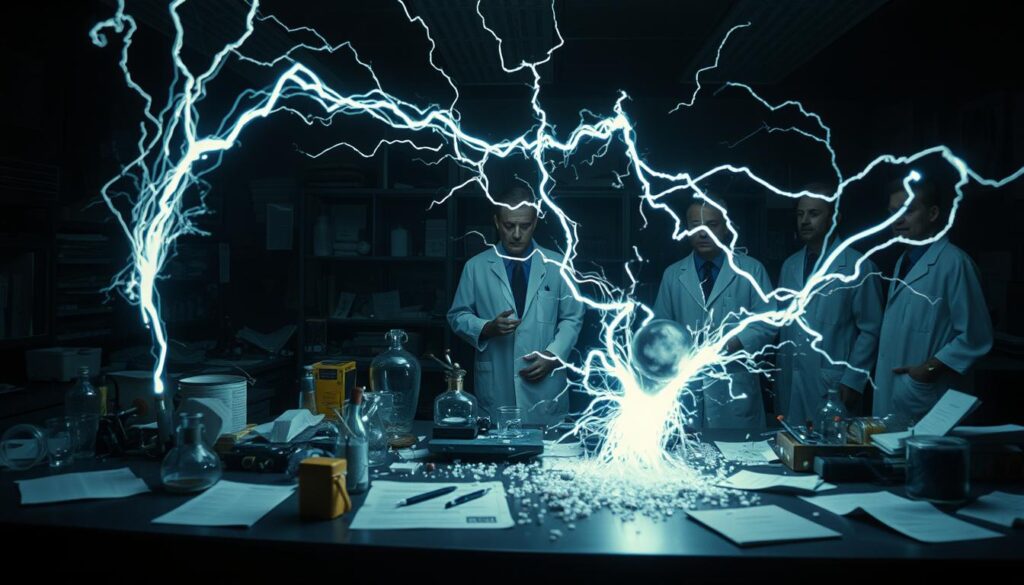
J.B. Rhine’s 1930s dice tests were groundbreaking—until critics spotted statistical flaws. Subjects rolled dice while “focusing” on numbers. The 52% success rate? Likely luck, not psychokinesis. Later, McDonnell Laboratory fell for magicians’ tricks, mistaking sleight of hand for real energy effects.
“Project Stargate wasted $20 million chasing psychic spies—with zero actionable intelligence.”
The PEAR Lab shut down in 2007 after replication failures. Their parapsychology studies claimed micro-telekinesis influenced machines. Independent labs found no proof. Similarly, Daryl Bem’s 2011 paper on “retroactive psychokinesis” was later retracted for flawed methods.
| Study | Claim | Outcome |
|---|---|---|
| Yale (1952) | Believers skew results | No repeatable effect |
| U.S. Army (1987) | Telekinesis weapons | Rejected as impractical |
| PEAR Lab (1979–2007) | Machine influence | Closed after failures |
Over time, double-blind protocols exposed these gaps. Without sensory cues or bias, effects disappear. Today, few universities host parapsychology studies—a testament to science’s rigor. For deeper dives, explore parapsychology studies and their pitfalls.
Magic Tricks That Mimic Telekinesis
Behind every “psychic” spoon bend lies a clever *magic* trick waiting to be exposed. Magicians use *techniques* like hidden threads and magnets to create illusions of *move objects* without *contact*. These methods exploit psychology and physics gaps to stun audiences.

Criss Angel’s levitation harnesses and Yuya Hasegawa’s magnetic tables are famous *examples*. Both rely on concealed tools—not mind power. Even “psychic surgeons” fake object movements with sleight of hand and pre-bent *spoons*.
“A magician’s job is to make you believe the impossible, even if it’s just wires and mirrors.”
Key debunking tips:
- Thread pulls: Watch for faint strings in dim lighting.
- Pre-bent metals: Spoons are often weakened beforehand.
- Misdirection: Focus on the performer’s other hand.
Uri Geller’s TV stunts mirrored Las Vegas *magic*—just showmanship. Ethical mentalists admit their tricks, unlike frauds claiming supernatural *techniques*. The difference? Transparency versus deception.
Telekinesis in Popular Culture
Hollywood has turned telekinetic powers into a cultural phenomenon, blurring lines between fantasy and reality. From Stephen King’s Carrie to Netflix’s Stranger Things, these examples captivate audiences with their dramatic flair.

Carrie White’s prom-night rage and Eleven’s nosebleed-inducing powers showcase horror and heroism. Even Star Wars Jedi use “mind tricks” as casually as lightsabers. These stories thrive on bending physics—and our disbelief.
“There is no spoon. It is not the spoon that bends, only yourself.”
Modern media expands the world of telekinesis:
- X-Men’s Jean Grey: An archetype of untamed potential.
- Video games: Control and Psychonauts gamify psychic battles.
- Superhero genres: Shift from 1970s horror to empowering narratives.
Yet, a paradox lingers. While science dismisses telekinesis, fiction celebrates it. Shows like Stranger Things even spark curiosity about real things—blurring education with entertainment.
Why People Still Believe
Why do millions cling to the idea of moving objects with their minds despite scientific rejection? A 1981 survey found 30% of Americans think thoughts can influence matter. Even today, belief thrives through psychology, culture, and clever marketing.

Evolution wired the brain to seek patterns. A Cambridge study linked this to dopamine—rewarding us for spotting “connections,” even false ones. This explains why people recall “successful” psychic attempts but forget misses.
“High dopamine levels correlate with magical thinking, from superstitions to belief in psychokinesis.”
Trauma also fuels faith. After Stuart Kauffman envisioned his daughter’s death before it happened, he questioned reality. Such events make life’s randomness feel controllable, reinforcing paranormal belief.
New Age gurus exploit this, selling “potential” through courses like “Unlock Your Brain’s Hidden Power.” Yet neuroscience confirms no untapped psychic zones exist.
- Parasocial bonds: Fans emotionally invest in psychic celebrities, ignoring debunkings.
- Cultural divides: Western individualism favors “self-powered” miracles, while Eastern traditions attribute them to spirits.
- Marketing: Labs like PEAR used ambiguous stats to imply proof, despite flawed methods.
In the end, people believe not because of evidence, but because it offers hope—a way to transcend life’s limits. Science may dismiss it, but the heart clings to wonder.
Prize Money for Proof of Telekinesis
Large cash prizes have been offered for decades to anyone who can prove they can move objects with their mind. From James Randi’s iconic $1 million challenge to modern $250,000 offers, these tests aim to separate fact from fiction. Yet, not a single claimant has succeeded under controlled conditions.

James Randi’s One Million Dollar Challenge ran from 1964 to 2015. Applicants had to pass preliminary tests before formal trials. Most failed at stage one—caught using hidden tools or misdirection. Randi’s rules required repeatable results, closing loopholes for tricks.
“We’re not testing magic; we’re testing claims that defy physics.”
Today, the Center for Inquiry offers $250,000 for proof of paranormal abilities. Like Randi, they use double-blind protocols to eliminate bias. Despite thousands of applicants, no one has moved even a paperclip under these conditions.
Why Do All Claimants Fail?
- Preliminary screenings: Catch frauds with infrared cameras or motion sensors.
- Statistical thresholds: Results must exceed chance by significant margins.
- No “energy” excuses: Tests account for environmental factors like humidity or vibrations.
| Challenge | Prize | Years Active | Claims |
|---|---|---|---|
| Randi’s Challenge | $1 million | 1964–2015 | 1,000+ (0 passed) |
| Center for Inquiry | $250,000 | 1996–present | ~300/year (0 passed) |
| Gerald Fleming’s Offer | £250,000 | 1970s | Uri Geller declined |
Historical prizes, like Scientific American’s 1922 $2,500 offer, followed the same pattern. These challenges educate the public about critical thinking—proving that extraordinary claims require extraordinary evidence. For deeper insights, explore parapsychology studies and their rigorous standards.
In 150+ years, no proof has stood the test of time. Whether due to human error or physics’ limits, the prize money remains unclaimed. For now, telekinetic energy stays firmly in the realm of movies and myths.
Conclusion
Science dismisses telekinesis as unproven, yet its cultural grip remains strong. Surveys show nearly 30% of people believe in mind-over-matter abilities, despite zero empirical support. Movies like Stranger Things keep the idea alive, blurring fiction and reality.
Instead of chasing myths, explore real world advances. Brain-computer interfaces and robotic limbs achieve what telekinesis promises—through technology, not magic. These innovations prove human creativity thrives within physical limits.
Today, critical thinking is key. Question extraordinary claims, but cherish imagination’s power. After all, the best stories—and inventions—begin with “What if?”