

Have you ever wondered if the mind can influence objects without physical touch? This idea, known as psychokinesis, has fascinated people for decades. From Hollywood movies to real-life experiments, the concept of moving objects with power of thought sparks curiosity.
Mainstream science remains skeptical, with studies like the National Research Council’s 1988 report finding no solid proof. Yet, historical cases—like Uri Geller’s spoon-bending claims—keep the debate alive. Some experiments focus on subtle effects, like dice rolls, while others explore bold theories linking brain signals to electromagnetic fields.
Despite military-funded research and parapsychology studies, no reliable evidence supports psychokinesis. Still, the mystery continues to captivate those who believe in untapped human potential.
Key Takeaways
- Psychokinesis claims the ability to move objects using the mind.
- Scientific consensus rejects it due to lack of reliable evidence.
- Famous cases, like Uri Geller, remain controversial.
- Research differentiates between visible and statistical effects.
- Military projects explored but abandoned the idea.
Understanding Psychokinesis: Definition and Basics
From Greek roots to modern debates, telekinesis sparks fascination. The term blends *tēle-* (far) and *kínēsis* (motion), describing the alleged ability to move objects with the mind. Often called psychokinesis, it’s distinct from telepathy or precognition—it’s about matter, not thoughts or future sight.
Parapsychologists split it into two types:
- Macro-telekinesis: Visible effects like spoon bending or levitation.
- Micro-telekinesis: Subtle shifts, like swaying random number generators.

Famous examples include Uri Geller’s spoon tricks. Yet, critics like physicist Mario Bunge argue these phenomena defy physics—energy conservation laws don’t allow mind-to-matter links. Even military tests found no proof.
Could it be wishful thinking? Or an undiscovered ability? The debate rages on.
The History of Psychokinesis: From Ancient Times to Modern Day
The idea of moving objects with thought isn’t new—it’s woven into ancient myths and modern scandals. For centuries, people have reported mind-over-matter feats, from Hindu yogis to Greek philosophers. But how much is fact, and how much is fiction?

Early Claims and Spiritualist Movements
The 19th century saw a boom in spiritualism, with séances claiming to levitate tables. Many were exposed as tricks—like Eusapia Palladino, who used hidden wires. In 1846, Angelique Cottin, the “Electric Girl,” was debunked for faking electromagnetic phenomena.
Yet, some researchers took these claims seriously. Harry Price’s 1930s lab tests aimed to separate fraud from potential ability. His work laid groundwork for later parapsychology studies.
Notable Figures in Psychokinetic History
J.B. Rhine’s 1934 dice experiments at Duke University brought lab rigor to the field. Though criticized, his work popularized the term “psychokinesis.” Cold War projects like Stargate later explored mind-power for espionage—with no success.
| Time Period | Event | Outcome |
|---|---|---|
| 1846 | Angelique Cottin’s “Electric Girl” case | Debunked as fraud |
| 1934 | J.B. Rhine’s dice experiments | Mixed results; criticized |
| 1979–1981 | Project Alpha hoax | Magicians fooled researchers |
Modern cases, like Nina Kulagina’s filmed spoon-bending, remain hotly debated. Magician James Randi’s million-dollar challenge exposed many as illusions. The history of psychokinesis is a mix of hope, hype, and healthy skepticism.
The Science Behind Psychokinesis: What Research Says
Can science explain mind-over-matter claims? Labs worldwide have tested these ideas with mixed results. Some studies suggest subtle effects, while others hit dead ends.

Experimental Studies and Their Findings
The PEAR Laboratory spent 28 years testing mind-matter links. Their random number generator (RNG) experiments showed tiny but statistically significant shifts. Critics, though, noted flaws in their methods.
A 2006 meta-analysis reviewed 380 studies. It found small effects—likely due to publication bias. Repeats, like Jahn’s 2000 trial, failed to confirm the phenomena.
- Military Tests: The US Army’s 1984 project found no usable evidence for battlefield applications.
- Magic vs. Science: SWRG’s 2014 study replicated spoon-bending with simple tricks.
Physics and the Challenges of Psychokinesis
John Taylor’s calculations on “fifth force” energy couldn’t bridge the gaps. Classic physics laws—like energy conservation—directly conflict with psychokinetic claims.
Quantum theories, like Walker’s 1979 model, proposed consciousness affecting particles. But these ideas remain speculative. As physicist Sean Carroll notes, “No known force allows minds to move matter.”
| Study | Focus | Outcome |
|---|---|---|
| PEAR Lab (1979–2007) | RNG influence | Small effects; criticized |
| US Army (1984) | Military applications | No evidence |
| SWRG (2014) | Magic replication | Debunked spoon-bending |
James Randi’s $1M challenge went unclaimed. Until repeatable evidence emerges, science remains skeptical.
Psychokinesis in Popular Culture: Movies, TV, and Comics
Mind-over-matter abilities have long captured imaginations in films, shows, and graphic novels. These stories often explore the darker or heroic sides of telekinetic powers, shaping how audiences view the phenomenon.
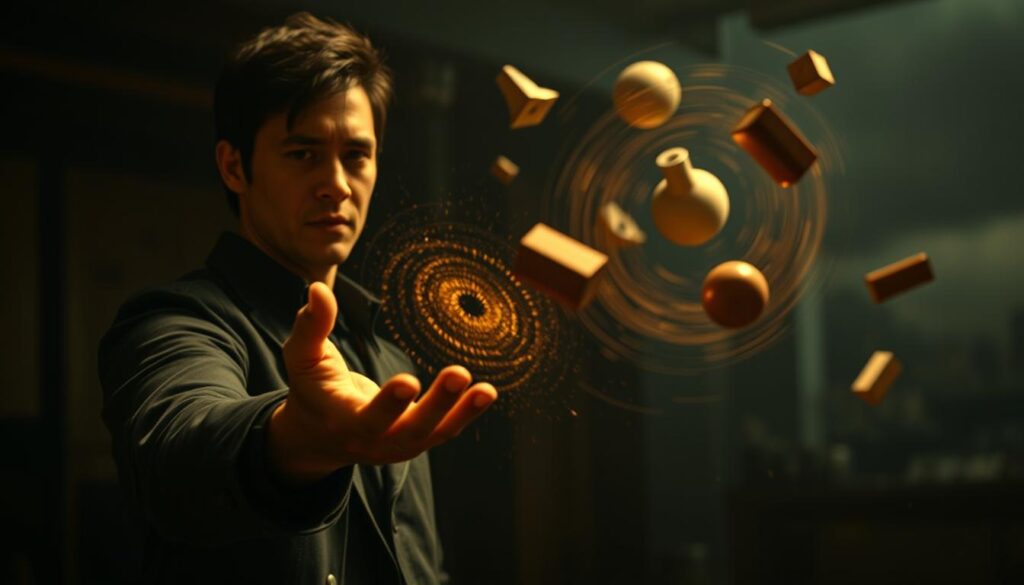
Stephen King’s Carrie (1976/2013) remains a cultural landmark. The bullied teen’s violent outbursts reflect societal fears of unchecked power. In contrast, Matilda (1996) portrays telekinesis as a tool for justice against cruelty.
Marvel’s comics and films feature iconic psychokinetic characters:
- Jean Grey: Her Phoenix Force arc shows the dangers of overwhelming ability.
- Scarlet Witch: MCU’s Wanda Maximoff bends reality in WandaVision.
- Martian Manhunter: DC’s alien hero uses telekinesis alongside other abilities.
Eastern and Western media offer distinct takes. Anime like Akira (1988) ties telekinesis to government experiments, while Stranger Things (2016–present) frames it as a weapon against supernatural threats.
| Title | Type | Portrayal |
|---|---|---|
| Chronicle (2012) | Film | Teens abuse powers, leading to tragedy |
| Mob Psycho 100 (2016) | Anime | Comedic yet philosophical take on ESP |
| The Men Who Stare at Goats (2009) | Film | Satirizes military psychokinesis research |
Despite scientific skepticism, these stories thrive. They tap into universal themes—power, control, and human potential—making telekinesis an enduring staple of speculative fiction.
Skepticism and Debunking Psychokinetic Claims
Behind the allure of telekinesis lies a trail of debunked myths. While stories of mind-over-matter captivate, rigorous skepticism reveals simpler explanations—from magic tricks to brain quirks.

Magicians and the Art of Illusion
James Randi’s exposés showed how magicians replicate “psychic” feats. Uri Geller’s spoon-bending? Thread manipulation. Metal switches and cold reading create illusions of supernatural power.
Banachek’s Project Alpha infiltration proved even researchers can be fooled. His team posed as psychics, using basic tricks to deceive parapsychologists for years.
The Role of Cognitive Bias
Why do people believe? Key biases play a role:
- Confirmation bias: Remembering hits, ignoring misses in psychic readings.
- Barnum effect: Vague statements feel personal (e.g., “You’re hiding creativity”).
- Ideomotor effect: Unconscious movements explain Ouija board “answers.”
| Debunking Method | Example | Outcome | |||
|---|---|---|---|---|---|
| Magic Replication | Randi’s spoon-bending demo | Exposed fraud in 1970s TV specials | |||
| Video Analysis | Wiseman’s 1995 study | Viewers misinterpreted staged footage | Scientific Review | National Research Council (1987) | No evidence in 130 years of experiments |
Even the German skeptics’ tests with dowsers showed results barely above chance. As Hannah Brites notes, critical thinking unravels most effects attributed to psychokinesis.
Famous Cases and Controversies
From spoon-bending to CIA files, psychokinetic cases blur fact and fiction. Some people became legends, while others were exposed as hoaxes. Let’s dive into history’s most debated famous cases.

Uri Geller’s 1970s spoon-bending shows split opinions. Scientists at Stanford failed to replicate his feats under controls. Yet, his TV performances mesmerized millions. “I never claimed to be supernatural,” Geller later admitted.
Nina Kulagina, a Soviet housewife, fascinated the CIA. Her filmed demonstrations—moving objects without touch—were studied for Cold War potential. Declassified documents reveal skepticism: “No conclusive evidence of paranormal ability.”
- Chizuo Matsumoto: The Aum Shinrikyo cult leader exploited psychokinesis claims to manipulate followers.
- Soviet Programs: Declassified files show wasted millions on psychic spies with zero results.
- James Hydrick: His televised confession revealed how he faked telekinesis with breath tricks.
| Case | Claim | Outcome |
|---|---|---|
| Ted Serios | “Thoughtography” (mind photos) | Exposed: Hidden camera lens |
| MacArthur Study | $625K paranormal research | No proof found |
| Michael Shermer | Former believer | Turned skeptic after tests |
Penn & Teller’s “Psychic Bullshit” show dismantled myths with humor. Their reenactments proved how easily fraud fools even experts. As critical thinking advocates note, extraordinary claims need extraordinary proof—still missing after decades.
Conclusion
Despite decades of fascination, psychokinesis remains unproven by modern science. Studies like Princeton’s PEAR Lab found tiny anomalies, but none passed rigorous replication. The human mind craves wonder, often mistaking tricks for truth.
This cultural fascination isn’t harmless. From cult leaders to fraudsters, pseudoscience exploits hope. Yet, ongoing research explores if quantum processes or brain signals could someday explain such claims.
For now, critical thinking is key. The wider world needs tools to separate fact from fiction. Whether future neuroscience unlocks new abilities or not, skepticism keeps us grounded.