

This Ultimate Guide tracks how a Renaissance pastime became a modern tool for insight while staying grounded in what scholars can verify.
Originating in 15th‑century northern Italy, the deck began as a trick‑taking game with four suits, a series of 21 trumps and the Fool. The first documented trionfi appears in Florence around 1440, and luxury sets like the Visconti‑Sforza show early artistry.
The game traveled across Europe, creating local decks and rules. In places such as France and Austria the pastime stayed common, while in English‑speaking countries it shifted toward divination and readings by the late 1700s.
This guide previews: the Italian roots, how decks spread, the anatomy of suits and trumps, regional play, the rise of occult meanings, and how modern communities use decks both for play and personal insight.
Key Takeaways
- Decks began as 15th‑century Italian trick‑taking games with trumps and a Fool.
- Early luxury examples include the Visconti‑Sforza; printed decks later made them widespread.
- The set’s structure let it serve both gaming and symbolic uses over time.
- Across Europe the pastime evolved into regional games and, later, divinatory practice.
- Understanding origins helps people evaluate modern claims and enjoy both play and practice.
Why Tarot’s Past Matters: Setting the Stage for an Ultimate Guide
Knowing when and where these packs began gives readers a firmer footing for interpretation. That clarity helps separate verified 15th‑century Italian origins from later mythmaking.
“Much of the occult history attached to these decks was a later construction,” notes scholar Michael Dummett.
Museums and archives provide the factual backbone. Objects like painted Renaissance sets and later printed runs trace design changes and continuity. This record makes it possible to link courtly commissions and printed patterns across centuries.
The deck’s structure also matters. Its suits and trumps worked for a game and later provided a scaffold people used for spiritual and psychological interpretation.
- Renaissance imagery—virtues, classical motifs, moral scenes—gave intuitive resonance.
- Understanding playable rules and layered symbolism improves modern readings.
- Appreciating context leads to nuanced interpretation and healthy skepticism.
| Aspect | Evidence | Why it matters today |
|---|---|---|
| Origins | 15th‑century Italian trionfi decks (court records, surviving sets) | Grounds modern claims in dated, verifiable events |
| Design changes | V&A and museum collections of painted and printed packs | Shows continuity and regional variation in imagery |
| Structure | Suits, trumps, Fool used in gameplay | Explains how mechanics became symbolic language |
| Lineages | Florence, Ferrara, Milan trump orders and patterns | Influences modern decks and readings |
As you read on, you’ll see how specific lineages shaped orders and imagery that still ripple through modern practice. For a practical guide to modern readings and decks, explore this resource on tarot.
From Playing Cards to Trionfi: The Italian Roots of Tarot
By the mid‑fifteenth century, Italy had reshaped European suit traditions into richly painted decks used at court.
Mamluk playing cards and the arrival of suits in Europe
Imported playing cards from Mamluk lands brought a four‑suit system to Europe. Italian makers adapted those suits into batons, coins, cups, and swords.
Early Italian decks: Visconti‑Sforza, Sola‑Busca, and courtly culture
Surviving luxury examples like the Visconti‑Sforza show fine painting, heraldry, and bespoke imagery made for patrons. The Sola‑Busca of the 1490s pushes classical motifs and unusual scenes.
These handmade packs were status objects before printing widened access. Cities such as Florence, Ferrara, Milan, and Bologna became innovation centers in the 1440s and later.
Trumps, the Fool, and the birth of tarocchi as a card game
Adding a sequence of 21 trumps and the Fool transformed ordinary suits into tarocchi for trick‑taking play. Some variants—like Visconti di Modrone—included virtues, while Minchiate later expanded with elements and zodiac figures.
The Italian template set an order and style that spread across Europe and evolved into many local games. For a focused look at one trump’s modern interpretation, see this discussion of the Chariot.
Propagation Across Europe: Orders, Names, and Local Games
Mass printing and the Italian Wars sent printed packs beyond Italy, turning luxury workshop products into common household sets. This shift made decks affordable and portable, and soldiers and traders helped move designs across borders.
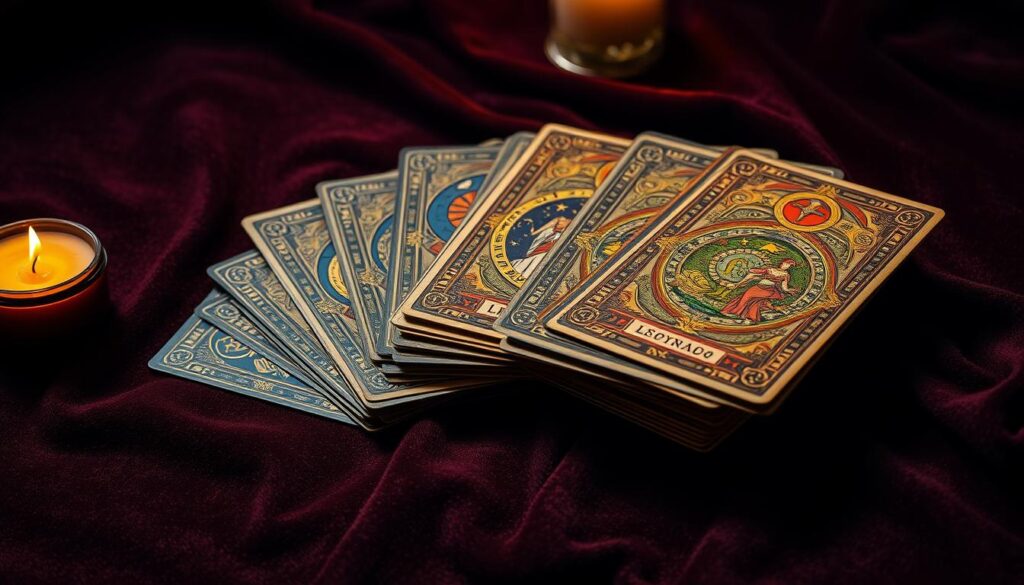
Printing, conflict, and the Marseille standard
Printers reproduced popular imagery, and Milanese models traveled into France and Switzerland. The result was a durable visual style that printers later labeled the Tarot de Marseille.
Regional trump orders and living traditions
Scholars note clear lineages. Florence and Bologna often placed the Angel high in their sequence. Ferrara preferred the World highest, with Justice and the Angel following.
Milanese order ranked the World then the Angel, a pattern reflected in Marseille types. These different orders shaped how people played a trick-taking game and how later readers weighted certain images.
Names, markets, and vanished lineages
As names shifted from trionfi to tarocchi or tarock, printers adapted to local tongues and markets. Some lineages, such as a Franco‑Italian Belgian stream, faded by 1800 as tastes and politics changed.
- Printing broadened access and standardized imagery.
- Order varied regionally and affected both play strategy and later interpretation.
- Market forces decided which visual families survived into modern decks.
Anatomy of the Tarot Deck: Suits, Arcana, and Symbols
A clear look at suits and trumps shows how practical play informed layered symbolism. A full pack has 78 pieces: 22 major arcana and 56 minor arcana that mirror everyday life.
Major arcana: archetypes and key figures
The major arcana present archetypal scenes from the Fool to the World. Names and numbering vary by tradition; the High Priestess is a common touchstone of intuition and hidden knowledge.
Minor arcana: suits and everyday scenes
The minor arcana split into four suits: swords, cups, coins, and batons. These suits map to the elements—air, water, earth, fire—and shape how meanings are read.
Social classes, trumps, and the Fool
Some scholars propose suits once reflected social strata, a useful historical lens for modern psychological readings.
“In games, trump cards and the Fool had definite roles; in readings they carry symbolic weight.”
- Structure: 78 total pieces split into majors and minors.
- Function: Trumps outrank suits in play; the Fool can excuse a play.
- Practice: Fully illustrated minor pip scenes (RWS) made intuitive interpretations easier.
Look at number progressions, suit patterns, and scene details. Reading arcana cards in combination reveals richer meanings than memorized keywords alone. For an example focused on cups, see the Knight of Cups.
Regional Tarot Games and Deck Families You Can Still Play
From France to Italy, living traditions keep these decks in use. Small clubs and national bodies run tournaments and casual meetups that welcome new players.

French-suited traditions
Tarot Nouveau (78 cards) drives France’s modern scene and is the nation’s second most popular game since the 1950s.
Central Europe favors 54‑card formats like Industrie und Glück and the animal-themed Adler‑Cego. These packs suit regional rules and faster play.
Italian and Italo‑Portuguese families
Italian play survives in several forms. Tarocco Piemontese uses 78 pieces, Bolognese runs 62 with unique trump ranks, and Siciliano uses a 64‑card, Italo‑Portuguese suit system.
Minchiate’s expanded arcana
Florence’s Minchiate (c. 1540s) grew to 97 cards by adding virtues, four elements, and the zodiac. It’s an example of local taste expanding a deck’s scope.
| Region | Common Pack | Cards | Play style |
|---|---|---|---|
| France | Tarot Nouveau | 78 | Social and competitive trick‑taking |
| Central Europe | Industrie und Glück / Adler‑Cego | 54 | Regional rules, fast play |
| Italy | Piemontese / Bolognese / Siciliano | 78 / 62 / 64 | Local tournaments and home games |
| Florence (historical) | Minchiate | 97 | Expanded ceremonial play |
“Try learning one regional rule set online—following suit, using trumps, and the Fool as an excuse makes the game click quickly.”
Tarot Card History: From Game to Divination in the 18th Century
Around 1750 a few annotated lists started to attach fixed meanings to specific trumps and suits. This marks the first clear evidence that playing cards were used as tools for interpretation rather than only for play.
Early cartomancy notes and Etteilla’s Egyptian-themed deck
By the 1780s Antoine Court and Jean‑Baptiste Alliette (Etteilla) popularized esoteric use in Paris. Etteilla published instructions and issued the first purpose‑built occult deck with an Egyptian frame around 1789.
His books offered spreads, assigned meanings to major arcana and pip sequences, and treated the deck as a systematic tool for readings.
Debunking myths: scholarly consensus on 15th‑century origins
Despite Etteilla’s Egyptian marketing, scholars agree the pack was invented in 15th‑century Italy as a game. No reliable evidence ties the designs to ancient mystery schools.
“Written guides in the late 18th century created the divinatory grammar we use today.”
| Key Moment | What Changed | Why It Matters |
|---|---|---|
| c.1750 notes | Annotations tie images to meanings | Started systematizing readings |
| 1780s Etteilla | Published manual and occult deck | Popularized divination and Egyptian imagery |
| Scholarly review | Documentary proof of Italian origin | Helps separate invention from myth |
Recognizing this 18th century pivot helps readers see modern systems as creative overlays on an older game structure. For a focused look at a modern interpretation, see the Queen of Pentacles discussion on Queen of Pentacles.
The Order of the Golden Dawn and the Rider-Waite-Smith Revolution
In the late 19th century, a British esoteric circle gave the deck a new, mapped grammar that fused symbolism with mystical systems.
Éliphas Lévi reframed the pack in 1861, naming the Major and Minor Arcana and linking them to Kabbalah and numerology. His work made the set useful not just for play but for ritual and study.
Order Golden Dawn correspondences
The Hermetic order golden dawn codified links between Hebrew letters, planets, zodiac signs, and elemental suits. Members used these correspondences in study and ceremony.
Waite, Smith, and a new visual language
A. E. Waite and Pamela Colman Smith, both in the order golden dawn, created the Rider‑Waite‑Smith deck in 1909–10.
Waite guided major arcana design while Smith painted fully illustrated minor arcana scenes. Her images gave readers clear visual narratives.
How illustrated pips changed readings
Before, pip cards showed suit symbols and numbers. Smith’s scenes added action, emotion, and context.
Illustrated pip cards made it easier to read combinations, invent stories, and trust intuition when using tarot for reflection.
“The RWS deck became a global template, shaping countless modern decks while coexisting with Marseille types.”
| Influence | What changed | Lasting effect |
|---|---|---|
| Éliphas Lévi | Named Major/Minor Arcana; linked to Kabbalah | Framework for occult readings and correspondences |
| Order golden dawn | Codified letters, astrology, elements | Standard reference for ritual and interpretation |
| Waite & Smith | Full illustrations for minor arcana | Visual storytelling that shapes modern meanings |
Today, the Rider‑Waite‑Smith model guides many designers and readers. For practical layouts and spreads that use this visual approach, see this guide on tarot spreads.
Tarot in Modern Times: Readings, Communities, and New Decks
Digital platforms have reshaped how people share spreads and interpret images. Social feeds, forums, and livestreams connect beginners and pros. Daily draws, collaborative posts, and short tutorials make reading approachable.
Online interaction and contemporary interpretation
Forums and apps host practice groups. Members post images, discuss suits like cups, swords, and coins, and offer feedback on a card reading.
New decks, themes, and how people use them
Designers remix RWS, Marseille, and hybrids into art, pop culture, and niche decks. These releases invite personal resonance and creative prompts for reflection rather than prediction.
“Modern reading styles range from psychological coaching to simple mindfulness prompts.”
| Community | Typical Use | Why it matters |
|---|---|---|
| Social media groups | Daily draws, live readings | Fast feedback and shared learning |
| Local clubs | Traditional play and study | Keeps the original game alive |
| Museums & libraries | Digitized decks for study | Compare old imagery with new decks |
Ethics matter: always get consent, set clear boundaries, and frame interpretation as a tool for insight. For a focused example of modern meaning, see the three of swords interpretation.
Conclusion
A traceable 15th‑century Italian origin anchors the deck, yet its journey spans many eras and uses. The documented shift in the 18th century turned a game into a tool for interpretation.
Symbols kept their power because they reflect shared human themes. Over time, trump and trump cards moved from play mechanics to central images in interpretive systems.
Examples of vitality include tournament play in France and Austria, contemporary artists’ decks, and lively online study groups. Try comparing two traditions, testing a simple three‑card spread, or learning a regional game as an example of playful roots.
Balance learned context with personal exploration. That mix keeps the set relevant across centuries as a flexible tool for insight, storytelling, and life.