
This concise guide lays out the core language practitioners use to describe sessions. It explains how the term remote viewing took shape in the early 1970s and why precise wording matters today.
We define key words used by military projects and modern researchers. Short, clear entries help readers grasp how people label sensations, impressions, and task results. This makes the field less puzzling for newcomers.
By clarifying these terms, the article builds a firm base for deeper study. You will see how historians, scientists, and explorers catalog the act of viewing distant subjects. For context on related capabilities, check a concise piece on psychic superpowers.
Key Takeaways
- Learn the main words used in controlled remote viewing terminology and definitions.
- The phrase remote viewing was coined in the early 1970s to mark a distinct practice.
- Clear terms help compare military work and private research.
- Simple labels let newcomers follow session reports and studies.
- This introduction prepares you for deeper, evidence-based discussion.
Understanding Controlled Remote Viewing Terminology and Definitions
Lyn Buchanan shaped a formal program that turned intuitive sensing into a step-by-step method. His model came from military work and set strict protocols to gather impressions with minimal bias.
Practitioners must learn specific labels so every session stays consistent and measurable. Training reduces guesswork, helps spot noise, and keeps the mind from steering raw data.
The method differs from general psychic practice because it relies on stages that guide data capture. This staged approach improves repeatability, supports clearer reporting, and makes peer review easier.

| Term | Short Meaning | Session Impact |
|---|---|---|
| Ideogram | Quick sketch of first impression | Speeds initial data capture |
| Gestalt | Overall shape or feel | Guides detailed follow-up |
| Analytical overlay | Mind’s interpretation slip | Flag to pause, reset |
- Learn core words to stay objective.
- Follow the staged method for cleaner results.
Core Concepts of Consciousness and Perception
Consciousness and perception form the backbone of how people notice and interpret subtle cues. This short section outlines the mental ground rules that shape advanced perceptual work.
Conscious Mind
The conscious mind is the part of the brain that handles awareness, focused thought, and comprehension of outside matters.
It sorts sensory input, labels experience, and checks for consistency. This sorting controls what information reaches deeper layers.

Altered States
Altered states arise through various means, from meditation to binaural beats. These shifts change how the brain filters impressions.
Researchers study how the mind processes information when it moves away from normal wakeful awareness. The goal is to improve the ability to access deeper subconscious layers.
Learning the mental process for shifting awareness is a practical prerequisite for advanced perceptual exercises. For related abilities, see clairvoyant abilities.
| Aspect | Conscious Mind | Altered States |
|---|---|---|
| Main Role | Focus, analysis | Reduced filtering, broader input |
| Typical Method | Deliberate thought, attention | Meditation, sound, breathwork |
| Effect on Data | Structured, labeled | Loose impressions, raw signals |
The Role of the Remote Viewer
Skilled practitioners use disciplined steps to shift attention and capture information about a place, event, or thing far away. A remote viewer is a person trained to extract data without relying on the five normal senses.
The primary role of the viewer is to act as a conduit. They follow a strict protocol that guides how impressions are noted, sketched, and labeled. This means the session stays focused on the target and not on personal guesswork.
This ability to perceive across space and time is what separates a professional remote viewer from casual psychic readers. Professionals practice methods to keep intuition on task and to flag any stray thoughts.
- Conduit role: receive and record raw impressions.
- Structured protocol: steps reduce bias and improve repeatability.
- Focused techniques: mental checks keep imagination at bay.
Defining the Target and Site
Naming the site and its role gives the session a concrete focus that reduces guesswork. A clear label helps the viewer lock attention on one thing at a time.
Target Location
The target is the specific person, place, or thing assigned as the object of attention during a session. A target site is the physical location the remote viewer attempts to describe.
Keep the label simple. Short, concrete tasking limits drift and keeps reports useful across time.

Gestalt
The gestalt gives the intended target as a whole. It offers a single, holistic impression that guides follow-up probes.
Start by noting shape, mood, and dominant form. This umbrella view steers later detail work toward the correct place in space.
Ideogram
An ideogram is a quick mark made at the session start. It links the viewer to the target site and anchors the mind to the target form.
Use the ideogram to begin focused viewing, then expand into words and sketches. For related practice on directing subtle intent, see how to send healing energy.
In-Session Mental Processes
Maintaining a clear inner field helps the viewer capture impressions without premature labeling. In a remote viewing session this focus prevents the conscious mind from reshaping raw signals.
During a viewing session the practitioner records impressions of a person, place, or thing as they arise. Short notes, quick sketches, and simple words hold the first data in its original form.
A skilled remote viewer spots when analysis slips in. They pause, mark the thought as an edit, and return to sensing. This habit protects the integrity of the information stream.
Staying present lets the viewer navigate apparent gaps in time and space. The process keeps the flow manageable so the session yields analyzable results after it ends.

- Set clear focus before the session starts.
- Record immediate impressions without labels.
- Flag analytic intrusions, then resume sensing.
- Format notes so data can be reviewed later.
| Phase | Main Action | Outcome |
|---|---|---|
| Initial | Capture ideogram and first impressions | Raw data in basic form |
| Middle | Expand sensory detail, avoid labels | Rich, low-bias information |
| Close | Organize notes for analysis | Actionable session record |
Clear process and steady focus make each session useful. Good technique turns fleeting impressions into reliable data for later study.
Managing Analytical Overlay and Interference
Disruptive mental chatter can twist raw impressions into a convincing but false narrative. That tendency is the main challenge for anyone trying to keep a session pure.

Analytical Overlay
Analytical overlay (AOL) happens when the brain rushes to label a signal using past knowledge. This turns fresh data into a guess and reduces accuracy.
A skilled remote viewer learns to mark those moments, pause, and return to sensation. That habit protects the integrity of the viewing session.
Castle Building
Castle building describes how the mind assembles a story around bits of input. The story feels coherent but often includes added detail that never came from the target.
To improve accuracy, a viewer must spot these constructions and set them aside as part of ongoing development. Doing so keeps the session focused on raw impressions rather than imagined plots.
- Identify overlay early.
- Pause, label, then resume sensing.
- Practice to reduce bias during each session.
Understanding Tasking Protocols
How a target is posed shapes the kind of information a viewer receives. Tasking sets the exact instruction a person will follow so the outcome is measurable. Good tasking limits background knowledge to avoid subtle influence.
A strict protocol often uses blind or double-blind methods. This ensures the person conducting the session cannot leak cues. It also protects the integrity of a remote viewing test.
During a remote viewing session the protocol controls how the target is presented. That prevents accidental hints and keeps the work focused on raw impressions.
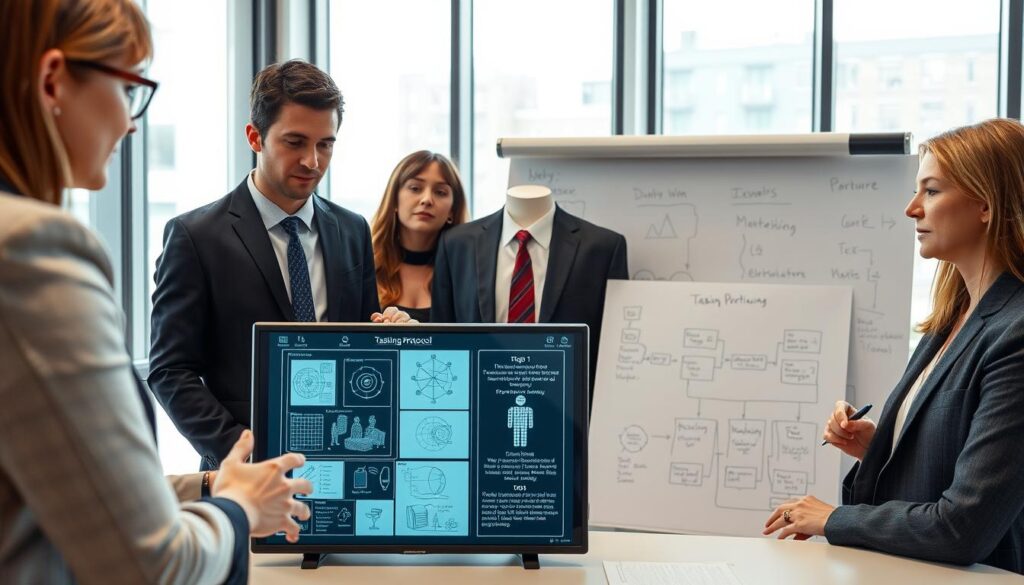
Well-formed tasking makes the assignment concise and verifiable. Researchers can then evaluate whether the session produced reliable data.
| Element | Purpose | Outcome |
|---|---|---|
| Tasking wording | Frame the target and limits | Clear, testable prompt |
| Blind protocol | Remove presenter cues | Reduced bias in results |
| Evaluation method | Compare report to truth | Quantified test score |
Data Collection and Recording Methods
Consistent record keeping turns fleeting sensations into usable research data. Good notes capture what the viewer senses at each moment. That practice makes later analysis possible and repeatable for research purposes.

Descriptive Words
Write every impression, even single words. The viewer should list textures, colors, moods, and short nouns as they appear. These descriptive words form the raw information that anchors a session.
Keep a clear record. The record of a remote viewing session serves as the primary source for evaluation. Organized logs let a team compare notes about the same target across sessions.
- Capture first impressions without judgment.
- Use concise labels so entries stay consistent.
- Timestamp each line to aid later review.
For related practice on documenting subtle impressions, see tarot card reading services. Careful collection supports reliable results and helps researchers use the session data for many purposes.
Feedback and Session Evaluation
Feedback closes the loop by showing which impressions matched the intended target. It is shared after the official end of a session so the viewer can learn without bias during the run.
Effective evaluation helps the remote viewer compare notes to reality. The tasking manager often gives structured feedback that highlights accurate details and points out interference or analytic overlay.
“Good feedback is a clear mirror: it shows success, exposes errors, and points the way to better technique.”
Reviewing results is part of the training process. By studying feedback, a viewer refines the process and improves performance in future viewing session work.
- Receive feedback after the official close.
- Note accurate impressions and common errors.
- Adjust practice based on findings.
| Item | Purpose | Outcome |
|---|---|---|
| Feedback report | Show actual target details | Clear comparison for learning |
| Tasking review | Assess instruction clarity | Better future task phrasing |
| Evaluation notes | Track trends across sessions | Steady skill improvement |

Historical Context of Remote Viewing Programs
In the 1970s a few labs began testing whether trained people could report accurate information about distant targets.
Ingo Swann suggested the term “remote viewing” in December 1971, and that idea moved quickly into funded experiments. Governments and researchers wanted to know if impressions could be turned into useful data for operational purposes.
Stargate Project
The Stargate Project ran from 1975 to 1995 and received roughly $20 million in funding. It was a government program that explored military uses of perceptual experiments.
Personnel were recruited to test whether a trained remote viewer could provide actionable information about a person, place, or thing across space and time.
Stanford Research Institute
Researchers at Stanford Research Institute, notably Russell Targ and Harold Puthoff, were key figures in early development. Their experiments shaped protocols for tasking and data collection.
These experiments used specific protocol steps to reduce bias while aiming to gather information about a target regardless of distance.
“The effort converted scattered reports into repeatable tests, even if debate over results persisted.”
| Program | Years | Focus |
|---|---|---|
| Stargate Project | 1975–1995 | Military intelligence experiments using trained personnel |
| Stanford Research Institute | Early 1970s | Laboratory experiments, protocol development, initial recruitment |
| Field Trials | 1970s–1980s | Operational tests of tasking and data evaluation |
- The program era showed how a term, formal testing, and funding shaped later development.
- Although the project ended in 1995, the event remains central to the history of these programs.
- For a detailed overview of methods and modern practice, see remote viewing.
Scientific Perspectives and Skepticism
Empirical scrutiny focuses on whether reported impressions survive blind testing and independent replication.

Scientific critics often point to inconsistent results and possible sensory cues as core problems. Reviews highlight that many positive outcomes fail to repeat under strict controls.
Notable work includes the PEAR lab at Princeton, which ran 336 formal trials by 1989 and reported significant findings. Those results sparked debate about methods and interpretation.
In 1995 Ray Hyman and Jessica Utts carried out a CIA-funded retrospective evaluation of the Stargate Project. Their report weighed evidence, procedural flaws, and the need for clearer theory.
Common concerns are weak protocol, experimenter influence, and absence of a reliable mechanism. Skeptics say these gaps keep the ability from moving into mainstream knowledge.
| Study | Years | Noted outcome |
|---|---|---|
| PEAR lab | 1979–1989 | 336 trials; debated findings |
| Stargate review | 1975–1995 | Mixed results; procedural issues |
| CIA evaluation | 1995 | Retrospective analysis by Hyman & Utts |
Bottom line: The field keeps drawing attention, but clear, repeatable tests and tighter tasking are needed before broader scientific acceptance of the data or use.
Distinguishing Remote Viewing from Related Phenomena
At first glance, clairvoyance and trained perception look similar, but they differ in process and intent.
Clairvoyance is often described as an innate ability to gain information about a person, place, or thing without normal senses. It usually appears as spontaneous insight or sudden images that a person receives.
Trained viewing uses a defined protocol so a viewer follows steps to describe a target site over time. The method is taught, practiced, and repeatable in ways that simple psychic flashes rarely are.
Practitioners note key contrasts: one is broad ability, the other is a focused form that relies on set means and structure. Knowing this helps teams choose training, tasking, or research paths.

| Aspect | Clairvoyance | Trained Viewing |
|---|---|---|
| Origin | Often innate | Learned skill |
| Focus | Any person or event | Specific target site |
| Method | Spontaneous impressions | Protocol-driven steps |
- Clarity about the term helps avoid confusion.
- Choose practice based on goals: exploration or structured reporting.
Conclusion
In summary, this guide clarified core phrases, steps, and historical notes so readers can weigh evidence and method. The entry on remote viewing aimed to set clear expectations about what trained practice looks like and why careful record keeping matters.
The material showed how each session uses set protocols to limit bias and collect usable impressions. That structure helps students, researchers, and curious readers compare reports in a repeatable way.
At this point, the article reaches its main point: disciplined method, honest evaluation, and open inquiry make the topic worth study whether one is skeptical or curious. For a related angle on subtle practice, see how energy healing works remotely.