

We’ll sort fact from myth and show which claims match historical records. This short intro lays out the plan and sets fair limits on certainty.
In 1555 the book Les Propheties appeared as hundreds of four-line quatrain verses. Readers across the centuries have linked lines to later events. Some ties feel tight. Others seem forced after the fact.
This article is a case-by-case list. You can scan top examples, then read deeper on items that catch your eye. We’ll pair famous lines with the historical scene and explain our method.
Expect a balance of story and analysis: the exact wording, the timing, and how well a line fits an alleged event. Along the way we note why so many people keep chasing claims about the future.
Key Takeaways
- Les Propheties (1555) uses compact quatrains that invite wide interpretation.
- We judge claims by wording clarity, timing, and fit to the event.
- Some matches are plausible; many are retrofitted after outcomes.
- This listicle presents examples first, then context for each.
- For more related readings, see a guide on psychic predictions.
Setting the stage: Nostradamus, his quatrains, and why people still care
The quatrain form made Nostredame’s verses easy to copy, translate, and debate across years.
Les Propheties began as a small book of four-line poems that printers reissued for centuries. Modern editions still sell, and that circulation keeps the lines alive for new readers.

Believers point to specific lines as a clear reference to later events. Skeptics reply that the language is broad and often read backward to fit a story.
The original text mixes French, Latin, and older forms. That blend makes translation tricky and gives editors room to shape meaning. Historians date editions, compare variants, and test whether a passage could truly foretell events in later years.
People return to these quatrains in uncertain time because short, symbolic lines ask less of the reader and promise more. If you want to explore how readers train their instincts, see a guide to develop psychic abilities.
In the rest of this piece we set a clear method: strong wording, reliable dating, and a solid link to an event are required before we say that nostradamus predicted or can predict future happenings.
How to read the prophecies: ambiguity, translation, and retroactive fitting
A careful reader soon notices how short lines invite many readings. The original text uses tight imagery, so a single quatrain can hold several meanings. That makes a line easy to match to different events across centuries.

Vagueness and multiple meanings
Brief quatrains leave gaps. Readers fill those gaps with modern events. That process turns a fuzzy line into an apparent prediction.
Postdiction and selective reporting
After an event, people often hunt for a line that fits. This post‑event fitting is common and explains why many believe a match exists. Historians treat such fits as weak unless the link was documented before the event.
Mixed languages and archaic forms
The book mixes French, Latin, and older spellings. Translators must choose words, and small choices can change tone and meaning. The scholarly process checks dates, early readings, and rival senses before accepting a claim.
For a short guide to related reading, see best book on angel numbers.
Death of Henry II: “cage,” “lions,” and the fatal “field of combat”
A famous tournament in 1559 ended in a fatal accident that linked a royal joust to a vivid quatrain.
The scene: King Henry II rode in a friendly tilt against Gabriel de Montgomery. A lance splinter pierced the king’s visor—described by some as a “golden cage”—and a shard lodged near his temple. He later died from the wound.
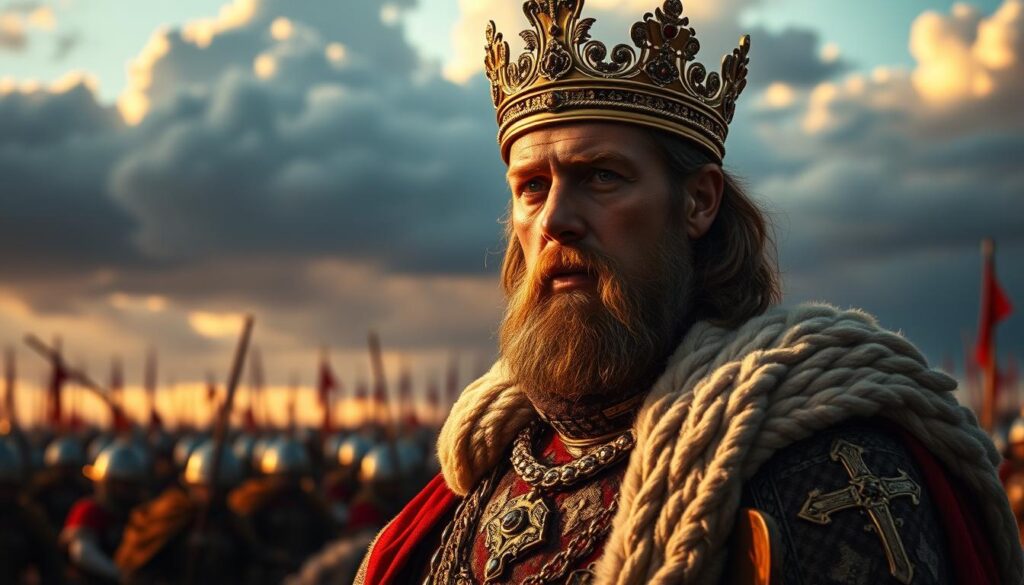
The joust, the visor “cage,” and the “young lion”
Believers point to words like lion, cage, and “field of combat” as strong links. The quatrain mentions a young lion facing an older figure, and readers see heraldic echoes in that image.
Historians note key doubts. Shields with lion motifs were common, and a tournament is not a full-scale battle or field combat in the strict sense. Still, the quatrain predates the event, so timing favors supporters.
“Two wounds made one” — commentators use this phrase to describe how lance splinters caused overlapping injuries and fatal bleeding.
- Eyewitness and medical accounts match the verse’s blood-and-wound detail.
- Symbolic words like lion are widespread enough to allow coincidence.
- The match is persuasive to many, but not definitive to all.
For a related reading on imagery in cards and knights, see a short note on the knight of cups.
The Great Fire of London: “the fire of ’66” and the ancient lady toppled
In September 1666 a single bakery blaze on Pudding Lane swelled into a citywide disaster that reshaped London.
The quatrain line about the fire of ’66 and an ancient lady toppled is often linked to this event. The city’s narrow streets, timber houses, and strong winds turned a small flame into a multi-day inferno.
Contemporary records show thousands of buildings lost and only a few official deaths listed. Historians debate the true death toll because records were incomplete and many victims were unrecorded.
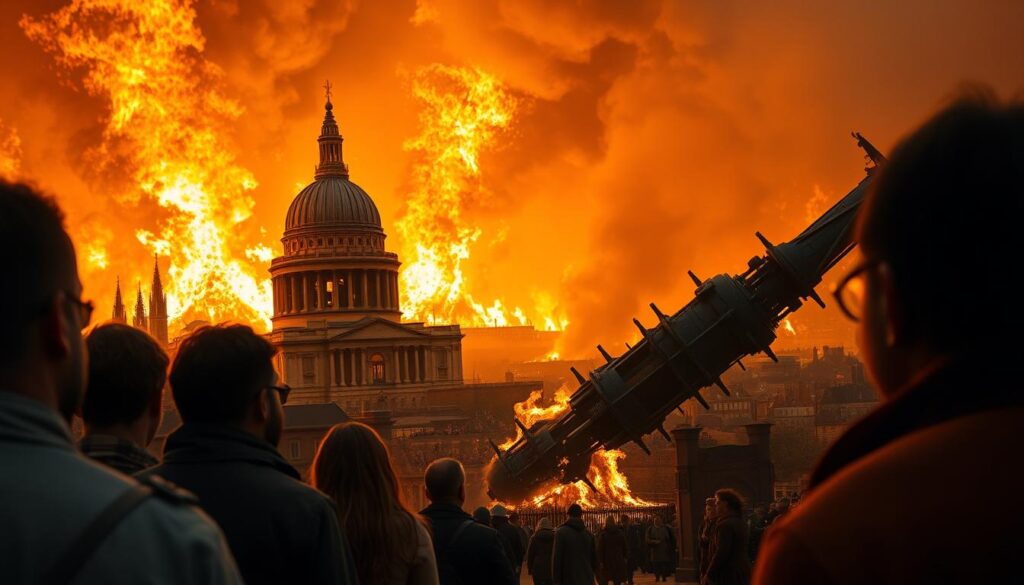
Some readers take the verse’s word blood literally, tying it to injury and death. Others read it figuratively: plague-bearing vermin burned, or the city’s lifeblood—its old halls and churches—was destroyed.
- The fire began on September 2, 1666, in Thomas Farriner’s bakery and spread fast.
- Wooden buildings and windy conditions explain the scale of the blaze.
- Incomplete records make casualty figures uncertain despite vast property loss.
“A spark became a flood of flames that changed a capital’s face.”
Overall, the quatrain’s date phrase gives the match weight, but the language is broad enough that critics say it could describe other major urban fires. For a related reading on symbolic number links, see a brief note on angel number 1919.
French Revolution: songs, chants, and demands that shook a monarchy
Voices rose in Paris in 1789, and those voices quickly became action. Ordinary people turned songs and chants into public pressure that targeted privilege and royal excess.
The storming of the Bastille in 1789 served as a catalytic moment. It was both symbolic and practical: an armory taken, a signal that the old order could be challenged.
References to a king and a battle in the quatrain map onto street fights, provincial uprisings, and the wider war that followed. Pamphlets, clubs, and newspapers amplified citizen demands and spread momentum fast.
Supporters point to timing and vivid imagery to call the line a prediction. Skeptics reply that broad language can fit many mass uprisings across years.
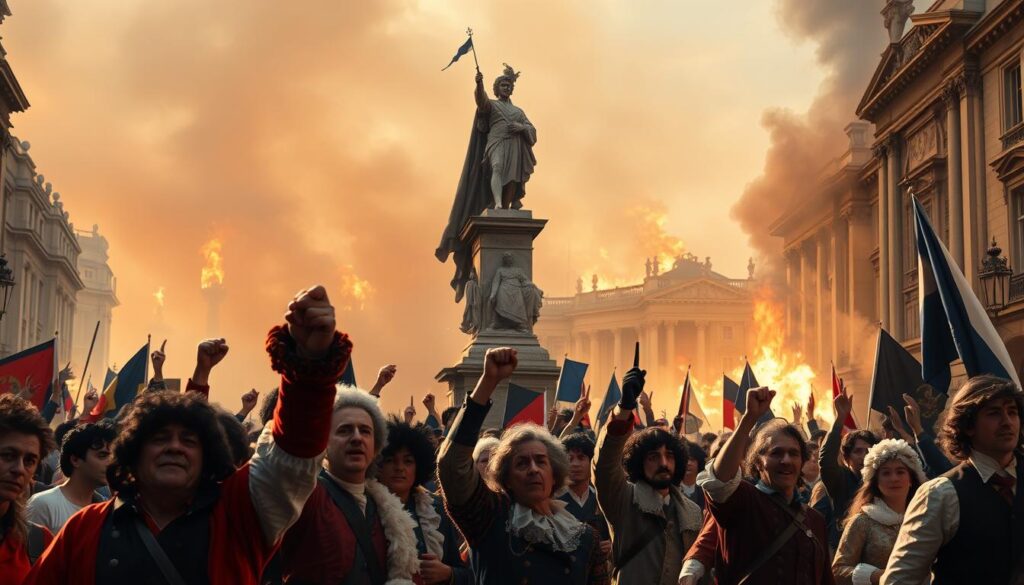
- The Bastille became a lasting symbol of resistance.
- Grassroots networks made scattered protests national in scope.
- Fiery metaphors describe both reform and the violence that followed.
In the end, the verse captures the spirit of the revolution well. Yet its loose phrasing also lets readers match it to other upheavals, so judgment depends on how strict you want your link to be.
Napoleon’s rise: Pau, Nay, Loron and the “great man” of more fire than blood
A single compact quatrain lists place‑names—Pau, Nay, Loron—that many readers treat as a clever anagram spelling “Napaulon Roy.”

Supporters point to that anagram as a striking link to a later great man. They also read the phrase “more of fire than blood” as describing energy and ambition over noble lineage.
“Pau, Nay, Loron”
His rapid success over a few years—from artillery officer to First Consul to Emperor—fits the image of a driven man whose rise forced European powers to react.
Yet caution is needed. The anagram can be arranged after the fact and the language is symbolic. Claims about Popes Pius VI and VII being denied or welcomed are woven into the story, but the verse itself stays sparse.
| Claim | Evidence | Strength | Notes |
|---|---|---|---|
| Anagram: Napaulon Roy | Names Pau, Nay, Loron in verse | Moderate | Requires reinterpretation and letter shifts |
| “More fire than blood” | Napoleon’s non-noble Corsican origin | Weak–Moderate | Fits many ambitious leaders, not unique |
| Papal episodes | Historical contacts with Pius VI and Pius VII | Weak | Quatrain lacks clear papal markers |
Overall, the quatrain yields a plausible match but not a decisive one. The anagram reading is clever. It leans toward retrofitting when judged strictly rather than serving as conclusive proof that a line foretold Napoleon’s career.
From kings to scientists: Philip II’s fortunes and Louis Pasteur’s discoveries
Power on the sea and breakthroughs in a lab both sparked readings that mix praise and doubt.
Philip II, the Armada, and the “young onion” adversary
Philip II enjoyed clear early success. Lepanto in 1571 was a major naval triumph that bolstered his prestige.
That high point later gave way to reversal. The 1588 Armada failed against England, bringing political strain, loss, and wider hardship and death for many sailors.
Readers point to playful terms like the “young onion” as a sly reference to rivals such as Henri IV. Translators and historians note the line can be read in several ways, so the link is intriguing but not decisive.
Pasteur celebrated, then “dishonored”: germ theory, vaccines, and controversy
Louis Pasteur is the man whose lab work changed medicine. He promoted germ theory and introduced pasteurization as a process to protect food and health.
For centuries his name symbolized scientific triumph; public praise treated him almost like a saint of medicine. Later scholarship, notably Gerald L. Geison, questioned aspects of his methods for the anthrax vaccine and suggested he relied on others’ techniques.
“Celebrated almost like a god, then shadowed by later critique”
Both cases show how brief lines invite broad reference. Royal setbacks, diplomatic shifts, and naval defeats can fit many verses. So can tales of a great lab worker whose fame changes with new evidence.
| Topic | Key event | Strength of match | Notes |
|---|---|---|---|
| Philip II | Lepanto (1571) & Armada (1588) | Moderate | Clear dates, mixed symbolism, naval reversal |
| “Young onion” reading | Henri IV link | Weak–Moderate | Playful translation, needs reinterpretation |
| Louis Pasteur | Germ theory, pasteurization, anthrax debate | Moderate | Major contributions; later critique affects legacy |
War and power in the 20th century: Hitler/Hister, De Gaulle, and atomic fire
A cluster of lines has been linked to the era of great armies, nuclear blasts, and political reinvention across Europe and Asia.
“Hister,” rivers crossed, and a rising German man
One quatrain uses the name Hister. Readers read it two ways: as a near-name for Hitler or as an old river name like the Danube.
Hitler’s birthplace and his oratory rise make the near-name tempting. The verse’s geography and talk of armies have been mapped onto battles and fields across Europe and the East.
Charles de Gaulle’s three roles
De Gaulle served as Free France’s leader, head of the provisional government, and later president of the Fifth Republic.
The neat count of three roles gives the match extra weight compared with vaguer lines.
Atomic blasts, the sky, and moral cost
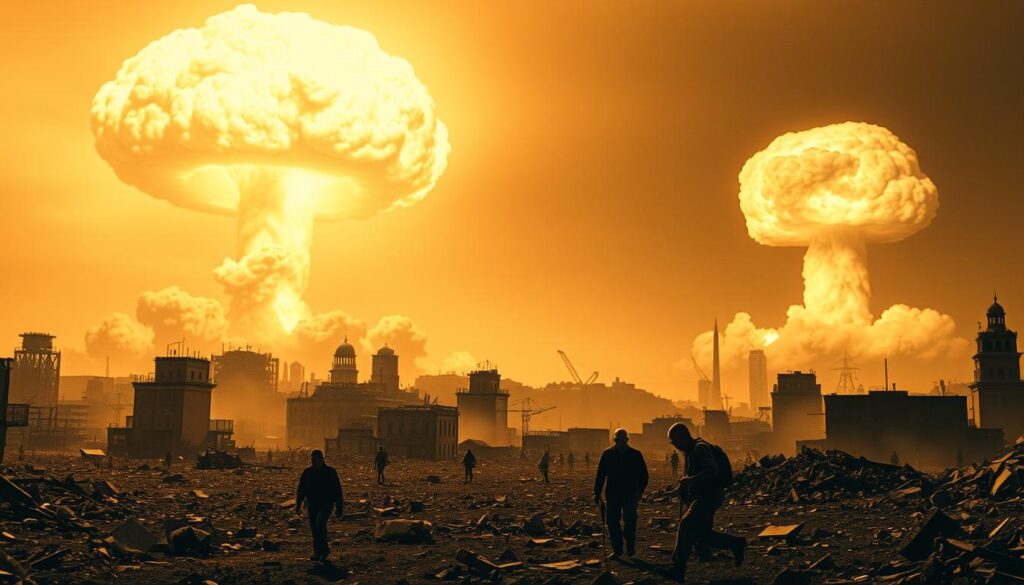
Lines about a “heavenly dart,” a stone in a tree, and a changed sky are often linked to the August attacks on Hiroshima and Nagasaki.
Observers tie mushroom clouds and sudden, terrible fire to that imagery and note the heavy blood toll on innocent people. Yet critics warn verses leave room for many wartime readings.
“Some matches feel specific; others still rely on hindsight and broad symbols.”
- Geography and names add plausibility.
- Imagery of sky and dart fits nuclear blasts.
- Overall, the wartime cases rank among the stronger but not conclusive matches.
America in crisis: assassination and a “great new city” on fire
When an assassination or an attack shakes a nation, poetic lines are pulled forward to make sense of shock. Two U.S. moments — a presidential murder and a mass strike on a skyline — have often been tied to brief quatrains.
JFK’s assassination: “from on high,” a “dead innocent,” and the mist
On November 22, 1963, John F. Kennedy was shot in Dallas. The fatal head wound came from above according to many medical reconstructions. Lee Harvey Oswald was accused and then killed in custody, and that sequence fueled lasting conspiracy talk.
Lines about a “dead innocent” and a sudden mist echo worries and unanswered questions that linger in public memory. Official inquiries narrowed key facts, yet doubt keeps the verse link alive for many.
New York on 9/11: “the sky will burn,” fire in a “great new city”
On September 11, 2001, hijacked jets struck the World Trade Center in New York, igniting massive fire and collapse that caused massive death and shock. Images of a burning sky and falling towers match the kind of symbolic language readers cite.
Large tragedies invite quick prophetic readings. Strong emotion can make a short line feel exact even when its wording is broad. For a further related read on cultural interpretations, see a note on ancient-aliens.

“Poetic lines meet public grief; the match can feel true without being specific.”
How we judged what did nostradamus predict correctly
We set a clear yardstick to separate striking matches from forced readings. Our goal is simple: test lines against concrete time, place, and independent records before calling a match real.
Matching lines to events vs. forcing the fit
Step one: date the text and verify early copies.
Step two: use reliable translations and avoid changing words to suit a story.
Step three: ask whether the verse fits without retrofitting details.
What many believe versus what evidence supports
Many believe vivid words—like cage, lion, or mention of fire and bombs—are proof. Skeptics point to vague language, translation quirks, and selective reporting.
“Pre-event documentation matters more than a clever post-event match.”
- Check clarity of wording and independence from translator choices.
- See if the verse existed in records before the event.
- Compare clean matches to stretches that force a link (field, field combat, or demands).
| Criterion | Why it matters | Strength of evidence |
|---|---|---|
| Pre-event source | Establishes timing and reduces retrofitting | High |
| Clear wording | Limits multiple interpretations | Moderate–High |
| Independent corroboration | Supports reading beyond poetic appeal | High |
| Symbolic language only | Often fits many events (e.g., assassination or general fire) | Low |
We also offer a quick checklist readers can use. Pair wording clarity with source date and independent records. That balances evidence against the natural pull of poetic narrative and shows where the strongest cases stand.
For related methods on interpreting sources and training judgement, see psychic techniques.
Conclusion
Many lines use vivid words—fire, sky, mist—that easily hitch to dramatic historical moments. Across a span of time, readers link a single quatrain to the great fire, the great fire london of ’66, and later scenes in new york and hiroshima nagasaki.
Some matches feel impressively aligned. Most depend on broad symbols—fire, death, a broken moon image—that travel across era and year. Mentions of assassination and lingering mist feed public interest and ongoing conspiracy debate.
Use a simple rubric: weigh specificity, timing, and independent corroboration before claiming any verse truly foretold an event. You can admire the literature and still favor an evidence-first view on whether nostradamus predicted a given moment.