
Michel de Nostredame is a name that links medical practice, poetry, and the idea of future reading.
Born in 1503, he worked as a physician and wrote the famous Les Prophéties, a book of 942 quatrains that shaped his reputation across time.
Scholars note his quatrains use mixed language and wide phrasing, which lets many map events to verses after the fact.
We’ll set the scene: his life, the years he published, why his name endures, and how readers tied verses to world events from fires to war.
Read on for a friendly primer that balances curious stories with historical fact and explains how the verses kept relevance through reprints and reinterpretation.
For a broader look at how later readers framed psychic claims and modern prediction culture, see this resource on psychic forecasts: psychic predictions.
Key Takeaways
- Nostredame was a 16th-century physician and author best known for Les Prophéties.
- His quatrains are vague and drew on older sources, letting readers match them to many events.
- Historians caution that reinterpretation after the fact shapes most claims about predictions.
- The book’s language and printing history helped it stay influential over the years.
- Understanding his work means balancing fascination with careful historical fact.
Who Was Nostradamus? From Physician and Apothecary to Astrologer and Author
Michel de Nostredame began life as a trained apothecary and practicing physician who treated patients during hard plague years.
As a student he left the University of Avignon when plague closed its doors and later studied at Montpellier. He was expelled for working as an apothecary, a manual trade banned by statutes. Personal death touched him early: his first wife and two children died in 1534, likely from the same disease he fought.

Plague doctor, almanacs, and the rise of an astrologer
He treated plague in cities such as Marseille and Salon-de-Provence and made remedies like “rose pills.” By 1550 he published almanacs that brought paying readers and elite patrons. That audience helped his name move from local healer to courtly astrologer.
Why quatrains and “Centuries” made his prophecies so flexible
In 1555 he issued a book of 942 quatrains grouped into Centuries. The mixed languages and stylized syntax made those short verses oddly timeless and open to many readings.
- His medical work gave credibility to some people.
- Printed works spread his ideas across France over the years.
- The organization by century helped readers link lines to later events in history.
How His Prophecies Worked: Quatrains, Sources, and Vague Language
The book’s four-line quatrains veil clear meaning with a patchwork of languages and classical style. This design made each short stanza easy to reframe across time and events.
Quatrains, mixed languages, and “Virgilianised” syntax
These four-line verses mix French, Latin, Italian, Greek, and Provençal. The odd syntax borrows a Virgilianised tone to obscure exact sense.
Arranged in centuries, the lines favor mood over detail. That allows readers to fit a few words to many moments later on.
Borrowed references and bibliomancy: historians’ view of his methods
Many scholars trace clear references to classical historians, medieval chroniclers, and recent manuals. These works supplied names, scenes, and imagery he could reshape.
Some evidence points to bibliomancy — opening sources at random to find a useful line. That method would turn shared material into fresh lines in a short book.
Why academics say prophecies fit many events after the fact
Critics note that vague words and borrowed material let readers map verses back to later happenings as a matter of fact. Professional astrologer rivals also questioned his comparative horoscopy.
Printing variations across editions change punctuation and phrasing, so a single quatrain can appear different over time. He even rejected being called a prophet, which adds nuance.
- Format: short quatrains arranged into centuries.
- Sources: clear borrowing from older historians and chronicles.
- Method: bibliomancy and collage-like assembly of material.
- Result: flexible verses that invite retroactive matches.
For a different side of mystical reading, see a recommended best book on angel numbers.
Famous “Hits” People Cite from History
Across centuries readers have pointed to several quatrains as matches for well-known historical events. Below are concise snapshots of the most-cited examples and why the verses feel, or fail to feel, specific.
The “young lion” and a fatal joust
Death of Henry II came after a joust in 1559 when a shattered lance pierced his eye and skull. A quatrain mentioning a “young lion” and “two wounds” fits for some readers.
Scholars note the verse refers to combat in battle, not a tournament, which shows how wording can be stretched to fit a tragic day.
The Great Fire readings
A quatrain with “twenty threes the six” is linked to the great fire london of 1666. Fans add the numbers to get 66 and point to London as the burning city.
But the verse mentions lightning while the blaze began in a bakery, so context clashes with the popular match.
Hister, a rise, and world war
Lines about a “child born of poor people” who will seduce a crowd and fight near “Hister” are often tied to adolf hitler and the rise of a tyrant before world war II.
Critics note “Hister” can mean the Danube, illustrating retrospective reading across years.
Two cities and scourges from the sky
“Within two cities… scourges” is read by some as Hiroshima and Nagasaki after air attacks. Mentions of famine, plague, and people put out by steel echo wartime devastation from the sky.
Assassination and a blamed innocent
A line about evil falling “from on high” and a “dead innocent” accused is applied to the JFK assassination and disputed guilt around the accused man.
Parliament, a king, and execution
Another verse naming a Senate or Parliament of London is linked to Charles I’s 1649 execution. This match appears more specific, which is why it often ranks among the strongest claimed hits.
“Readers across time layer their present crises onto short stanzas, making vague words feel precise.”
| Claim | Quoted Words | Historical Event | Strength of Match |
|---|---|---|---|
| Young lion | “young lion… two wounds” | Death of Henry II (1559) | Moderate — wording ambiguous |
| Twenty threes the six | “twenty threes the six; London” | Great Fire of London (1666) | Weak — imagery conflicts |
| Hister | “born of poor people… Hister” | Rise of adolf hitler / WWII | Moderate — name is debated |
| Two cities | “within two cities… scourges” | Hiroshima & Nagasaki (1945) | Moderate — evocative but general |
| Parliament of London | “Senate (Parliament) of London… king” | Execution of Charles I (1649) | Strong — relatively specific |
What He Actually Wrote Versus Later Interpretations
A single archaic word can send scholars and fans in very different directions. That happens when readers map a short stanza onto a modern figure or event.
From “Hister” to Hitler: rivers, names, and retrospective matches
Some quatrains use the old name Hister, a Latin term for the Danube. Later commentators read this as a reference to adolf hitler, showing how a single name can be retrofitted to a famous person.
Historians note this is a stretch. The original references come from older sources the author borrowed, so context matters more than sensational readings.
Lightning, fireballs, and bakeries: when imagery collides with facts
The claim linking a line to the great fire london rests on cryptic numbers and a city name. Yet other words in the same quatrain mention lightning or fireballs while the actual blaze began in a bakery.
Small editorial differences between editions change those words. That makes one quatrains reading feel convincing and another implausible.
- Fact: editions and borrowed references shaped many images.
- Work: single words often determine a match.
- Name: meanings shift when readers add later events.
“Close reading and source history often outweigh dramatic matches.”

For a view of how modern readers frame visions and dreams, see psychic dreams and predictions.
Did Nostradamus Predict Anything? Parsing Fact, Prophecy, and Pseudoscience
Measuring a line’s accuracy requires setting clear standards for what counts as a prediction. Historians and skeptics ask for dates, names, and context. Without those details, a verse stays poetic and open to many fits.
Prophecies, predictions, and how “accuracy” is measured
Experts separate broad prophecies from testable predictions. A prediction ties a claim to a date or event. A vague stanza does not.
That is why scholars compare quatrains to contemporary sources and to printed editions. Tiny textual changes across time can change meaning. Printing differences often decide whether a line seems specific or merely evocative.
Academic skepticism versus popular belief
Academic work finds clear borrowing from older texts, and critics note use of comparative horoscopy rather than supernatural sight. This view explains how many matches arise after known events and years.
Popular belief survives because stories are compelling and people seek patterns about the future. Both sides matter: treating these quatrains as cultural artifacts helps preserve curiosity while keeping claims tied to fact.
“Close reading and source history often outweigh dramatic matches.”
For a view of how modern readers frame supernatural claims and skill sets, see supernatural abilities.
The Broader Impact: Prophecies in War, Politics, and Popular Culture
When societies face sudden shocks, old verses often reappear as tools for shaping public mood.
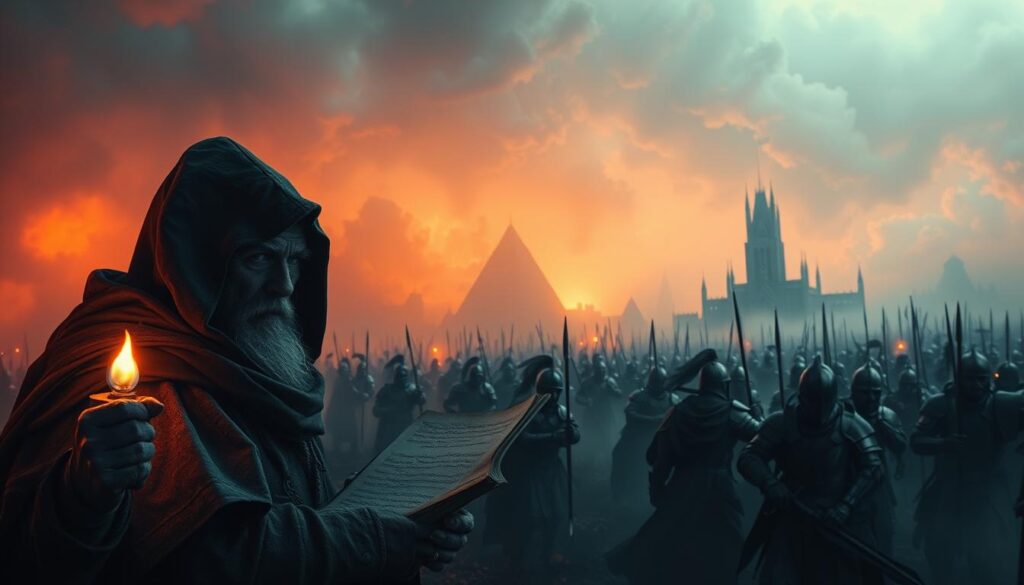
Quatrains in propaganda moved from a printed book into newspapers, radio, and staged events. Leaders in the Third Reich, including Joseph Goebbels, used Nostradamus-themed messaging during World War II to influence opinion and morale.
In modern times, extremists and some media outlets still invoke those short stanzas to spread ideas or create buzz. The lines became part of campaigns that aimed to frighten or comfort people, depending on the goal.
Why interest spikes after crises
Interest in prophecies surges after wars, pandemics, and disruptive events. People seek patterns, solace, and simple narratives when history feels chaotic.
That rise in attention helps explain why works from centuries ago keep returning to public view. The book’s long print life — more than 200 editions and some 2,000 commentaries — shows how the verses became a durable cultural part of the modern conversation.
“Old lines are often read as maps when the world seems to lose its bearings.”
- Propaganda use: quatrains repurposed in wartime and political campaigns.
- Media role: headlines and broadcasts amplify interest after major events.
- Cultural persistence: centuries of editions keep the material available for reuse.
For a related look at how fringe ideas enter mainstream media, see this examination of ancient-aliens narratives in modern culture: ancient aliens.
End-of-the-World Themes: Plague, War, and the “King of Terror”
Many quatrains return to images of burning cities, pestilence, and strange signs in the sky.
Recurring motifs include plague, war, cities aflame, and ominous marks that fall or cross the sky. These images reappear across a century of verses and link to broad fears about the end world and hard times.

1999 and later: failed doomsdays
A famous line about July 1999 and a “King of terror” from the sky sparked late-century panic. That day passed without the event, showing how vivid wording can fuel a false countdown.
“Dramatic imagery often outlives the date tied to it.”
- Cities and the sky appear because they symbolize sudden, visible change.
- References to plague and war echo real public worries in hard years.
- Stories like the great fire london persist even when details conflict with historical fact.
| Motif | Symbol | How readers use it |
|---|---|---|
| Plague | Illness sweeping a city | Mapped to pandemics and social collapse |
| Cities on fire | Smoke, flames | Linked to great fire and wartime bombing |
| Signs in sky | Comets, falling objects | Read as omens for a single day or a long-term end |
Takeaway: vivid quatrains shape fear about the future, yet striking imagery is not a dated forecast. After hard years, people remake these lines to explain loss and hope, not to prove a literal end.
Conclusion
,What lasts is a set of vivid quatrains that let readers map a line to many events across centuries. The appeal blends artful language with flexible imagery, not a steady record of dated predictions.
His background as a physician and apothecary and the 1555 book made his name part of history. Famous matches — from the great fire london to a cruel rise and assassination — depend on reading the verses after the fact.
Balance curiosity with evidence. Treat each prophecy as a cultural artifact: check the text, the sources, and the context. For modern takes on psychic work, see psychic readings.