

Telepathy describes the idea of sending information from one mind to another without using normal sensory channels. This introduction gives a clear, friendly glossary-style view so readers know what to expect.
We’ll cover the core meaning, pronunciation, and the 19th-century origin of the term. The piece balances popular fascination with a scientific outlook that notes weak evidence and replication issues in past lab tests.
People worldwide find the concept compelling because fiction shows dramatic powers and reported experiences promise deeper communication. Still, most controlled studies fail to rule out ordinary explanations.
This article previews classic experiments, practical descriptions of how some claim to use telepathy, and the common benefits people report—like closer connection and clearer communication—while stressing the difference between anecdote and controlled proof.
Key Takeaways
- Learn the basic definition and history of the idea.
- See why scientists remain skeptical based on past experiments.
- Explore claimed benefits and how they differ from evidence.
- Find clear terms and cultural examples for readers to follow.
- Keep an open but critical mind when examining claims.
- Check related resources like psychic superpowers for cultural context.
Telepathy: Meaning, Definition, and Core Concept
The Merriam-Webster definition calls telepathy “communication from one mind to another by extrasensory means.” This dictionary-grade line sums what proponents mean: bypassing sight, hearing, and touch to move ideas or feelings.
In practice the concept explores the claimed ability to transfer information—images, moods, or brief impressions—directly between a sender and a receiver. These reports range from a fleeting hunch to a detailed mental image.
Parapsychology groups this idea under ESP alongside clairvoyance and precognition. Scientists note that “extrasensory means” implies no known sensory pathway, which is why experiments need tight controls to rule out normal channels.
Advocates often describe a straight line from one mind to another or a felt link connecting one mind another person. Everyday stories—like twins sensing each other—are vivid but do not replace careful testing.
Key points:
- Defines a claimed transfer of information one person to another by non-sensory means.
- Claims vary in clarity and require operational definitions in experiments.
- Belief in an ability does not equal scientific proof.

How to Pronounce Telepathy and Its Etymology
The word itself tells a story: roots meaning “distant” and “feeling” anchor the idea in language.

Simple American pronunciation is “tuh-LEP-uh-thee.” Dictionaries list the phonetic form tə-ˈle-pə-thē, and most speakers stress the second syllable.
The term comes from Ancient Greek: τῆλε (têle, “distant”) + πάθος / -πάθεια (páthos, “feeling” or “perception”).
First known use was in 1882, when Frederic W. H. Myers coined the word while working with the Society for Psychical Research.
Giving the idea a clear name helped researchers propose tests and compare results. That naming improved clarity when describing an claimed ability and the subtle impressions people report.
| Item | Detail | Why it Matters |
|---|---|---|
| Pronunciation | tuh-LEP-uh-thee | Standard stress aids clear discussion |
| Etymology | “distant” + “feeling” | Explains the link to sensing across space |
| First known use | 1882 | Anchors the term in late-19th-century inquiry |
| Impact | Framed research and public talk | Helped standardize how people discuss this ability |
Different authors vary a bit in stress, but the common American form keeps emphasis on the second syllable. That consistency matters when reading reports about tests of mind-to-mind communication.
Tip: Use the standard pronunciation and term when comparing studies. It keeps conversations precise as you read about claims, experiments, and the cultural power that followed.
First Known Use and Dictionary Notes
Dictionaries pin the first known use to 1882. Merriam-Webster records that date and defines the word as a form of communication from one mind to another by extrasensory means.

Modern dictionary entries list related forms like telepathic (adjective) and telepathically (adverb). They supply example sentences and cross-references that help a person navigate this idea within a larger set of phenomena such as extrasensory perception.
Lexicographers categorize the term under ESP to show how it fits with clairvoyance and precognition. That classification matters when readers compare claims about a claimed ability versus the evidence offered in research papers.
Dictionary notes focus on meaning and usage, not on proving whether the ability exists. Use those stable definitions as a baseline when you later read experiments that try to measure information transfer between one person and a target.
For a practical angle on related practices, see a hands-on guide like how to move things with your. This article will next contrast these formal definitions with actual experimental designs and cases.
Scientific Perspective: Is Telepathy Real?
Scientific reviews ask for firm, repeatable evidence before accepting claims of mind-to-mind effects.
Why mainstream science is skeptical: Large reviews classify the phenomena as pseudoscience because many studies show poor controls, weak blinding, and results that do not replicate. Replication is central: extraordinary claims about an ability require consistent confirmation by unaffiliated teams.

Common methodological problems
Sensory leakage and subtle cueing often explain apparent hits. In Zener-card series, better controls removed high scores.
Dream studies and Ganzfeld work faced similar critiques: experimenter influence, target handling, room cues, and gaps in documentation. Independent labs failed to match original results.
| Issue | Typical Cause | Effect | Outcome |
|---|---|---|---|
| Replication failures | Small samples, selective reporting | Inconsistent results | No reliable evidence |
| Sensory leakage | Poor blinding, cues | False positives | Scores drop under strict controls |
| Physical mechanism claims | EM field hypotheses tested | Measured energies too weak | Null findings |
| Experimenter effects | Expectancy, handling | Biased outcomes | Need preregistration |
Bottom line: Current evidence does not validate this power. Readers should favor studies with preregistration, randomization, and open data when evaluating new claims.
Origins of the Concept in the Late 19th Century
In the late 1800s, a wave of scientific curiosity pushed scholars to test whether minds could share impressions across distance.

The Society for Psychical Research (SPR) formed as a hub where people and scholars logged reports, ran demonstrations, and tried small experiments. The group connected public figures with investigators who wanted to treat such claims seriously.
The SPR and early psychical studies
SPR activities mixed public shows, case files, and controlled trials. Early work often placed a sender and a receiver near each other, which left room for cueing or muscle-reading to explain results.
From “thought-transference” to a new name in 1882
F. W. H. Myers coined the term in 1882, replacing the longer phrase “thought-transference.” The new label gave researchers a concise way to discuss the alleged ability and to compare a growing series of anecdotes and tests.
“Enthusiasm among some early members risked biasing results,”
| Aspect | Late-19th Context | Impact | Why it matters |
|---|---|---|---|
| Scientific climate | Rapid gains in physics and biology | Encouraged empirical tests | Framed mental claims as researchable |
| SPR role | Network of investigators and public | Collected many reports | Standardized methods and terms |
| Naming (1882) | Term replaced older phrases | Shaped study aims | Made reporting more consistent |
| Method limits | Close-proximity demos common | Hard to rule out ordinary cues | Spurred later calls for stricter protocol |
Bottom line: The modern concept gained cultural traction quickly. But early enthusiasm and method flaws explain why the ability remained contested as protocols improved and the field moved toward stricter tests.
Telepathy in Parapsychology and ESP
In parapsychology, telepathy is treated as part of a wider search for extrasensory perception. Researchers group it with clairvoyance and precognition under the theoretical label “psi.” This umbrella helps teams compare results across similar claims.

What psi covers: It names alleged powers that move information outside known sensory channels. Parapsychologists test whether a sender and a receiver can link so that judged targets match by chance levels.
Common lab tools include Zener-card trials and Ganzfeld setups. Investigators operationalize a mind-to-mind link by preselecting targets, randomizing them, and using independent judges to score matches.
- Supporters say telepathic abilities vary with context and state, which complicates repeatable tests.
- Critics point to sensory leakage, poor controls, and replication failures across studies.
| Approach | How it tracks information | Main concern |
|---|---|---|
| Zener cards | Card guessing vs. chance | Sensory cues |
| Ganzfeld | Homogeneous sensory field and target judging | Experimenter effects |
| Dream protocols | Sender chooses target; dream report compared | Scoring reliability |
“Persistence in research reflects curiosity about the mind,”
Ultimately, the field continues because people remain curious. Readers should weigh the conceptual model against the published data when judging claims about this ability.
Types of Telepathy Often Described
Descriptions of claimed mental links often sort into named types that highlight timing or intent.
Latent (deferred) telepathy is said to occur when a proposed transfer information shows up after a delay. Proponents argue the gap raises questions about how time factors into an alleged ability to move impressions from one mind to another.
Latent (deferred) telepathy
Advocates define this as hits that appear hours or days later. Tests struggle because delayed reports complicate scoring and allow ordinary coincidence.
Retrocognitive, precognitive, and intuitive forms
Retrocognitive claims involve thoughts about the past. Precognitive accounts concern future events. Intuitive impressions cover present, vague cues. These labels hinge on whether the claimed thoughts target past, future, or current content.
Emotive (remote influence) and superconscious telepathy
Emotive or remote influence describes attempts to change feelings or bodily sensations in others. Such cases approach claims of manipulation and require tight controls to rule out suggestion.
Superconscious varieties are portrayed as access to broader wisdom, sometimes called second sight in popular language. These names describe proposed content and timing, not proven mechanisms.
“These categories help researchers define what to test, even if the labels lack scientific consensus.”

| Type | What is claimed | Key experimental challenge |
|---|---|---|
| Latent (deferred) | Impression appears later | Scoring delay; coincidence risk |
| Retrocognitive / Precognitive | Thoughts about past or future | Time-window definitions; verification |
| Emotive (remote influence) | Alters feelings or sensations | Demand characteristics; suggestion |
| Superconscious / Second sight | Access to broad or collective info | Vague targets; high subjectivity |
Note: Researchers often use predefined target pools and blind scoring to test whether any claimed ability yields above-chance matches. Claims that effects occur across space complicate explanations because distance should not matter for a physical signal, if one existed.
Foundational Experiments and What They Show
Researchers designed a series of controlled trials to judge whether claimed mind-to-mind effects held up under scrutiny. Early work used clear procedures so results could be compared to simple chance expectations.

Zener card protocols and sensory leakage
Zener cards use five symbols; each guess has a 20% chance of success. A sender picks a target and a receiver attempts identification across many trials in a series.
Subtle cues—card backs, reflections, or experimenter behavior—can leak information. Such leakage can make apparent hits look like skillful reading of the situation rather than a genuine ability.
Dream studies at Maimonides: claims versus replication
Dream telepathy at Maimonides reported positive matches between dreamed content and sealed targets. Independent labs later ran similar protocols and found null results.
Critiques pointed to weak controls and experimenter presence during target handling, which could influence another person trying to match a dream to a target.
Ganzfeld methodology and debate
The Ganzfeld approach reduced sensory input to increase sensitivity to weak signals. Analysts later found practical problems: imperfect soundproofing, handling cues, and statistical choices that raised doubts.
Both advocates and skeptics agreed that earlier studies had procedural flaws. As controls improved, above-chance scores largely disappeared, suggesting no stable power under rigorous conditions.
“Independent judging, strict randomization, and sealed target handling are essential to prevent others from inadvertently signaling information.”
- Key takeaways: Zener trials require 20% chance benchmarks; dream studies failed broad replication; Ganzfeld suffered leakage risks.
- Single-lab series do not substitute for multi-team replication when judging a claimed ability.
- Foundational experiments were innovative but have not produced reliable support for the phenomena.
Notable Case Studies and Thought Reading Demonstrations
Well-documented stage acts and archive cases show how ordinary tricks can masquerade as extraordinary claims.

Muscle-reading offers a clear example. Performers like Washington Irving Bishop and Stuart Cumberland used light contact to sense tiny movements. Scientists called these ideomotor cues, not a paranormal ability.
Stage acts versus claimed mental powers
Skilled magicians read people by body language and suggestion. These techniques let a person appear to know a hidden target without any mysterious transfer of information.
SPR-era exposures
Cases such as the Creery Sisters and the Zancigs won praise, then fell apart when codes and confessions emerged. The Zancigs famously published their signaling system in 1924.
Radio tests, diaries, and data scandals
Large radio-era experiments in the 1920s gave chance-level results. Long-distance diary projects also suffered from misses and weak controls.
“High scores can hide errors: poor blinding, nonrandom targets, and data manipulation matter.”
| Case | Claim | Why discredited |
|---|---|---|
| Bishop & Cumberland | Thought-reading on stage | Muscle-reading, physical contact |
| Creery Sisters / Zancigs | Mediumship / coded signals | Exposed codes, confessions |
| Radio tests & diaries | Mass participation experiments | Chance results, poor controls |
| Norman Soal | High-scoring series | Score-sheet tampering, nonrandom targets |
Bottom line: Across a series of case studies, normal mechanisms explain apparent hits better than claims of telepathy. Treat dramatic demonstrations as entertainment unless verified under strict, independent conditions.
Cognitive Biases and Why People Perceive Telepathic “Hits”
Our brains are wired to spot patterns, so random matches between a guess and an outcome often seem meaningful. That tendency makes some apparent hits feel like evidence for a special ability.
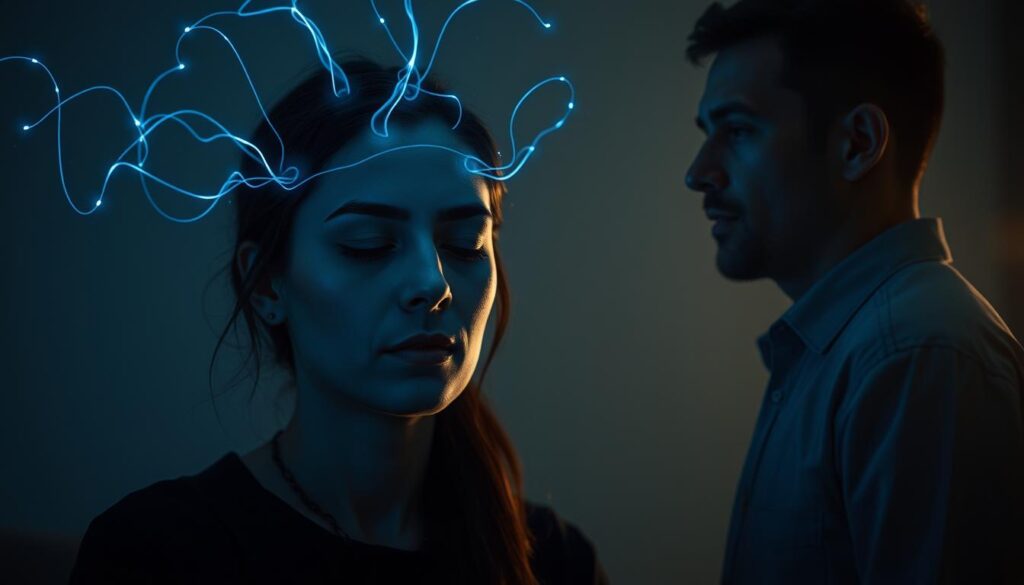
Covariation bias is the habit of seeing a link between a guess and a target even when results match chance. Research (Schienle et al., 1996) found believers overcount such coincidences.
Confirmation bias makes us notice hits and ignore misses. Over time this skews how much information a person thinks supports the claimed ability.
Hindsight bias lets memories change after outcomes, so a hit feels inevitable in retrospect (Rudski, 2002).
Practical steps to reduce error
- Log all trials immediately and neutrally.
- Use independent judging and blind scoring.
- Test with unambiguous targets to limit subjective filling-in.
| Bias | What it does | Countermeasure |
|---|---|---|
| Covariation | Sees links where none exist | Record full series; analyze base rates |
| Confirmation | Focuses on supporting hits | Count misses; preregister methods |
| Hindsight | Alters memory after outcome | Time-stamped reports; blind review |
Acknowledge these tendencies without dismissing experience. Clear methods help separate meaningful signals from normal mental habits and explain why telepathy narratives persist despite weak aggregated evidence.
For related topics on claimed mind powers, see what are PK abilities.
Proposed Mechanisms Tested and Refuted
If the phenomenon were real, it should leave detectable traces that instruments could record. Researchers focused on physical carriers to move claimed content across space. One major candidate was electromagnetism.

In a notable series, Taylor and Balanovski (1979) measured electromagnetic fields during controlled trials. They found signals many orders of magnitude too small to carry usable information between people.
Those null findings matter because a plausible mechanism must fit established physics and make testable predictions. If a real signal existed, results should change with distance, shielding, and time in predictable ways. That pattern has not appeared.
Reproducibility is crucial. Independent labs ought to record the same signatures if a true link connects one mind to another. They do not.
Mechanism-first tests also reduce claims of manipulation. Automated targets and instrument logging remove human handling and post hoc explanations. When those controls are in place, paranormal effects vanish.
| Mechanism Tested | Key Result | Implication |
|---|---|---|
| Electromagnetism (Taylor & Balanovski) | Measured EM too weak; no paranormal effect | Argues against EM-based explanation |
| Distance/shielding tests | No predictable modulation with shielding | Not consistent with a physical carrier |
| Automated series with logging | Null behavioral signals when human handling removed | Reduces manipulation and bias |
Bottom line: Current mechanism work offers no support for claimed telepathy as a physical ability. For a convincing case, readers should look for convergence: repeated behavioral effects plus a measurable, plausible mechanism. Note that lab-built brain-to-brain interfaces using electronics differ fundamentally from extrasensory claims and rely on clear instrumentation and known physics.
Telepathy in Fiction, Media, and Pop Culture
Stories across comics, film, TV, and games make mind links a handy way to show inner life and raise stakes. Writers give characters sweeping powers like reading thoughts, controlling others, or sending messages across space to drive drama.

Comics and Superheroes
Iconic figures—Professor X, Jean Grey, Martian Manhunter, Emma Frost—show how a power can grow into defense, manipulation, or team coordination. These series often portray characters able read dozens of minds to lead or protect others.
Film and TV
Shows like Stranger Things and Doctor Who use mental links to connect people and others, sometimes miles away. The Shining mixes second sight with telepathic impressions to build dread.
Games and Anime
In games and anime—Final Fantasy VII, Dragon Ball, Naruto—telepathic scenes serve strategy and emotional beats. Characters coordinate across battles, alter memory, or signal allies in real time.
- Twin telepathy and perfect mind-reading are common tropes that resonate emotionally.
- Fiction expands abilities beyond what experiments support; enjoy the world-building but keep scientific claims separate from storytelling.
Related Terms and Distinctions
Confusing showmanship with claimed extrasensory skills can mislead both audiences and investigators.
Mind reading on stage usually means clever psychology, suggestion, and observation. Performers rely on body language, cold reading, and practiced routines to seem like they know another person’s thoughts.
Telepathic communication is a specific ESP claim: an alleged direct transfer between one mind and another mind without normal senses. Researchers treat that as a testable hypothesis, not a magic trick.
How the terms differ in practice
- Use “mind reading” for performance or casual talk.
- Use “telepathic communication” when describing an alleged mind-to-mind exchange in studies.
- Reserve “extrasensory perception” as the umbrella that covers telepathy, clairvoyance, and precognition.
| Term | Typical context | Key test feature | Why it matters |
|---|---|---|---|
| Mind reading | Stage, entertainment | Observation & cues | Not evidence of ESP |
| Telepathic communication | Parapsychology | Sender/receiver design | Requires blind protocols |
| Extrasensory perception | Theory umbrella | Various target types | Frames hypotheses |
| Second sight | Colloquial use | Vague intuitive flashes | Not a precise scientific term |
Clear definitions help avoid mixing cold reading, memory cues, and claims that one person can transfer information to another person. Researchers must specify sender, receiver, target, and judging rules so testing focuses on actual exchange of thoughts or signals.

Techniques People Use to Explore Telepathic Communication
Laboratory procedures and casual exercises differ sharply in how they try to detect mind-to-mind effects.

Lab-style setups—for example, Ganzfeld sessions—place a receiver in a reduced sensory field while a sender in another room focuses on a predefined target. Strict randomization, sealed targets, and blind judging limit leakage and bias.
Everyday practices are informal. Friends try thought-sending or guessing games without controls. Those exercises feel vivid but are prone to suggestion, selective memory, and experimenter effects.
How tests assign roles and protect signals
- Senders pick or view a predefined target; receivers report impressions.
- Physical separation and timing logs document any claimed transfer across space.
- Independent scoring prevents the experimenter from shaping results.
| Feature | Lab protocol | Casual practice |
|---|---|---|
| Target handling | Sealed, randomized | Open or chosen |
| Judging | Blind, independent | Self-judged |
| Record keeping | Time-stamped logs | Memory-based reports |
| Controls | Shielding, no cues | Minimal or none |
“Controls are not hurdles but tools that show whether an ability produces consistent, above‑chance results.”
Practical advice: use blind targets, log all trials, and ask for independent scoring. Enthusiasts should expect that claimed telepathic abilities must show repeatable above‑chance performance across sessions to be convincing.
Benefits People Commonly Claim from Telepathic Abilities
Many people describe moments when they seem to know a loved one’s mood before a word is spoken. These reports frame the claimed ability as a kind of deep empathy that improves everyday interaction.
Perceived connection and smoother nonverbal communication
People often say they feel unusually close to partners or family members. They interpret subtle cues—tone, posture, timing—as evidence of shared understanding.
Teams and couples report faster coordination because impressions align without explicit talk. That feeling of one mind guiding another feels practical and comforting.

Stories also include sensing someone’s state miles away. Such narratives can be meaningful even when science explains them as inference, shared routine, or chance.
Practical note: treat these experiences respectfully but test assumptions. Ask clarifying questions rather than assuming exact message-level transfer of information one person to another.
“Shared habits and context often create accurate guesses that feel extraordinary.”
Some view these moments as spiritual or psychological practices rather than literal powers. Be mindful of manipulation risks when influence is claimed; ethical boundaries matter.
For more on related spiritual concepts, see types of spiritual power.
Conclusion
To conclude, curiosity about mental links reflects both human imagination and scientific caution. We traced the word’s origin in 1882, its cultural pull, and decades of experiments that fail to show a reliable ability to send clear thoughts from one mind to another under strict controls.
Enjoy stories and personal reports, but weigh them against transparent methods and open data. Strengthen real communication, practice empathy, and use critical thinking when evaluating claims that someone can influence others or transfer information.
Ethics matter whenever influence or manipulation is suggested. Keep curiosity alive, test fairly, and read related material like this telekinesis guide for broader context.