

Who is Nostradamus serves as the opening question for this concise biography-style overview. Michel de Nostredame was born in Saint-Rémy-de-Provence in December 1503 and died in Salon-de-Provence in July 1566.
He worked as an astrologer, apothecary, physician, translator, and author. In 1555 he published Les Prophéties, a book of 942 quatrains that sparked centuries of debate about prophecy and predictions.
The Latinized name Nostredame links to a family that converted to Catholicism a generation earlier. He studied at Avignon and Montpellier, gained fame with almanacs, and drew noble patrons like Catherine de’ Medici.
This piece outlines his life, the writing methods behind the quatrains, and how later readers tied those verses to world events and the future. It aims to separate documented fact from later myth while keeping a friendly, clear tone.
Key Takeaways
- Michel de Nostredame was a 16th-century French physician and author of Les Prophéties (1555).
- The Latinized name explains how his writings became widely known under one label.
- His quatrains inspired centuries of varied interpretations and modern predictions.
- Study of his life shows a mix of real historical roles and later sensationalism.
- The article will balance the allure of prophecy with clear historical facts.
A quick look at the man behind the prophecies
This man moved between apothecary shelves, plague wards, and the printed page. He began as a practical physician and apothecary, later gaining notice as a french astrologer whose almanacs reached readers in town squares and noble courts.
His life followed a clear arc: student, expelled apprentice, healer during outbreaks, and a writer whose annual forecasts from 1550 made him widely read. Almanacs mixed seasonal advice with predictions about the year, helping both farmers and patrons plan ahead.
Major events shaped his path — university closures for plague, early setbacks, and a loyal court supporter in Catherine de’ Medici. The quatrains in Les Prophéties used a poetic, obscure style that let readers fit verses to later happenings.
Across time, the interplay between medical work and public reputation widened his reach. The combination of practical healing and bold prediction helps explain why readers still debate meanings today.

- Snapshot: A Renaissance-era physician and seer whose forecasts made him household-known.
- Legacy: Practical almanacs plus elusive quatrains kept conversations alive.
Origins and family: from Jewish roots to Catholic life in Provence
Born in Saint-Rémy-de-Provence in December 1503, records differ on the exact day — some list 14, others 21 — and he was baptized Michel. This early detail frames a life tied to local records and family ties.
Family life mattered. He was one of at least nine children of Jaume (Jacques) de Nostredame, a notary, and Reynière. That large household formed a support network and gave him standing in the town.
His paternal grandfather, Cresquas, converted to Catholicism around 1459–60 in Avignon. On the saint’s day of conversion he adopted the Christian name “Pierre” and took the surname Nostredame, linking the clan to Our Lady and to a new public identity.
At about 14 he entered the University of Avignon, but plague cut his studies short. This interruption repeats across his early life and shaped choices in education and work.

| Detail | Fact | Historical note |
|---|---|---|
| Birth date | 14 or 21 December 1503 | Municipal plaque records 14 (Julian) |
| Family background | At least nine children; parents Jaume & Reynière | Large household helped local standing |
| Religious shift | Grandfather converted catholicism (~1459–60) | Surname Nostredame tied to “Our Lady” |
| Education | Entered University of Avignon ~age 14 | Plague interrupted studies, shaping later path |
Education and the plague years: student, apothecary, and early setbacks
A sudden epidemic forced him out of formal study and into the practical world of remedies.
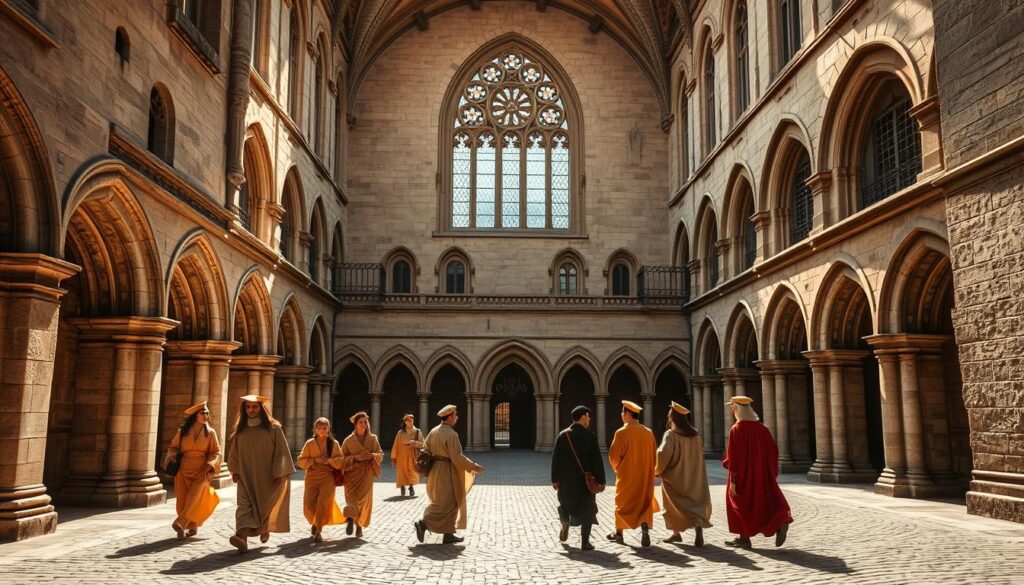
University Avignon accepted him around age fourteen, but the campus closed after a severe plague outbreak. His studies lasted just over a year, so he turned to travel and hands-on work to learn herbal cures.
University of Avignon and studies interrupted by plague
Shifting from classroom to field, he spent several years researching plants and preparing treatments. That time shaped his approach to health and mixed learned theory with practice.
Apothecary work and expulsion from Montpellier
He later enrolled at the University of Montpellier for a medical degree but was expelled when records showed prior apothecary trade work (Register S 2 folio 87). The statute barred manual trades from the faculty, so formal study ended again.
He claimed success with a “rose pill” as a plague preventative, a remedy rooted in contemporary ideas about medicine and astrology. Those turbulent years taught him to move between books and the bench, building a reputation for practical healing.
“The mix of study, travel, and craft made his practice both learned and hands-on.”
| Period | Action | Outcome |
|---|---|---|
| ~Age 14 | Entered university avignon | Campus closed due to plague; studies cut short |
| Following years | Travel and apothecary practice | Herbal research and remedies (rose pill) |
| 1529 | Enrolled at Montpellier | Expelled for prior manual trade (per faculty register) |
Marriage, loss, and medical practice amid epidemics
Around age twenty-eight he married in Agen, but joy gave way to tragedy. In 1534 his wife and two children died, likely from a sudden plague outbreak. That loss shaped his early life and work.
Early marriage and family grief
The blow pushed him toward travel and service. He returned to medical work soon after, driven by both sorrow and a renewed sense of duty.
Service during later outbreaks and a settled life
By the mid-1540s he assisted physician Louis Serre during a major plague in Marseille. He treated patients in Salon-de-Provence and Aix, using the era’s hygiene ideas and available medicine to help people amid chaos.
In 1547 he settled in Salon and married Anne Ponsarde. The couple raised six children and he invested in local projects like the Canal de Craponne to improve livelihoods.
“Grief, public service, and stability shaped his path from hands-on healer to public figure.”

| Year | Event | Impact |
|---|---|---|
| 1531 | Marriage in Agen | Family life begins |
| 1534 | Death of wife and two children | Personal tragedy; spurred travel |
| 1545 | Assisted Louis Serre in Marseille | Noted for plague work |
| 1547 | Settled in Salon; remarried | Stable household; six children |
These years blended loss with growing credibility. His age and experience as a physician helped set the stage for later writings and wider influence. For more on starseed themes and related lore, see Sirian Starseed.
From physician to French astrologer: almanacs, patrons, and rise to fame
His 1550 almanac acted like a signal flare, calling readers from market stalls to noble courts. The printed sheet mixed seasonal advice, planting tips, and bold prognostications that many found useful and intriguing.
Almanacs arrived yearly, each one adding forecasts and celebrity. People across classes bought them for weather and farming guidance, and for the promise of a glimpse into the future.
The almanac market and public appetite
The almanacs blended practical calendars with astrological prediction. That mix made them both a tool and a conversation starter.

Court influence and powerful patrons
Requests for horoscopes followed the almanacs. Nobles sought personal readings despite the era’s rough calculations. Catherine de’ Medici read his 1555 forecast and invited him to explain threats and cast charts for her children.
“The steady work on yearly forecasts turned a regional practitioner into a trusted adviser at court.”
| Item | Role | Impact |
|---|---|---|
| 1550 almanac | Public forecast | Launched wider reputation |
| Annual almanacs | Published editions | Built readership across classes |
| Court summons | Royal counsel | Elevated status; led to official appointment |
The steady almanac output created a platform for the later book Les Prophéties. At a time when astrology and medicine overlapped, his combined skills drew others to seek guidance about work, health, and the future. For private readings and related services, see psychic readings.
Les Prophéties and the quatrains: how the book was built
A printed volume of compact quatrains, Les Prophéties blends borrowed tales and sly wordplay. The work groups poems into labeled sets called Centuries, meaning blocks of about one hundred quatrains rather than calendar centuries.
The editions vary. Sixteenth-century typesetting, variant spelling, and punctuation mean no two books match exactly. That fact complicates precise readings based on a single edition.
Style matters: the verses use mixed languages, Virgil-like syntax, and deliberate word games. This opaque approach lets readers fit a single quatrain to many events over time.

Sources, gaps, and the role of astrology
Many quatrains rework classical and medieval sources—Livy, Plutarch, Froissart—and astrological compendia. The book leans on earlier material as much as invention.
Publication problems left the final 58 quatrains of Century VII missing in surviving copies. Printing logistics shaped what readers got.
- Organization: 942 rhymed quatrains plus one odd verse, grouped in Centuries.
- Printing: variant editions and missing texts affect interpretation.
- Mystique: language, sources, and press history create much of the book’s power.
For modern takes on prediction culture, see psychic predictions.
who is nostradamus in history? Life, work, and a name that endured
Across a turbulent age, a provincial physician combined practical medicine, astrology, and printing to shape a public reputation that lasted past his time.
His life reflects the Renaissance habit of mixing disciplines. He wrote almanacs, cared for plague patients, and published the quatrains that made his name famous at court and in markets.

Academics later argued that vague, poetic language invites readers to map verses to later events. Still, royal patrons and wide circulation during his lifetime cemented public interest.
The result is a lasting brand: editions and debates kept the man visible in the world long after his death. People keep returning to the quatrains when big events prompt searches for meaning.
“Understanding him in history means seeing both the man and the phenomenon that followed.”
- Context: a learned figure of the age linking medicine and letters.
- Endurance: a name kept alive by reprints, court stories, and continuous interpretation.
- Balance: cultural fascination meets scholarly caution about literal prophecy.
What did he “predict”? Famous quatrains and their interpretations
Several short quatrains have become touchstones for later predictions. Readers often match these verses to dramatic events after the fact.
One famous verse mentions a “young lion” overcoming an older one. Interpreters link it to the fatal jousting wound of King Henry II in 1559. The symbolic language makes that match possible, but it relies on selective reading and translation choices.
Another quatrain has been read as a warning about a king’s death at the hands of Parliament. That line gets tied to Charles I’s execution in 1649. Related readings tie a phrase like “thrice twenty and six” to London’s Great Fire of 1666.
Broader attributions and wartime use
Enthusiasts later apply verses to the French Revolution, Napoleon, and Hitler. These associations show a pattern: readers project big historical names onto vague lines across centuries.
Propagandists such as Joseph Goebbels even used such verses in World War II to claim prophetic support. That demonstrates how predictions can be repurposed to sway public opinion.
“Quatrains can feel eerily apt, but scholars warn that vague wording allows many retrofits over time.”
For balanced reading, treat popular links between quatrains and later events as interesting cultural history rather than proof that specific future years were accurately foretold.
Skeptic views: vagueness, mistranslations, and cultural reuse
A core skeptical view stresses how poetic ambiguity lets lines be applied to many moments. Critics argue that the quatrains’ vague phrasing and symbolic language create wide interpretive room.
Translation matters: a single word swap can turn a general line into a seemingly precise prophecy. That linguistic flexibility fuels apparent matches to later events.
Historical reuse also matters. Over centuries, others have taken verses and shaped them for agendas. Political actors and publishers repackaged the text to suit changing tastes and claims.
From propaganda to modern mythmaking
Notably, Nazi propaganda under Goebbels amplified select readings to influence opinion. That episode shows how malleable verses serve persuasion rather than proof.

“Many ‘hits’ follow careful retrofitting and selective translation, not clear foresight.”
- Poetic vagueness enables retrofit to multiple events.
- Translation choice can create an illusion of prediction.
- He avoided calling his work strict prophecy in prefaces and letters.
- Today, media reuse spreads dramatic claims quickly across the world.
| Issue | Effect | Example |
|---|---|---|
| Vague language | Allows multiple fits | Quatrain applied to different events |
| Translation variance | Shifts meaning | One word alters perceived prediction |
| Cultural reuse | Amplifies authority | Propaganda and tabloid cycles |
| Author disclaimers | Warn against literal reading | Prefaces distance text from strict prophecy |
Approach these verses critically. Context, time, and editorial choice shape the claims you read. For related discussions on abilities labeled mystical or unexplained, see PK abilities.
Final years, death, and legacy today
His final years showed a quieter rhythm as illness and paperwork replaced public appearances.
Gout had long troubled him. By 1566 the joint pain progressed into painful swelling and edema. He spent those months mostly indoors, tending to letters and family affairs.
Shortly before his death he drafted a will. He left property and 3,444 crowns to his wife, held in trust for their children. That record shows the practical side of a life that mixed public work and private duty.
One famous anecdote says he told his secretary on July 1 that he would not be found alive at sunrise. The next morning he was discovered in his chamber and declared dead.

Burial and memory
He was first buried in a Franciscan chapel in Salon-de-Provence. During the French Revolution his remains were moved and reinterred in the Collégiale Saint-Laurent, where the tomb remains today.
Why the prophecies endure
The appeal of those verses lives on because poetic mystery invites readers to link lines to later events. People seek meaning about the future, and ambiguous phrasing lets each generation see its own concerns.
“His work straddled service and story, leaving a legacy that invites fresh readings in later years.”
More than predictions, his life and writings show how time and interpretation shape cultural memory. That is why fascination with his quatrains persists: not only for possible forecasts, but for what they reveal about how people make sense of events and time.
Conclusion
Conclusion
The portrait that emerges is of a Renaissance apothecary and physician who turned practical work into widely read almanacs and a compact book of quatrains. His name now lives in conversations about predictions and prophecies across centuries.
Personal tragedy — the loss of a first wife and two children — and a later family life ground the public story in human fact. The cloudy language of the quatrains, mixed sources, and printing quirks explain why readers fit verses to later events rather than find clear dated forecasts.
Approach these writings with curiosity and care. Enjoy the craft, note the history, and remember how people around the world keep testing old lines against the future. For related topics on supernatural abilities, see that overview.