

Michel de Nostredame rose from provincial Provence to lasting fame for his book of poetic quatrains. Born in December 1503 in Saint-Rémy-de-Provence and dying in July 1566, he earned a name as an apothecary, physician, author, and astrologer.
He studied at Avignon and later Montpellier, though university rules forced him out because he practiced a manual trade. By the 1550s he published almanacs and then Les Prophéties, a 1555 collection that framed his reputation for eerie predictions.
Readers around the world still debate his methods. Scholars note he drew on classical chronicles, judicial astrology, and preexisting sources. Many argue his verses are vague and often match events only after the fact.
In this article we trace his life, the publication history of his book, and why his quatrains keep attracting attention. For related background on mystical techniques and historical practices, see supernatural abilities.
Key Takeaways
- Nostredame combined medicine, astrology, and publishing to shape his legacy.
- Les Prophéties (1555) contains 942 quatrains that made his name famous.
- His education and trades influenced how he wrote and marketed his work.
- Academics warn quatrains are often vague and retrofitted to events.
- The article follows a clear, chronological approach to his life and impact.
Introduction to Nostradamus: The Man Behind the Prophecies
A single 1555 volume of quatrains turned a regional apothecary into a figure whose lines still spark debate across the world.
Les Prophéties compiled short, image‑rich verses that invite endless interpretation. That poetic ambiguity keeps his reputation alive over time and draws people to rewrite meaning for each era.

His rise was aided by annual almanacs and royal interest, including the patronage of Catherine de’ Medici. Those publications spread a style that mixed medical notes, astrology, and classical learning.
“Ambiguity is the engine of legend; vague lines allow readers to fit events to text.”
Today, admirers see precise predictions; scholars stress deliberate obscurity, translation errors, and retrospective readings. Both views shape how the modern world reads his life and work.
- The quatrains’ poetic form invites multiple readings.
- Almanacs built an early audience for prophecy in times of crisis.
- Medical practice and astrology gave his writing credibility then and now.
Who Was Nostradamus
The early life of Michel began in Saint‑Rémy‑de‑Provence in December 1503. He was baptized Michel and grew up in a large household.
The notary Jaume de Nostredame and his wife Reynière raised at least nine children. Known siblings include Delphine, Jean, Pierre, Hector, Louis, Bertrand, Jean II, and Antoine. Large families shaped daily duties, schooling chances, and social ties in that era.

Birthplace and upbringing
Local records place Michel’s origin in a community where religious and cultural shifts mattered. A paternal line of Cresquas had converted to Catholicism around 1459–60 and adopted the form of the current family name. That change affected the family’s public identity for later generations.
Tradition and record limits
Some traditions claim he learned from his maternal great‑grandfather Jean de St. Rémy, though documents fade after 1504. Historians separate verified facts from later family stories and note gaps in the archival record.
- This short account traces his family roots in regional history and religious change.
- It also notes how his son César later helped shape public memory of his father’s life.
Education and Early Career: From University Halls to the Plague
A teenage scholar in Avignon, he soon traded lecture halls for apothecary benches when plague struck. That early disruption shaped a practical approach to medicine that followed him for decades.
Studies at Avignon and the University of Montpellier
At about 14 he studied in Avignon until the epidemic forced the school to close. In 1529 he sought a medical doctorate at university montpellier, but an expulsion record (Register S 2 folio 87) shows he left before finishing.
Apothecary work, “rose pills,” and treating plague across Provence
Years as an apothecary gave him hands‑on skills. He developed the famed rose pills, a remedy reputed to help against the plague, and treated patients directly.
His practical cures and field experience helped build a working reputation that sometimes mattered more than formal credentials.

Marriage, loss, and the physician’s reputation
Invited to Agen, he married, but in 1534 his first wife and two children died, likely of the plague. That personal loss deepened his commitment to medical work.
He later aided Louis Serre during the 1545 Marseille outbreak and treated cases in Salon and Aix. By 1547 he settled in Salon‑de‑Provence and married Anne Ponsarde; they had six children.
- Fact: Expulsion from Montpellier is a documented turning point.
- Hands‑on practice in epidemic years made him a known physician despite limited formal degree status.
Nostradamus Begins to Write: Almanacs, Astrology, and a Growing Reputation
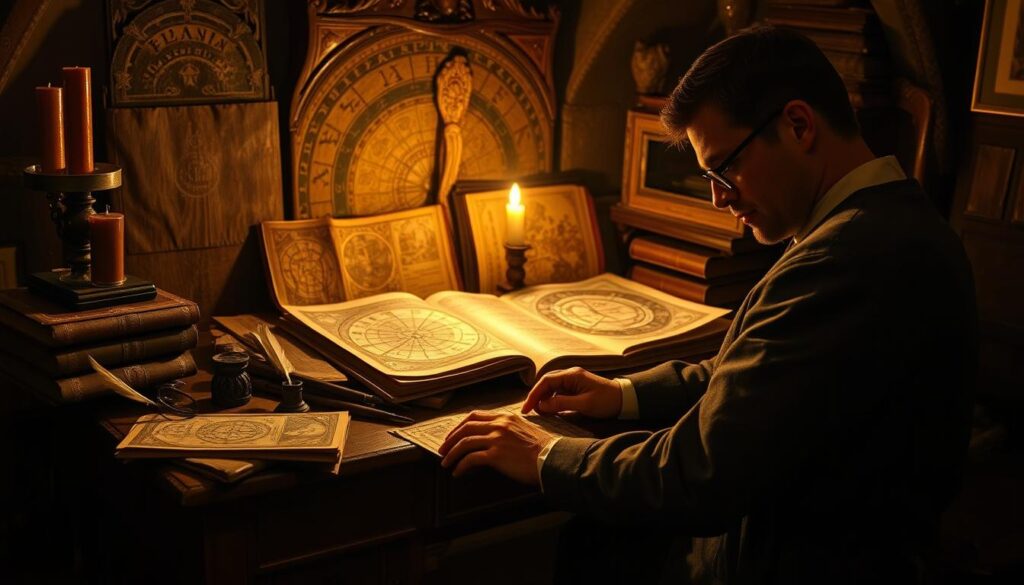
In the 1550s he published short annual booklets that mixed calendars, weather notes, and brief forecasts. These almanacs made the content easy to read and helped his rise from local healer to public author. The phrase nostradamus began to appear in print with steadily growing circulation.
The rise of the annual almanacs and prognostications
His first almanac appeared for 1550 and he continued producing yearly issues. Over time those pamphlets added up to thousands of short calendars and predictions that readers checked each season.
Patrons, courts, and royal interest
Astrology informed much of his work, and many people sought horoscopes and advice. Members of the French court began commissioning charts. Catherine de’ Medici took special interest after reading the 1555 almanacs, which boosted his reputation at court.
“Printed calendars proved as powerful as personal consultations in shaping public trust.”
| Feature | Function | Effect |
|---|---|---|
| Annual almanacs | Calendars, weather, short forecasts | Broadened readership |
| Astrological charts | Birth data and prognostication | Attracted patrons |
| Printed distribution | Affordable circulation | Raised public profile |
He sometimes relied on clients’ birth charts and on published tables to calculate charts. That method worked often, but occasional errors crept in when local adjustments were ignored. Still, the almanacs served as both practical guides and a vehicle for lasting fame.
For related modern services, see psychic readings.
Les Prophéties: Quatrains, Books, and How They Were Published
Les Prophéties debuted as a compact volume in the mid‑1500s and later grew into a complex, multi‑edition corpus.
Centuries and verses: the structure
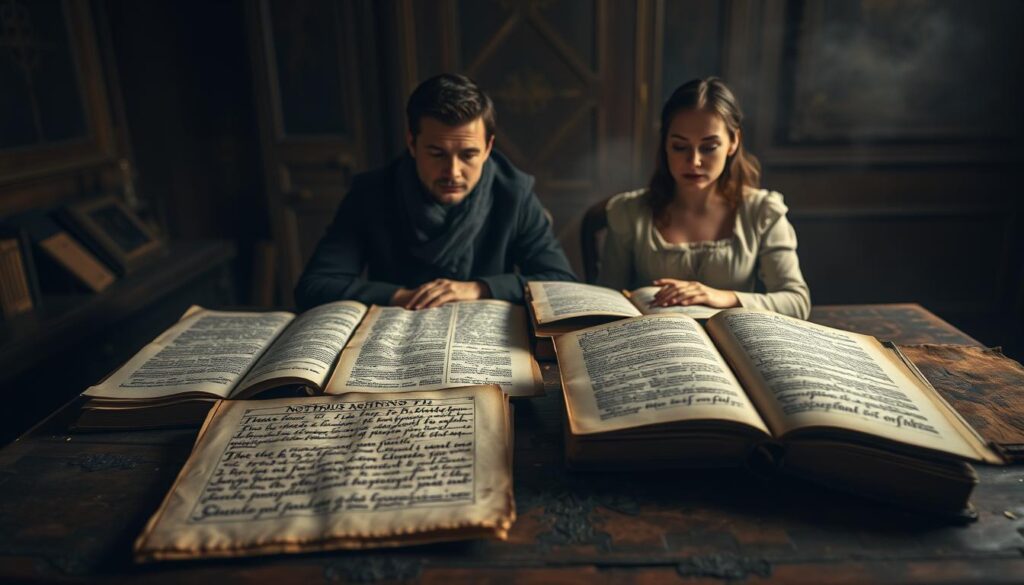
The first book in the year 1555 contained 353 quatrains. A later omnibus (1568) gathered 942 rhymed quatrains and one unrhymed item, arranged in nine sets of 100 and one of 42, called “Centuries.” A notable fact: the final 58 lines of Century VII are missing from surviving editions.
Language, obscurity, and translation
He mixed French with Latin, Greek, Italian, and Provençal and used a Virgilianized syntax to mask intent. That deliberate obscurity increases interpretive flexibility and reduces risk.
Translation choices matter. Small shifts in a single word change a verse’s apparent meaning. Readers should treat translations as interpretive work, not fixed fact.
Printing practices and edition differences
Typesetting from dictation, inconsistent spelling, and variable punctuation produced many variant copies. No two extant editions match exactly, which complicates claims about hidden codes.
| Feature | Details | Impact |
|---|---|---|
| First appearance | 1555, 353 quatrains | Established the book |
| Omnibus edition | 1568, 942 quatrains + 1 unrhymed | Expanded corpus |
| Language mix | Multilingual wordplay and classical syntax | Deliberate ambiguity |
| Printing quirks | Dictation typesetting; varied spelling | Multiple differing editions |
“Translation alters more than words; it shapes meaning.”
- Tip: Compare editions when citing a verse.
- Tip: Consider original languages and printing context before assigning firm prophecy readings.
Famous Predictions and Historical Events Often Linked to Him
A few short quatrains gained outsized fame by being read against major historical moments. Scholars and enthusiasts have long matched verses to dramatic incidents, creating striking, if sometimes dubious, connections.
King Henri II’s fatal joust and the “young lion”
One quatrain about a “young lion” facing an older opponent is commonly tied to King Henri II’s 1559 jousting death. Supporters point to similar imagery and timing as evidence the verse fits the event.
Critics note that vague animal imagery and loose dating allow many post‑facto fits, so the link remains persuasive to some and speculative to others.
London’s king and the great fire
Another quatrain mentions Parliament putting a king to death and London burning “by fire.” Readers connect this to Charles I’s execution in 1649 and the 1666 Great Fire.
Textual variants and translation choices change the apparent meaning, so these attributions depend heavily on interpretation rather than clear, contemporary evidence.
Napoleon, Hitler, revolutions, and wartime use
Later readers retrofitted verses to figures like Napoleon and Hitler. Propaganda figures such as Joseph Goebbels also invoked prophetic lines to shape public perception during war.
That history shows how quatrains become tools for political storytelling as much as objects of scholarly debate.
“Poetic ambiguity invites readers to map events onto text after those events occur.”
- Takeaway: Many famous pairings rest on broad imagery and flexible dating.
- Advice: Treat claims that nostradamus predicted specific outcomes with critical caution and check variant texts.
- For related symbolic readings, see an analysis of the Knight of Cups.

Methods, Sources, and the Role of Astrology in His Work
He claimed celestial calculation guided many lines, but documentary sources supplied much of the imagery.
Judicial charts and practical forecasting
Judicial astrology meant calculating planetary positions to judge events. He used almanacs and a form of comparative horoscopy to frame forecasts.
Contemporaries such as Laurens Videl publicly challenged his technique and accuracy.
Classical and medieval source material
Quatrains borrow freely from Livy, Suetonius, Plutarch, Froissart and compilations like Mirabilis Liber.
Bibliomancy — drawing meaning from random passages — may explain associative imagery in many verses.

Apothecary, physician, and translation work
His career as an apothecary and physician produced medical manuals such as Traité des fardemens and paraphrases of Galen.
He also compiled Orus Apollo, a flawed hieroglyphic translation, showing limits in scholarly method.
“Method and sources created verses that read like timeless predictions but rested on accessible facts.”
- Astrology shaped form; printed almanacs spread his work.
- Classical texts supplied much of the vivid vocabulary.
- Knowing these sources helps explain why modern readings diverge from scholarly interpretation.
For more on related interpretive guides, see a recommended book on angel numbers.
Controversies, Heresy Accusations, and Skeptical Readings
In a tense religious climate, a single pamphlet could trigger official censure or even short detention. Records note an early clash with church authorities in Agen in 1538 that raised suspicion about his activities.
Heresy charges and publishing permission
Later, in late 1561, local officers briefly imprisoned him at Marignane for issuing an almanac for 1562 without episcopal permission. Church rules and royal oversight in that century made printing forecast material risky.
Skeptical readings
Scholars argue that the quatrains’ vague wording invites many retroactive links to major events. Mistranslation and flexible dating often tilt a line toward a given interpretation, so apparent prediction frequently follows the fact.
Propaganda and devoted followers
Over time, committed readers—sometimes called “Nostradamians”—and political actors amplified selected verses to serve narratives during crises. That process reshaped reputation more than any single verified forecast.
“Vagueness allows verse to bend toward many histories.”

- Takeaway: Religious rules and publishing laws created real legal risks for authors of prophetic material.
- Skeptical methods stress translation checks and context before tying a quatrain to specific people or events.
- For ongoing debate about labeled predictions and modern readings, see psychic predictions.
Final Years, Death, and Lasting Legacy
In his last years the physician faced steadily worsening symptoms and took clear steps to settle affairs.
Gout, edema, and his death in Salon‑de‑Provence
By 1566 his long‑standing gout had progressed into edema. He grew weaker and stopped public work.
In late June he drew up a will. He left property and 3,444 crowns to his wife, held in trust for their children.
On July 1 he told his secretary Jean de Chavigny he would not be found alive at sunrise. He died that night.

Family, will, and tomb: the end of a physician‑astrologer’s life
The legal arrangements show a practical end to a busy public career. His family retained papers and promoted his memory.
He was first buried in a local Franciscan chapel in Salon. After the Revolution his remains were moved to the Collégiale Saint‑Laurent.
Why his prophecies endure in popular culture today
His life and printed works stayed in circulation through constant reprints and thousands of commentaries.
His son César and other relatives shaped the narrative that kept interest alive across the world.
- Careful wills and trusts protected family claims.
- Burial and reinterment tied the site to local memory.
- Continuous printing and commentary sustained popularity.
“A practical estate and a printed book proved equal partners in crafting a lasting name.”
Conclusion
From apothecary bench to a widely read book, his life tied hands‑on practice, yearly almanacs, and a collection of quatrains that crossed centuries. Plague and courtly interest shaped the topics and tone of many verses.
Readers across years keep returning to those prophecies and predictions because the language invites projection onto later events. Famous links — like king henri and London’s trials — show how verses meet the needs of each time.
Scholars urge caution: printing variance and vague wording make firm claims risky. Yet the name endures, and curious readers find related ideas online, for example a Sirian starseed profile for further mystical reading.
In the end, understanding the past helps explain why his verses still speak to the future.