
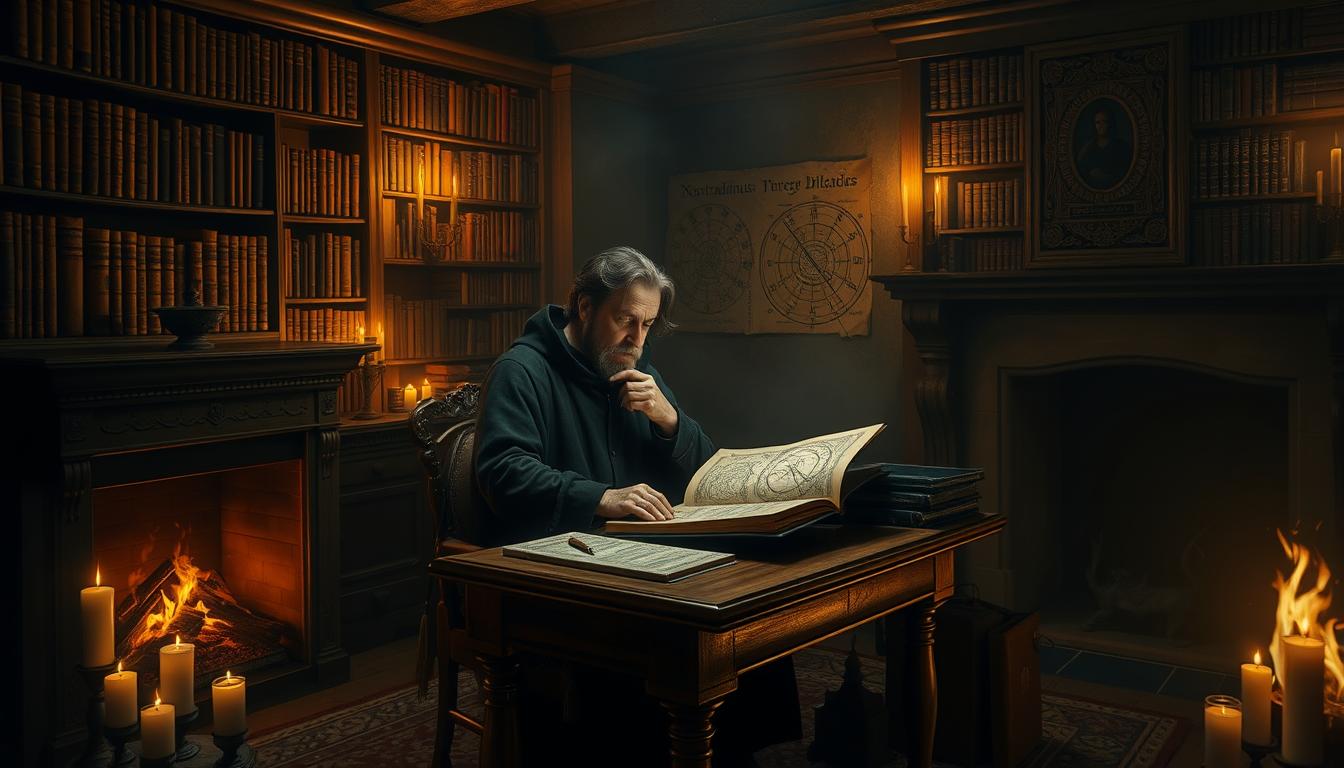
Quick guide: Michel de Nostredame rose from a provincial apothecary to a famous physician, astrologer, and author in 16th-century France. He published Les Prophéties in 1555 and annual almanacs that drew wide attention. These writings sparked debates about his prophecies and later predictions.
Born in Saint-Rémy-de-Provence in December 1503 and dying in Salon-de-Provence in July 1566, his life mixed medical practice and court consultation. He treated plague victims and advised nobles, which helped spread his reputation across European print networks.
Scholars note many quatrains are vague and often read backward into history. Yet popular culture links his words to dramatic events around the world, from royal deaths to great fires.
This article lays out the main facts, traces how his fame grew through printers and patrons, and separates colorful legend from verified history. You will find clear dates, major works, and an honest take on the lasting appeal of his verses through time and events.
Key Takeaways
- He combined roles as apothecary, physician, astrologer, and author.
- Les Prophéties (1555) and almanacs made him widely read.
- His quatrains are often vague and open to many readings.
- Court ties and print culture amplified his public fame.
- We will separate myths tied to famous events from documented facts.
Who Was Nostradamus? Setting the Historical Stage
Michel de Nostredame grew up in Provence and trained amid the medical and religious tensions of the early sixteenth century.
He was born in Saint-Rémy in December 1503; sources list either the 14th or 21st as the likely date. His family had a converted Jewish lineage that adopted the surname Nostredame in the mid-1400s. That background shaped social pressures in a century of confessional change.

As a young student he attended the University of Avignon but left when the plague closed the school. He then spent about eight years researching herbal remedies and traveling the region before seeking a medical degree at the University of Montpellier in 1529.
Montpellier expelled him because statute barred those with prior apothecary trades from earning a formal degree. He returned to practice as an apothecary and physician and gained a reputation with practical remedies like the so-called “rose pill.”
These roles—doctor, apothecary, and later astrologer and author of almanacs—placed his name at the crossroads of medicine and celestial consultation. The following sections use these key facts to trace his life, work, and the history that made his writings influential.
- Key facts: birth December 1503; death July 1566.
- Family conversion and social context in Renaissance France.
- Study, plague disruption, practical remedies, and rise to public notice.
To explore related modern readings and how practitioners link historical methods to today’s practice, see a short guide to psychic readings.
What Was Nostradamus Known For
His public image rose from two publishing paths and practical care. Les Prophéties (1555) gathered hundreds of short, enigmatic quatrains and became the signature book tied to his name.

Les Prophéties: The quatrains that fueled his fame
The volume grew in editions to 941 rhymed quatrains plus one unrhymed piece. Those brief verses invited interpretation and kept readers returning to older copies.
Annual almanacs and prognostications that captivated Europe
Starting in 1550, yearly almanacs offered quick forecasts and calendars. These pamphlets reached many readers and spread his prediction style across print networks.
Physician-apothecary work during plague outbreaks
He worked as a practicing apothecary and physician. Remedies like the rose pill and direct care during epidemics raised his public profile.
Astrological consulting for nobles and a royal connection
As an astrologer he advised nobles and sometimes relied on clients to supply natal charts. Catherine de’ Medici’s patronage tied court attention to his writings and boosted his fame.
| Type | Form | Impact |
|---|---|---|
| Les Prophéties | Quatrains, Centuries | Long-term mystique; literary reach |
| Almanacs | Yearly forecasts | Wide, immediate circulation |
| Medical work | Treatments, remedies | Local trust and reputation |
Print amplified both books and pamphlets, turning short forecasts into a lasting public presence. For related modern readings, see a short guide to psychic predictions.
Life and Times: From University of Avignon to Salon-de-Provence
From student rooms to plague wards, his path mixed study with urgent care across southern France.
Early family life reflected a converted Jewish lineage that shaped social standing in Provence. That family context influenced opportunities and local ties during turbulent religious years.

Student years and the University of Montpellier
He studied at Avignon until the plague forced the school to close. After several years researching herbal remedies, he enrolled at university montpellier in 1529 to pursue a formal degree.
Officials expelled him because his prior trade as an apothecary violated statutes. He returned to hands-on practice and kept refining treatments during long travels.
Marriage, loss, and work during outbreaks
Around 1531 he took a wife; tragedy followed when his wife and two children died in 1534, likely of plague. That loss pushed him into itinerant work as a doctor in afflicted towns.
He later aided Louis Serre during the 1545 Marseille crisis and worked in Salon and Aix. By 1547 he settled in Salon-de-Provence, married Anne Ponsarde, and raised six children while engaging in local projects like the Canal de Craponne.
The final chapters of his life show chronic gout that progressed to edema, leading to his death on the date recorded as 1 or 2 July 1566. These years gave his medical reputation a steady platform that helped spread his writings and astrological consultations.
Works and Books: From quatrains to medical and cosmetic recipes
He compiled terse quatrains, yearly pamphlets, and recipe books that captured both imagination and local needs.

Les Prophéties: Centuries and compact verses
Les Prophéties first appeared in 1555 with 353 quatrains. Later omnibus editions gathered nine sets of 100 and one of 42, yielding 941 rhymed and one unrhymed quatrain in some printings.
The Century format made short verses portable and endlessly interpretable. The tight structure invites many readings and resists one-to-one mapping of terms and metaphors.
Almanacs and practical manuals
Almanacs, launched around 1550, were his most popular works. They ran year after year and produced thousands of short predictions and calendars that readers used daily.
The Treatise on Cosmetics and Conserves blends health tips, early toothpaste using cuttlefish bone, preserves, hair dyes, and the famed rose pill. These recipes show applied medical thinking alongside literary production.
- He paraphrased Galen and compiled the Orus Apollo manuscript.
- Lyon’s archives safeguard many primary sources.
- Printing quirks mean editions differ in spelling and punctuation, so exact counts and texts vary by part and edition.
To explore modern reading lists, see a recommended best book on angel numbers.
Predictions People Point To: From kings to world-shaking events
Fans and critics have long tied a handful of brief quatrains to dramatic turns in European history. These links helped turn a poetic book into a cultural reference point across later years.

“Young lion” and the death of King Henry II
A famous quatrain was read as predicting King Henry II’s fatal jousting wound in 1559. That reading spread quickly and boosted public interest in subsequent predictions.
London’s king and a city on fire: Charles I and 1666
Another line—cited about Parliament putting its king to death—became linked to Charles I’s 1649 execution. The same passage’s reference to London burning “in thrice twenty and six” was later matched to the Great Fire of 1666.
Later attributions: revolutions, Napoleon, Hitler, and world war
Readers later mapped vague verses onto revolutions, Napoleon, Hitler, and global conflict. Wartime propaganda even leaned on these lines—Joseph Goebbels used them to shape public opinion during WWII.
- Short, evocative lines fit many dramatic events when read after the fact.
- Court attention—especially from the wife who became queen—helped spread regal readings.
- Variation across editions and the poetic, multilingual phrasing make strict verification difficult.
How He Worked: Astrology, sources, and the making of a prophecy
His process mixed formal astrology, borrowed texts, and random cues from opened books to generate cryptic verses.

Comparative horoscopy and library luck
He claimed to use judicial astrology—calculating planetary influence to read events. That method fit the era’s belief that skies guided earthly life.
Comparative horoscopy compared current charts to earlier moments. Professional astrologers and critics like Laurens Videl said this gave too many false matches. Modern scholars note the method lacked rigorous controls.
Books, historians, and intentional obscurity
He pulled from many sources: Livy, Suetonius, Plutarch, Villehardouin, Froissart, Petrus Crinitus, Iamblichus, and astrological texts such as Richard Roussat’s work.
“He often blurred literal meaning by mixing languages and poetic syntax.”
Bibliomancy likely supplied sudden lines. At the same time, his medical work and plague experience colored dire images in verse.
| Method | How it worked | Strength | Critic |
|---|---|---|---|
| Judicial astrology | Planetary charts and natal timings | Systematic, familiar to readers | Seen as speculative by peers |
| Comparative horoscopy | Match past configurations to present | Appealing pattern-making | Accused of retrofitting |
| Bibliomancy & sources | Random openings + quotes from historians | Rich literary echoes | Raised issues of originality |
These methods explain much of the mystery. Rather than a lone seer, many facts point to a craftsman who mixed learned tradition, chance, and theatrical obscurity. Readers who want related modern practices can see a short guide to supernatural abilities.
Patrons, Critics, and Cultural Impact
Court patronage gave him resources and visibility, but critics kept a close watch on every printed line.
Catherine de’ Medici, court status, and growing popularity
Catherine read his almanacs and made him Counselor and Physician-in-Ordinary to King Charles IX. That royal tie sent his pamphlets straight into court circles.
Being near power helped his work travel faster through noble households and provincial networks. People at court treated him as both an adviser and a curiosity.
Skeptics, scholars, propaganda, and the end-of-world narrative
Institutional pushback followed. In 1561 he faced a brief imprisonment for printing without episcopal permission, a reminder that print had political limits.
Many scholars stress vagueness and selective reading as reasons verses fit later events. That critique sits against popular readings that tie lines to major world events.
Propaganda also shaped his reception. During World War II, Joseph Goebbels used texts to influence opinion. End-of-world claims—like the July 1999 “King of terror” panic—reappear at anxious times.
“Different people at different times mine the quatrains to mirror current fears.”
| Force | Effect | Example |
|---|---|---|
| Royal patronage | Raised social standing and circulation | Catherine’s court; access to the king |
| Institutional limits | Legal and ecclesiastical pushback | 1561 printing imprisonment |
| Scholarly critique | Claims of vagueness and retrofitting | Academic reviews of quatrain method |
| Propaganda use | Weaponized in modern conflicts | Goebbels during World War II |
The cultural afterlife of these verses shows how a centuries-old text can still shape public life. Enthusiasts and scholars keep debating meaning, while media cycles revive dramatic readings that match the mood of the time. For a related modern perspective, see a concise psychokinetic overview at psychokinetic overview.
Why Nostradamus Still Matters Today
Centuries after his verses first circulated, readers still turn to short quatrains to make sense of sudden crises.

Psychology and pattern seeking
Open-ended verses invite projection. People read a few images and fit them to modern headlines about the future.
Media, social sharing, and crisis cycles
When global shocks arrive, attention spikes. Selective lines spread online and gain fresh meaning during each new panic about the end or the end world.
Practical reading tips
Balance curiosity with caution: check editions, compare translations, and avoid overreading poetic metaphors into hard predictions.
| Reason | Effect | Takeaway |
|---|---|---|
| Open phrasing | Flexible fits across centuries | Read as literature, not precise prophecy |
| News cycles | Rapid resurfacing worldwide | Context matters when claiming links |
| Short memorable lines | Easy to share and misquote | Verify source and edition |
| Cultural need to foresee | Comfort in uncertainty | Use critical reading and multiple translations |
“Many return to verses to name fears and hopes.”
In short, nostradamus prophecies persist because they meet a human need at uncertain time. Read them with interest, and keep a skeptical eye.
Conclusion
By the time print spread his verses, short quatrains and yearly almanacs had reached a Europe eager for predictions.
He earned a reputation as a physician-apothecary during plague years and as the author of Les Prophéties (1555) and many almanacs. Those published works, arranged in Centuries, made his name a shorthand for public prophecies across centuries.
The power of the quatrains lies in suggestive language and broad imagery drawn from classical, medieval, and astrological sources. That mix lets readers map lines onto later events and world war claims, and allowed propaganda to reuse verses.
Remember the human story too: marriage, family loss, and his death in early July 1566 anchor the text in real life. Read the works as literature and cultural history, compare editions and translations, and keep healthy skepticism about precise forecasts of the future.
For a modern spiritual angle, see a short Sirian starseed guide.