

Michel de Nostredame rose from provincial France to a figure known across the world for his quatrains. He worked as an apothecary, physician, and astrologer, and he wrote popular almanacs and medical texts.
Les Prophéties (1555) gathered poetic quatrains that fed a steady stream of interpretation. Readers have long linked those verses to later events, and many modern takes focus on his predictions and the mix of legend and scholarship around them.
The name he chose reflects a crafted public identity. His life under Renaissance patrons like Catherine de’ Medici and his training shaped both tone and reach.
Scholars note vagueness, mistranslations, and historical sourcing in analyses that weigh myth against fact. This guide will map origins, methods, claimed hits, and how his work became a cultural shorthand for prophecy.
Key Takeaways
- Nostredame was a multifaceted Renaissance figure: apothecary, physician, astrologer.
- Les Prophéties remains famous for short, enigmatic quatrains.
- Many readings rely on broad language and later historical fitting.
- His name turned into a cultural symbol beyond the historical man.
- Experts separate literary method and historical context from supernatural claims.
What does Nostradamus mean? Origins of the name, role, and reputation
His surname tells a short history of identity, faith, and scholarly fashion in Renaissance France.

Etymology: From Nostredame to a Latin signature
Nostredame was a family surname adopted after conversion to Catholicism; it translates as “Our Lady.” Around 1550 Michel Latinized that name in print, following a common scholarly habit that gave authors a learned stamp.
Medical, astrological, and prophetic roles in the sixteenth century
In the 1500s a physician might also mix apothecary work and astrological practice. Academic training tied these fields together, so being an astrologer did not exclude medical practice.
He avoided calling himself a prophet in his prefaces, stressing precedent and caution. Yet readers treated his quatrains as prophecy, and debate followed.
- Court praise by elites boosted his public image.
- Professional astrologers and clergy voiced criticism.
- Early editions and later biographies provide key references that trace his changing reputation.
| Role | Sixteenth-Century Meaning | Modern Equivalent |
|---|---|---|
| Physician | Medical care, apothecary, and academic training | Doctor / medical specialist |
| Astrologer | Part of learned curriculum; used in timing and diagnosis | Astrology as a belief/practice |
| Prophet | Often a literary or classical label; contested when claimed | Religious seer or modern predictive figure |
These definitions shaped how readers in his time read his lines and how later history judged his legacy. For modern curiosity about prophetic claims, see a practical resource like psychic readings.
Nostradamus in context: Time, place, and the world he lived in
The sixteenth-century French scene combined new art, fierce religious debate, and daily fears that colored how people read the future.
Renaissance France and religious conflict
France sat in the middle of Reformation tensions. Catholics and Protestants clashed in politics and towns. Family histories reflect pressure on Jewish communities to convert or leave.
Plague, medicine, and everyday life in the 1500s
Plague waves closed universities and changed medical practice. Medicine mixed with astrology, alchemy, and home remedies like rose pills.
Doctors and apothecaries adapted quickly, offering practical care amid scarce resources and shifting theory.

Why prophecy and astrology resonated with people
Faced with famine, war, and disease, people sought patterns in the sky and page. Almanacs and quatrains gave a calendar for fear-filled events and comfort to elites and commoners alike.
History and current events pushed readers to map verses onto familiar crises, so predictive lines reached a broad audience.
- Time of upheaval made prognostication practical and popular.
- Medicine and astrology worked together in daily life.
- Social conflict magnified demand for guidance about coming events.
For practical modern parallels on prediction and interpretation, see psychic predictions.
Life and career: From student to physician and French astrologer
Early family choices and regional ties shaped a career that mixed remedies, charts, and public reputation. Born in December 1503 at Saint-Rémy-de-Provence, his family had converted to Catholicism a century earlier, adopting the name that marked social standing in Provence.

Student years and academic challenge
He began study at Avignon but left when the city closed during a plague year. Later he enrolled at university montpellier, where previous apothecary practice led to expulsion. That episode shaped how peers viewed his training.
Apothecary practice and early reputation
He worked as an apothecary and produced popular remedies, including “rose pills.” This practical work overlapped with medical service and helped build local trust.
Tragedy, family life, and plague work
In 1534 his first wife and two children died, likely from the plague. He later remarried Anne Ponsarde in Salon-de-Provence and raised six children. Hands-on care during outbreaks earned him patrons and critics alike.
Mid career and final years
As a noted physician and french astrologer, he served wealthy clients and courtiers, gaining favor from figures such as Catherine de’ Medici. In later life he suffered severe gout that progressed to edema. His death came in Salon-de-Provence on 1 or 2 July 1566, closing a complex public role.
“He combined bedside care with astrological counsel, a blend typical of his time.”
For notes on sources and modern privacy practices see our privacy practices.
Works that shaped a legend: Les Prophéties, almanacs, and medical writings
A string of printed texts — from terse forecasts to practical manuals — made his name reach readers across Europe.
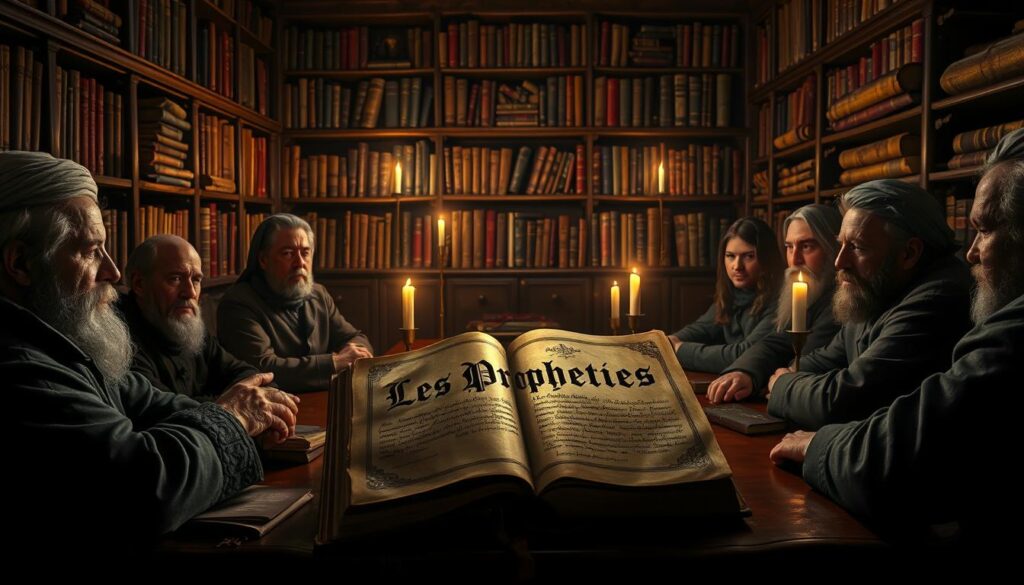
Les Prophéties: quatrains arranged in Centuries
Les Prophéties appears as a book of enigmatic quatrains grouped into numbered centuries. The 1555 collection ultimately held 942 short poems that encouraged flexible reading and many later interpretations.
The almanacs and public popularity
The almanacs began around 1550 and offered yearly forecasts, calendars, and household advice. They spread his name quickly and built steady demand for his services.
Medicine and other texts
He also wrote on medicine, including a Galen paraphrase and the Traité des fardemens. The Orus Apollo manuscript survives in Lyon and shows his broader scholarly interests.
Editions, variations, and textual challenges
Sixteenth-century printing practices produced spelling and punctuation differences across editions. Later reprints expanded availability but added inconsistencies that complicate modern references.
“Readers often expect precise prediction, yet the verses invite interpretation across eras.”
- The mix of genres widened his audience.
- Obscure wording helped verses stay relevant to new events.
- The book format and later editions both spread and muddied the record.
For context on related supernatural topics and public appetite for forecasts, see supernatural abilities.
How he wrote: Methods, sources, and the making of prophecies
He built a literary method that masked sources behind layered language and mixed tongues. The quatrains use French, Latin, Italian, Greek, and Provençal to veil meaning and invite many readings.
Astrology and practical charting
Judicial astrology and comparative horoscopy shaped timing and tone. He compared charts to earlier events to suggest patterns.
Errors appear in some tables and dates, so charts are not uniformly reliable. Those slips help explain later reinterpretation.
Books, sources, and learned references
He borrowed from classical authors like Livy and Suetonius and medieval compilations such as the Mirabilis Liber. These references anchored his lines in shared history.
Technique and rhetorical devices
Bibliomancy may have supplied sparks: opening a book and lifting an image or phrase to build a stanza. He often stressed precedent rather than fresh revelation.
“He preferred to bind past precedent with poetic ambiguity, not claim new sight.”
That way of composing made the verses flexible enough to travel the world and fit many events. The method blends scholarship and performance, which helps explain enduring interest in his prophecy.
From predictions to “hits”: What Nostradamus predicted—fact-checked
Short, obscure verses gain power when later readers pair them with dramatic historical events. This section checks high-profile matches and the facts behind them.
The “young lion” and Henry II
One quatrain is linked to the 1559 jousting death of Henry II. Supporters point to imagery and a duel-like scene. Critics note the wording is broad and fits many violent rulers, so the link is debated.
London’s king and the Great Fire
Readers have mapped lines about a king’s death to Charles I in 1649 and a separate verse to the 1666 Great Fire. Each read depends on flexible counting and later editorial changes, not on clear, contemporaneous prediction.
Napoleon, Hitler, and retrofits
Claims tying quatrains to Napoleon or Hitler usually stretch translation and ignore historical context. These attributions often follow headlines rather than textual proof.
July 1999 and the end
The famous July 1999 phrase of a “great King of terror” produced apocalyptic buzz but no definitive end. Scholars stress post hoc matching over strict fact-based prediction.
“Selective reading turns poetic ambiguity into retrospective hits.”
For further reading on symbolic number patterns and modern interpretation, see angel number 2929.
Belief, skepticism, and reputation during and after his lifetime
His contemporary reputation was a study in contrast—celebrated by rulers, questioned by scholars.
Court favor and institutional friction
Catherine de’ Medici summoned and later honored him, which gave him prestige at court. That support helped his public profile among elite people.
Yet he faced criticism from professional astrologers and some clergy. In 1561 he was briefly imprisoned for publishing without episcopal approval, not for formal heresy.
Academic skepticism and textual trouble
Scholars point to vagueness, frequent mistranslation, and editorial changes that make strict readings risky.
Printing inconsistencies mean modern references and citations can differ across editions. That variation lets others fit lines to later events.
| Support | Criticism | Textual issues |
|---|---|---|
| Court patronage (Catherine de’ Medici) | Professional astrologers and some clergy | Variant editions, spelling, and punctuation |
| Public almanacs and clients | Academic doubts about method | Mistranslation and vague language |
| Short-term fame in his lifetime | Occasional legal trouble (1561) | Later editorial emendations by others |
In a global world, readers keep projecting hopes and fears onto the verses. Always weigh dramatic claims against textual and historical fact.
For related context on psychic methods and critique, see psychokinetic research.
Impact and afterlife: How Nostradamus shaped culture and politics
Centuries of reprints moved the quatrains out of private hands and into public life. Over two hundred editions and thousands of commentaries appeared after his death, and print piracy amplified reach.

Print culture, piracy, and spread
The physical form of the book made copying easy. Cheap editions, unauthorized reprints, and translations sent lines across the world.
Readers in different towns folded verses into local fears and hopes. The flexible wording let adapters reshape meaning to fit events.
Propaganda and manipulation
Others have used the name for influence. The Third Reich’s propaganda machine cited verses to bolster narratives and morale under Joseph Goebbels.
Modern movements repeat that tactic, using selective lines to support political or social claims.
Why ambiguity endures
Ambiguity keeps the verses alive. When language is open, media cycles revive quatrains during crises, inviting new readings every time.
“A book of adaptable prophecies travels best when readers need answers more than proof.”
| Mechanism | Effect | Example |
|---|---|---|
| Cheap editions & piracy | Rapid, wide distribution | Hundreds of early modern reprints |
| Selective citation | Political legitimization | Nazi-era propaganda use |
| Textual ambiguity | Ongoing reinterpretation | Media revivals in modern crises |
Across time, readers layered new history onto old lines. The global popularity owes as much to format and distribution as to the verses themselves.
Key years and events: A quick timeline of Nostradamus’s life and work
A tight timeline of decisive years helps trace a life that mixed healing, print, and public attention.
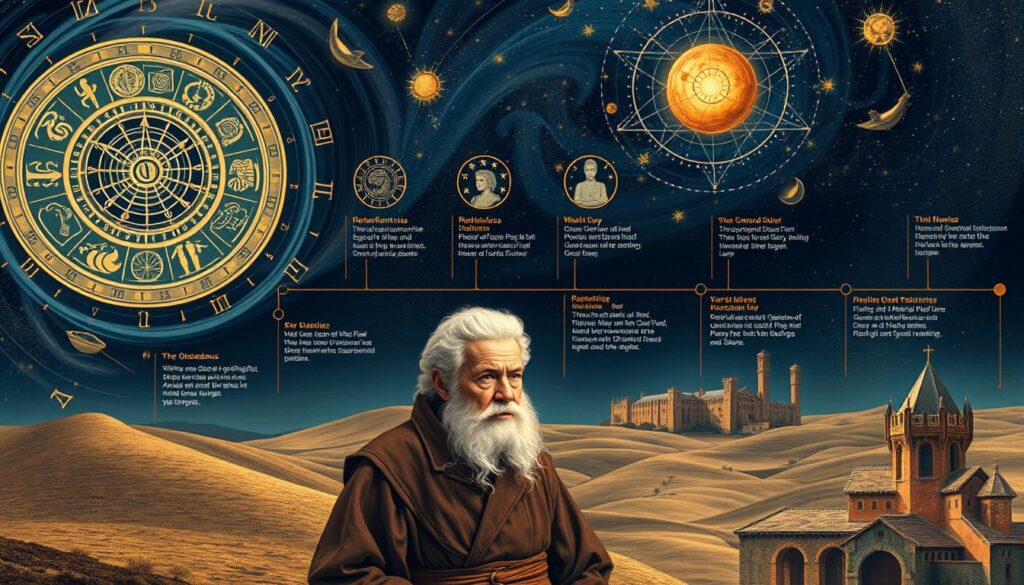
1503 — Born in Saint-Rémy-de-Provence, beginning a life rooted in provincial France.
1520s — Studies at Avignon paused when plague closed the university, a turning point that altered educational plans.
1529 — Enters the University of Montpellier and is later expelled, a fact that shaped early professional standing.
1531–1534 — Marries, then suffers the tragic loss of his first wife and two children; this grief influenced later choices.
1547 — Settles in Salon-de-Provence and builds a local practice that later supports wider fame.
1550 — Publishes the first almanac, a practical work that spreads his name among readers.
1555 — Releases Les Prophéties, a collection that becomes central to later references and debate.
1556 — Summoned to court by Catherine de’ Medici, an event that links provincial work to royal attention.
1561 — Briefly imprisoned over publishing issues, highlighting tensions around authority and print.
1566 — Dies in Salon-de-Provence, closing a career that spanned major sixteenth-century shifts.
“These years show how medical practice, printed almanacs, and public reputation moved together in one life.”
| Year | Event | Significance |
|---|---|---|
| 1503 | Birth | Roots in Provence; start of a provincial career |
| 1520s | Avignon closure (plague) | Changed studies and career path |
| 1529 | Montpellier entry & expulsion | Affected credentials and reputation |
| 1531–1534 | Family tragedy | Personal loss that shaped decisions |
| 1550–1555 | Almanac (1550) & Les Prophéties (1555) | Major publications that defined later references |
| 1556–1561 | Court summons & imprisonment | Court favor and conflict with authorities |
| 1566 | Death | End of a life in a changing century |
Names, terms, and references you’ll see in Nostradamus studies
A handful of terms — each with a specific meaning — helps new readers sort printed quatrains from practical almanacs.
Les Prophéties, quatrains, “Centuries,” and almanacs
Les Prophéties is the central book: a loose collection of four-line quatrains gathered into numbered centuries.
The quatrains are short, cryptic verses. The Centuries are simple groupings meant to organize those verses.
Almanacs differ. They gave yearly advice and practical forecasts, not undated poetic lines. Readers used almanacs for daily planning and Les Prophéties for long-range interpretation.

Places, people, and quick references
The university montpellier marks a contested academic chapter in his life. Salon-de-Provence served as his long-term base and local reputation center.
Catherine de’ Medici raised his public profile at court. His son César is linked to a familiar portrait, and his later children figure in family accounts.
- Use clear references when citing editions and translations.
- Check edition notes: wording and punctuation vary across prints.
“Treat labels as guides, not proof; they help you find primary references.”
What does Nostradamus mean for us today?
Today’s readers meet centuries-old verses inside a stream of news, data, and speculation. That mix makes short, vague lines easy to amplify and misuse.

Understanding predictions in an age of data and misinformation
The modern world has more data but also more noise. Charts and headlines can lend false certainty to poetic lines.
Scholars warn about mistranslation, edition shifts, and deliberate retrofitting. Historical examples show how groups repurpose verses for political ends.
How to read a prophecy responsibly
Read with context. Check original language and edition before accepting a modern claim about the future.
Compare translations, note editorial changes, and beware selective quotation. Treat nostradamus prophecies as literary texts, not hard forecasts.
“Balance curiosity about the future with clear standards of evidence and text-critical reading.”
- Verify the edition and original phrasing.
- Look for contemporary sources, not retrofits.
- Keep healthy skepticism when lines fit many events.
Conclusion
A single career blended hands-on care, popular almanacs, and poetic lines that invite continual reading.
His work sits at the crossroads of medicine, learning, and occult practice in Renaissance France. That mix shaped a public role that was practical and performative.
Textual choices favor precedent and ambiguity, so verses reward many readers and many eras. This pattern explains why his reputation outlives strict historical proof.
At the end, the best approach balances curiosity with caution. Check original editions, consult sound scholarship, and treat striking lines as literary material, not immediate fact.
For a deeper view of his life and the history behind printed quatrains, explore primary texts and modern critical studies to move beyond popular claims and into careful understanding of the life and legacy.