
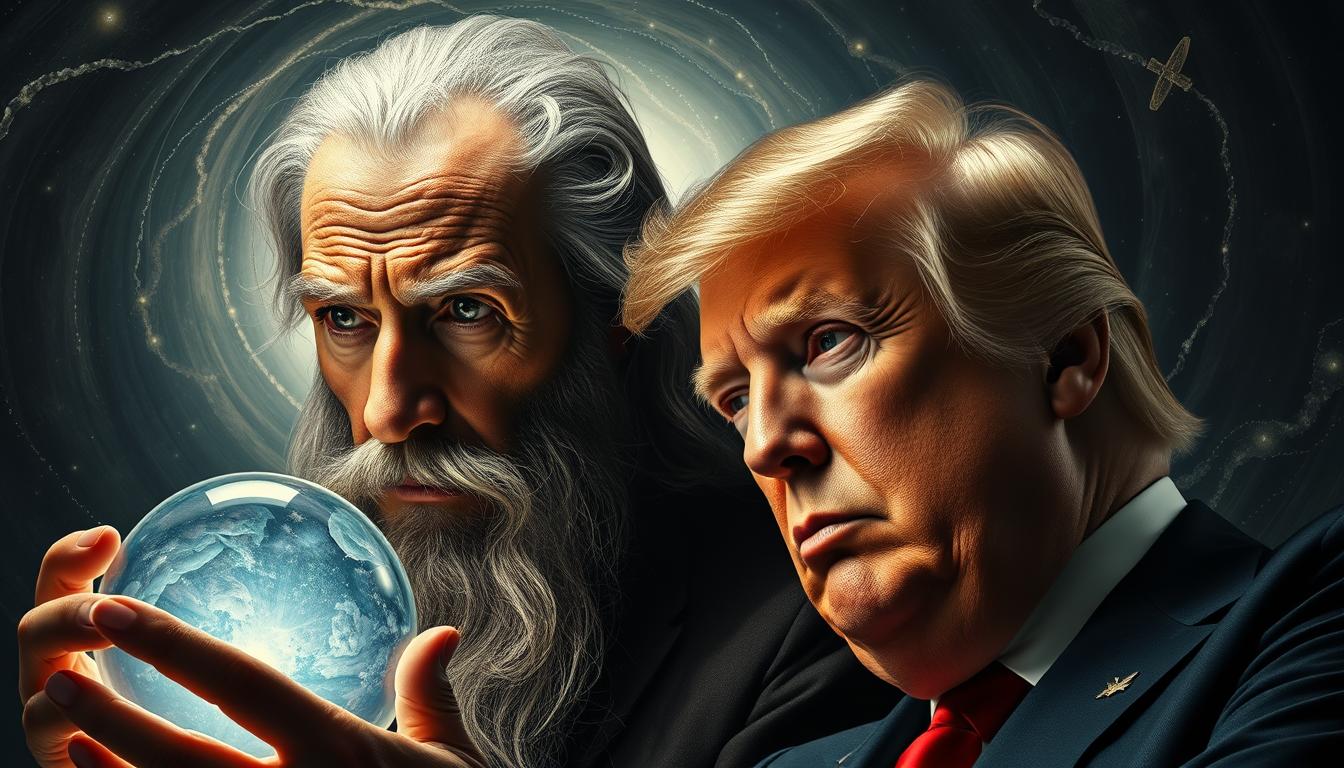
Why centuries-old quatrains still spark debate is simple: readers love patterns. The phrase “what did nostradamus say about trump” resurfaces whenever headlines turn chaotic. People map vague lines to modern leaders and moments.
The most cited verses mention a loud figure and a false trumpet. Scholars stress that translations and puns shape those links. At the same time, viral takes revive these lines during each election cycle.
We’ll look at key predictions and the two quatrains often quoted. I’ll show how context, translation, and human pattern-seeking change meaning. The goal is clear: balance scholarly caution with the popular readings that appear online.
Expect a roadmap: a primer on the author and method, close readings, modern trend analysis, and what these interpretations mean for readers in the United States.
Key Takeaways
- Centuries-old quatrains get reinterpreted when headlines shift.
- Translations and puns shape links to modern leaders.
- Psychology often fuels pattern-seeking in vague text.
- Two quatrains are most cited in recent years.
- Read on for context, close readings, and modern trends.
- For related predictive claims, see psychic predictions.
Decoding Nostradamus in a Modern Lens: Why Trump Enters the Conversation
Les Prophéties, published in 1555 by Michel de Nostredame, grouped short poetic quatrains into “centuries.”
These compact lines mix classical allusion, symbolism, and multilingual wordplay. Translators often fragment context, which widens the range of possible readings. That process helps explain why some people treat these verses as near-term predictions.
Who Nostradamus Was and How His Quatrains Work
He published centuries of shorthand poetry that read like layered riddles. Each quatrain packs images and names that can cross eras and culture. Scholars argue this invites metaphorical study rather than literal forecasting.
Pattern-seeking and apophenia: why vague verses feel specific in chaotic times
Psychologist Michael Shermer calls humans “pattern-seeking mammals.”
“We are wired to connect dots, even when the links are loose or imagined.”
In anxious moments—political upheaval, market swings, or war—readers lean into these lines. Brief symbolism lets current events fill gaps. That is apophenia: the urge to build a clear story from ambiguous cues.

| Feature | Effect on meaning | Why it matters |
|---|---|---|
| Oblique language | Multiple plausible readings | Allows alignment with many events |
| Fragmented translation | Shifts nuance and emphasis | Feeds online reinterpretation |
| Archaic references | Loose historical anchors | Invites metaphorical use over time |
Quick takeaway: these lines act as cultural mirrors. They show both our hunger for guidance and the ease with which the past can be read into the present. For readers curious about modern psychic claims tied to old texts, see a range of offerings like psychic readings to compare approaches to the future.
What did Nostradamus say about Trump
Readers often pair vivid lines with modern leaders when politics grows heated. Below we quote and unpack the most cited passages, then weigh common readings against linguistic and historical caution.
“The great shameless, audacious bawler” — text, context, and claims
Quoted lines: “The great shameless, audacious bawler, He will be elected governor of the army: The boldness of his contention, The bridge broken, the city faint from fear.”
Popular reading links the brash tone to a commanding public man and to fears about military influence and domestic strain.
The “false trumpet” passage: language, symbolism, and the Trump/trumpet pun
Another often-cited quatrain mentions a “false trumpet concealing madness” and shifts in laws and money. Because the original is in French/Latin, the English pun with the surname fuels viral connections.

Bridges broken, cities faint from fear: linking verses to division and upheaval
Readers tie “bridge broken” to strained alliances and domestic polarization. “City faint from fear” is read as social unrest, protests, or security crises. Such readings map images to current events rather than proving prediction.
Limits of attribution: no name appears
Scholarly caveat: the quatrains never name a modern leader. Interpretations rely on selective translation, metaphors, and retrofitting lines to fit public figures.
“The lines offer archetypes—ambition, disruption, aftermath—more than precise forecasts.”
| Quatrain line | Common public reading | Scholarly limit |
|---|---|---|
| “Great shameless… governor of the army” | Brash leader with military sway | Vague language allows many fits |
| “Bridge broken, city faint from fear” | Broken alliances, unrest at home | Imagery is symbolic, not specific |
| “False trumpet… changing money and standards” | Policy churn, economic shifts | Original words differ; pun is English-driven |
For readers comparing prophetic claims and modern psychic offerings, see a related discussion on ten of wands and how broad symbols circulate in popular forecasting.
From Prophecy to Trend: How War, Money, and Power Shape Today’s Predictions
A single viral lecture can turn cautious academic frames into public predictions overnight.
Beijing-based historian Jiang Xueqin sketched a scenario in May 2024 where a second administration faces pressures pushing toward war with Iran. He named a joint plan—“Operation Iranian Freedom”—and listed likely partners: the U.S., Israel, Saudi Arabia, the UK, and the UAE.
Why this spread fast: it tied security fears, economic leverage, and alliance politics to an easily shared narrative.

Operation Iranian Freedom: actors and estimates
Jiang suggested an initial U.S. deployment of about 100,000 troops. He warned that true occupation would demand 3–4 million—logistically and politically unrealistic given Iran’s terrain and cohesion.
| Actor | Role cited | Rationale |
|---|---|---|
| U.S. | Lead military power | Hegemony, ally defense |
| Israel | Security driver | Protect against regional threats |
| Saudi/UK/UAE | Allied support | Regional balance, economic interests |
Echoes of old themes
These projections show how talk of war, shifts in laws, and moving standards can reshape markets and national moves. Public forecasts mix strategic analysis with cultural motifs, blurring history and the imagined future.
“Speculative scenarios often become part of the public story when a crisis feels near.”
For related predictive currents and cultural framing, see a modern take on ancient claims at ancient-aliens.
Past as Prologue: How 2024-2025 Talk Revived Nostradamus
Annual prophecy cycles act like a cultural echo, bringing short lines back into view when headlines shift.
During the 2024–2025 window, a mix of crises pushed fresh predictions into public conversation. Commentators linked lines about the “world’s garden” to climate fires and floods.
Others read mentions of a long war and empty coffers as warnings that armies could run out of pay and will. That framing fed fears of sustained war and resource collapse in some analyses.
Debates also tied symbols like “Gallic brass” or a crescent sign to tensions in a European country or Turkey. At the same time, talk of a cosmic harbinger spurred dual anxieties: asteroid or atomic event.

“Open-ended lines let each year refit past words to modern headlines.”
Why it sticks: broad imagery handles many narratives—royal unrest in England, financial strain, or space risks—so predictions recur each year. For a related symbolic reading, see the five of swords reading.
Conclusion
Clear-eyed readers should treat dramatic quatrains as poetic prompts, not literal roadmaps. The verses invite bold interpretation, yet careful study shows no named modern leader. Keep one eye on language and one on evidence when claims link a single man or headline to centuries-old lines.
Context matters: viral trend analyses — like Jiang Xueqin’s wartime scenario — amplify fears of war, legal upheaval, and economic shock. That pattern shows how prophecies and modern forecasts travel together through anxious time and reshaped memory.
Respect the poetry, weigh the facts, and look for practical sources when you want grounded insight into the future of the world or a single figure such as donald trump. For related symbolic readings, see a Tarot take on the Knight of Cups and an overview of supernatural abilities.