

Structure gives a reading purpose. A clear layout turns intuition into practical steps you can use in daily life.
Different themes — love, career, moon phases, zodiac timing, and Major Arcana focus — shape which layout fits your question. Groups like Labyrinthos organize patterns such as three-position daily pulls, job-hunt strategies, and self-love layouts.
This guide walks you from simple three-item draws to deeper ten- or twelve-position frameworks. You will learn classic layouts, zodiac and lunar patterns, and how to design a custom spread that matches your intent.
Each position has a job: assign roles to positions and the result is a repeatable process that supports sharper decisions, clearer communication, and better timing for life changes.
Approach every layout as a focused conversation. Journal placements and outcomes to track growth and build confidence over time.
For a helpful library of patterns and examples, see tarot spread resources.
Key Takeaways
- Layout and position create order so insights become actionable.
- Choose a quick three-item draw for clarity or a multi-position layout for depth.
- Use themed patterns (love, career, moon, zodiac) to focus readings.
- Assign roles to positions to make interpretations consistent and practical.
- Journal readings to spot patterns and improve decision-making.
- Layouts support choice and perspective; they complement your free will.
What Are Tarot Card Spreads and Why They Work
When cards are placed with intent, their relationships reveal a coherent story. A spread is a mapped layout where each position answers a prompt. That order gives the reading purpose and keeps interpretation focused.
Layouts, positions, and proximity: physical placement matters. Neighboring placements can support or challenge each other. Proximity can signal tension, escalation, or ease between symbols on the table.
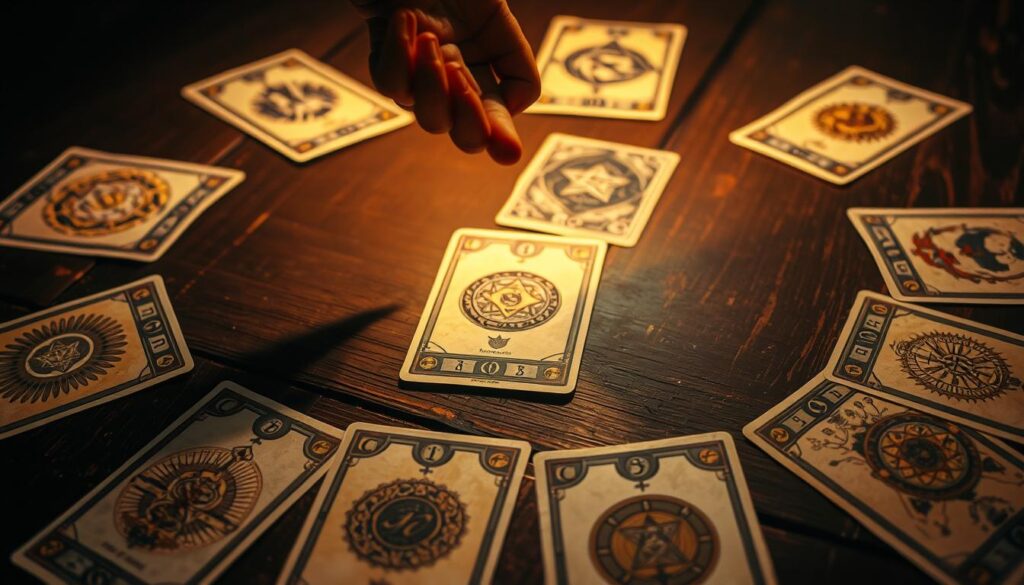
Reading the “story”: suits, numbers, and Major vs. Minor Arcana dominance
Scan the spread for dominance. If major arcana appear more often than minors, expect themes about life chapters and big shifts. A repeated suit points to one element as central.
Numbers echo themes: multiple 2s highlight choices; repeated 7s suggest assessment or testing. Start with each position’s prompt, then synthesize across rows or clusters to build the full meaning.
- Name the position aloud, place the card, state its core link to the prompt.
- Then read neighbors to refine timing, tension, or support.
- Use knowledge + intuition: let the prompt hold the baseline while letting flashes of insight add nuance.
For a collection of mapped layouts and examples, see tarot spread resources.
Decks, Suits, and the Role of Intuition in a Reading
Choosing a deck is like choosing a language for the conversation you want to have. Pick tender imagery for relationship work, raw art for blunt truth, muted visuals for healing, or surreal styles for shadow exploration.

Choosing a deck by purpose
Popular options include Modern Love Tarot for romance clarity, The Penumbra Tarot for subconscious work, Bad Bitches Tarot for direct feedback, and the Awakened Soul Oracle for soothing integration.
Practical tip: choose your tarot spread first, then pick the deck whose images answer those prompts most clearly.
When to use the full deck, Major Arcana-only, or court emphasis
Use the full deck for nuance and finer detail. Pull only major arcana when you want to highlight life cycles and big themes.
Emphasize court cards to map roles, leadership styles, or relationship dynamics. Courts act as quick personality proxies in a reading.
- Interview your deck: ask what it’s best at and how it likes to guide you.
- Watch suits: repeating Wands, Cups, Swords, or Pentacles shows elemental focus.
- Journal: note which deck gives clear answers for each tarot spread over time.
For deeper archetypal context and practical examples, see The Chariot insights.
Tarot Card Spreads for Beginners: 3-Card and 5-Card Foundations
Start small: three- and five-position layouts teach structure and build confidence fast.
Core three-position patterns are ideal for quick clarity. Use Past–Present–Future for a snapshot of flow. Choose Situation–Challenge–Advice when you want actionable next steps.
Other useful 3-card examples include Action–Reaction–Outcome and Do–Don’t–Proceed with Caution. Pick the version that best fits your questions so the reading stays focused.
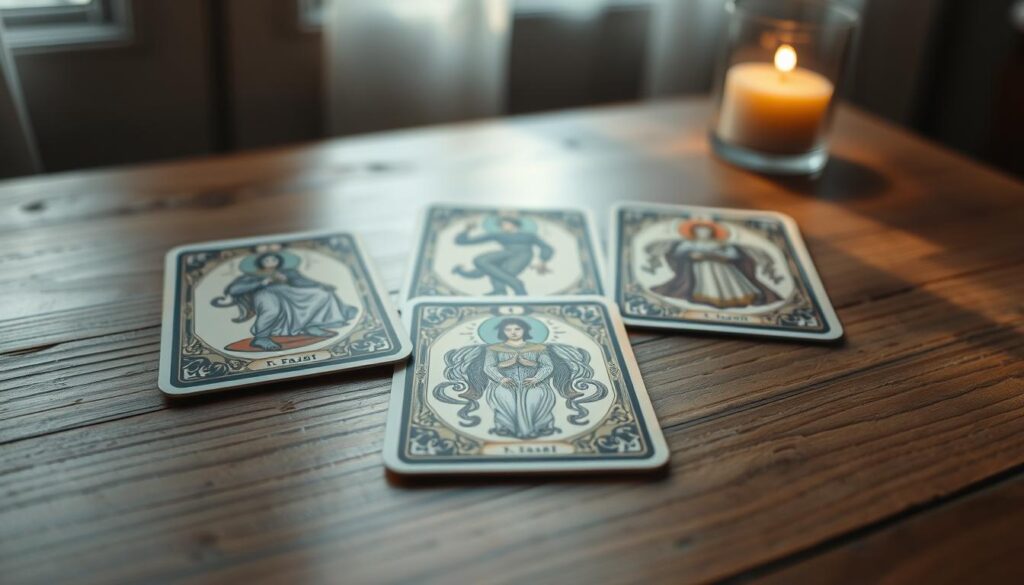
Mini-spreads for love and work
For a simple love layout to find “the one,” ask: where you’ll meet, how the encounter unfolds, and when timing lines up.
For a career leadership check, pull three to show how to communicate, where to inject motivation, and what to celebrate to keep momentum at work.
Reading combinations
Name each position aloud, then link card 1 to card 2, and 2 to 3. Craft a short, linear story before you zoom out to the whole picture.
Tip: summarize the through-line in one sentence at the end to lock in meaning and order.
Five-card cross template
The 5-position cross expands depth without chaos: Center (core energy), Past (trigger), Future (projection), Known (conscious focus), Unknown (subconscious). Use it when a quick check needs more context.
- Shuffle with intent, cut when ready, place cards in precise order.
- Practice the same layout weekly with one deck to speed learning and pattern recognition.
“Practice small layouts often; they train your eye to spot links and build reliable intuition.”
From Classic to Advanced: Celtic Cross and the Twelve-House Astrology Spread
A focused ten-position cross and a twelve-house life map offer two clear approaches: solve one complex situation or scan many life areas at once.
A refined Celtic Cross gives exact prompts so each position feels actionable.
A refined cross: prompts that clarify meaning
- 1 — Self: current state and main influence.
- 2 — Cover: the protective mask or obstacle; if it aligns with Self it supports, if it conflicts it blocks progress.
- 3 — Internal: beliefs and hidden patterns shaping choices.
- 4 — External: circumstances or other people pushing the situation.
- 5 — Past: events that led here.
- 6 — Future: likely trajectory if nothing changes.
- 7 — Strengths: assets and blind spots you can use.
- 8 — Others: allies, rivals, and their likely influence.
- 9 — Advice: the lever you can pull now to alter outcome.
- 10 — Outcome: projected result based on current course.
Separate Positions 3 and 4 to tell internal forces from outside pressures. That split makes action planning clearer.
Read Advice (9) as the active tool to nudge the Outcome (10). Treat them as a pair when you plan next steps.

The twelve-house life map
The twelve-house layout anchors a broad life review. Angular houses (1, 4, 7, 10) are strongest; read them first to set identity, home, partnerships, and career tone.
| House | Focus | How to read it |
|---|---|---|
| 1 | Self | Identity and current persona — start here. |
| 4 | Home/Roots | Foundation, family background, stability. |
| 7 | Partnerships | Close relationships, contracts, mirrors. |
| 10 | Career/Public | Public role, status, long-term goals. |
“Use the cross for one knotty issue; use the house map to revisit life chapters over time.”
Quick cadence: try the cross for a single complex question and run the twelve-house scan quarterly for broad perspective and steady knowledge growth.
For an example of how personality figures show up in readings, explore a focused archetype like the Knight of Cups.
Love, Career, Daily, and Spiritual Tarot Spreads You Can Use Today
Simple, repeatable pulls bring clarity to love, work, daily choices, and deeper soul work. Pick one small layout and run it weekly to notice shifts.
Love and relationships
Try a quick connection check: What to celebrate, what needs repair, and one step for your partner. For new romance, pull timing, vibe, and next move.
Career and work
Use a three-position job-hunt spread: Opportunity, skill gap, and networking action. For business planning, swap in market energy, strength, and risk.

Daily draws
Morning three-card reading: focus, obstacle, and small action. Prefer a yes/no approach for fast decisions, but expand when questions feel complex.
Spiritual growth
Use a ten-position development spread for self-love, major arcana review, or archetype mapping. Revisit the Celtic Cross when you want a richer, guided overview.
| Use | Positions | When |
|---|---|---|
| Love check | 3 (Celebrate, Fix, Action) | Weekly or after conflict |
| Job strategy | 3 (Role, Gap, Network) | During job search |
| Daily clarity | 3 (Focus, Obstacle, Move) | Every morning |
| Spiritual map | 10 (Growth overview) | Monthly or on New Moon |
“Pick one love and one career layout and use them often; mastery comes from repetition.”
Tip: track energy and themes over time and align practice with the moon to spot repeating patterns in relationships and inner work.
Moon Magic: Full Moon and New Moon Spreads by Zodiac Sign
Aligning a spread with the lunation and its sign helps your questions land with more purpose. Use the full moon to examine harvest and closure. Use the new moon to plant clear intentions that follow the sky’s lesson.
Full moon focus: tailor the pull to the sign. Libra asks for balance and fairness. Scorpio asks for depth and secret truth. Sagittarius asks for perspective and long-term goals.

New moon intentions by sign
New moons invite planting. Choose prompts that match the sign: Aries for ignition and action, Virgo for method and routine, Aquarius for innovation and community. Ask practical questions that point to the next step.
Timing your reading
Pull within 24 hours of the lunation for peak clarity. Then check back three to seven days later to note shifts toward the future you intend. Journal one sentence after each session to hold the lesson.
Mercury retrograde check-in
Use a five-position retrograde check: 1) How to prepare, 2) Theme for this retrograde, 3) What to wrap up, 4) Where to hold power, 5) How to keep communication clear.
| Use | Sign Focus | Prompt Example | When |
|---|---|---|---|
| Full Moon | Libra | Where do I need balance now? | Within 24 hours of full moon |
| Full Moon | Scorpio | What needs deeper truth or release? | Within 24 hours of full moon |
| New Moon | Aries | What action should I ignite first? | New moon night or next day |
| Retrograde Check | Mercury | How do I protect clear speech? | Start of retrograde |
“Match your questions to the sign’s lesson and journal one sentence after each moon pull to track steady growth.”
Tip: Moon-aligned practice clarifies relationship dynamics and inner energy. For guided sessions and readings, see a trusted resource like psychic readings.
Major Arcana Focus Spreads: Working with Big Life Energy
When the world feels weighty, use a major-focused layout to translate archetypal energy into action. These layouts center a single image to guide how you frame a problem, sort emotion, and pick the next step.

The Moon: navigate confusion and trust instinct
Use this spread when things feel foggy or secretive. Positions: Fear vs. Intuition, Hidden Factor, Practical Next Step. This helps split worry from gut sense so you move forward with calm clarity.
The Tower: sacred disruption and rebuilding
Positions: What must fall, What to protect, Where help is, How to rebuild. Read these to plan practical recovery and keep what matters safe while making space for new foundations.
The Star & The Sun: hope, healing, and illumination
Pair these when recovery and joy matter. Positions: Small healing milestone, Daily joy practice, Where light warms relationship or work. Use the pair to map growth and welcome brighter energy.
Death, Justice, and The Wheel: endings, choices, and cycles
Positions: What to release, Decision point, Next cycle’s lesson. This trio frames endings as openings and helps you weigh facts with compassion while riding change with intention.
“Try one Major-focused layout each month to build a library of lessons and track how your resilience grows.”
| Focus | Sample Positions | When to Use |
|---|---|---|
| The Moon | Fear vs. Intuition; Hidden Factor; Next Step | When things feel unclear or eerie |
| The Tower | Must Fall; Protect; Support; Rebuild | After a sudden upheaval |
| The Star & Sun | Healing Milestone; Joy Practice; Illuminate | During recovery or celebration |
| Death/Justice/Wheel | Release; Choice; Cycle Mapping | When endings lead to new paths |
Note the emotional temperature of each reading. Track feelings and outcomes to see how your capacity to meet change grows over time. For broader context and examples, visit the resource library.
How to Choose, Create, and Evolve Your Tarot Spreads
Start by sizing the question — a focused ask needs fewer positions, a wide life issue needs more depth.
Match scope to layout: use a 3-position pull for tight focus, a 5-position layout when nuance matters, and larger frameworks when a situation spans home, work, and relationships.
Designing your own layout starts with clear prompts for each position. Name each slot (for example: Core, Obstacle, Next Step), set an order, and test the spread on a known situation to check clarity.
Test and refine: if a position returns vague meanings, rename or move it. Small changes in order often improve signal and make readings more actionable.

Yes/No method: the ace-count approach
Shuffle while asking the simple question. Deal face-up into three piles. Stop each pile when you hit an Ace or the 13th card. No pile should exceed 13 cards.
- Count Aces: 3 = Yes.
- 2 = Probably yes.
- 1 = Probably no.
- 0 = No.
When to avoid binary answers: if stakes are high or context is complex, expand into a targeted layout that unpacks timing, motives, and resources instead of forcing a yes/no reply.
Practical checklist before any pull
| Step | Why it matters | Action |
|---|---|---|
| Confirm the question | Keeps the reading focused | State it aloud and keep it brief |
| Pick a layout | Matches depth to scope | Choose 3, 5, or larger based on need |
| Set position prompts | Stops drift and vague phrasing | Write short labels for each spot |
| Test the spread | Checks clarity and usefulness | Read for a known example, adjust as needed |
Keep a personal library of layouts and notes on what each layout does best. Journal what changed after readings to build real-world knowledge and improve future advice. For a deeper example of position-driven clarity, see this refined approach to the Ten of Wands reading at ten of wands.
“Design with purpose, test with care, and iterate until each position tells a clear part of the story.”
Conclusion
Small, repeatable readings build the muscle to use larger layouts when a situation needs more detail. Important: pick two or three spreads that match how your mind works and practice them until interpretation flows.
Use moon-timed pulls or a major arcana focus when the season or a big life shift calls for deeper review. After each session, state your intent, pull with presence, write one clear lesson, and choose one small action to take today.
Spreads are tools: they give people and partners a way to turn insight into action. Save this post, revisit passages as you grow, and keep building a personal library that puts insight into real-world power and better choices for the future.