

Welcome. This short guide treats the practice as a practical, intuition-led tool for everyday decisions and self-reflection, not a rigid fate-telling system.
Start small. You will learn to work with a few cards at a time, use simple spreads and routines, and build confidence as you go.
We’ll explain how the system works, how to choose a first deck, and how suits and archetypes map to real life. Expect easy daily pulls, a Four-Card Check-In, and tips on asking clearer questions.
No memorization pressure. Learn images and meanings gradually through short, frequent practice. This approach blends intuition with simple frameworks to make the idea a steady habit.
Examples, exercises, and educator-sourced tips appear in each section. You can begin reading yourself with one or two cards and expand as your comfort grows. To explore deck choices, see trusted resources.
Key Takeaways
- Approach the practice as an intuition-first, practical tool.
- Begin with one or two cards and short daily pulls.
- Use simple spreads and a Four-Card Check-In to clarify choices.
- Build meaning slowly through practice, journaling, and reflection.
- Expect insight, not sealed fate; stay grounded and curious.
Start here: what tarot really is and how beginners can use it today
A simple pull can turn vague feelings into a short story you can respond to with practical steps. The system uses 78 illustrated pieces that reflect symbols, emotions, and possible paths. It works like a mirror: images spark ideas your conscious mind might not name yet.
Use it for self-reflection and decision support. Pull one or two pieces to unpack a situation, narrate the story you see, then journal first impressions before checking guide meanings. That practice strengthens your intuition and breeds clarity.
Small, specific prompts give clearer results. Ask, “What action can I take now?” rather than broad yes/no questions. Pick a quiet time, set an intention, and aim for short daily pulls or a weekly three-item check-in.

- Mirror use: reflects likely paths, not fixed fate.
- Quick method: look at figures, symbols, direction, and color.
- Rhythm: short daily pulls or weekly three-item checks.
| What to do | Why it helps | Quick tip |
|---|---|---|
| Pull one item | Focuses on a single issue to reduce overwhelm | Journal first impressions |
| Pull two or three items | Creates a simple story arc for decision-making | Ask specific action-based questions |
| Use a weekly check-in | Tracks patterns and growth over time | Note repeats and emotions |
For a closer look at classic imagery and archetypes, explore a focused example like The Chariot guide. Different readers will interpret the same images differently; your view adds meaning and direction. Keep the practice compassionate and curious—it’s a tool to talk honestly with your inner life.
Choosing your first tarot deck and learning the basics
Pick visuals that spark curiosity. A single deck should feel like a good match. If the artwork invites ideas and questions, you will practice more often and learn faster.
Begin with a classic or find a modern voice. Many readers start with Rider-Waite-Smith because its scenes clearly suggest meanings. Other options to compare include Thoth Tarot, The Next World Tarot, She Wolfe Tarot, and Cosmic Slumber Tarot. Each style changes tone and language, so pick what clicks.
Quick system basics
A standard set has 78 cards: 22 Major Arcana and 56 Minor Arcana. The major arcana show big themes and life milestones. The minor cards map daily life through four suits.
Suit energies at a glance
| Suit | Element | Keywords |
|---|---|---|
| Wands | Fire | Passion, ambition, action |
| Cups | Water | Emotions, relationships, flow |
| Swords | Air | Thoughts, communication, decisions |
| Pentacles | Earth | Work, body, home, resources |
Many readers learn meanings in this order: look at the picture first, name what you see, then add traditional notes. A simple idea to practice is a one-card daily pull: describe the scene in your own words before checking a guide.
When shopping, do a quick feel check. If the deck’s imagery sparks curiosity, it will teach you more easily than a design you only like a little. One solid deck is enough to build confidence and a steady habit.
Build an intuition-first routine that fits your day
A short, consistent habit can make intuitive practice feel natural and useful in everyday life.
The daily draw is a tiny ritual that anchors attention and invites insight. Pick a reliable time each day, ask, “What do I need to know today?” and pull one card to focus your intention.
The daily draw: your card of the day practice step-by-step
Two simple methods: pull the top item each morning and place it at the bottom later to work through the order of the deck, or shuffle fresh each day and accept repeats that call your attention.
Journal immediately: date, the pull, quick impressions—colors, symbols, suit hints—before checking any guide. At night, reflect and add traditional meanings as a second layer.
Shuffling, cleansing, and setting the mood
Keep the setup low-fuss. Light a candle, breathe, or play soft music to settle your energy. Any shuffling style is fine if you stay present and focused on the question.

- Short practice: five minutes most days beats long, infrequent sessions.
- If a pull repeats a lot, treat it as a clue—track themes over several days.
- If the deck feels stale, reset it under your pillow or do a mindful cleanse and return refreshed.
Tarot card reading for beginners: simple spreads that work
Simple, small spreads cut the noise and highlight what matters in a single session. Start with layouts that fit the question and your time.
One-card pull: quick clarity
Pull one card and ask, “What do I need to know today?” Describe the image first, then add a clarifier if needed. This quick spread is perfect for a noisy day.
Two-card spread: compare options
Label positions A and B to weigh choices. Note suit differences, court roles, and numbers to see which path fits your values and energy.
Three-card spread: a short story
Lay three cards left to right as past, present, future. Watch for suit clusters — many Pentacles often point to money or work themes. This mini timeline shows movement without overcomplicating the situation.
- Keep spreads to one–three cards to avoid overwhelm.
- Match the spread to the question: choices use two; storylines use three cards.
- End by writing one action sentence you can try this week.
Go a little deeper with the Four-Card Check-In
The Four-Card Check-In turns a short spread into a focused health and clarity review.
Setup: separate Major and Minor arcana. Pull one Major Arcana signifier as the headline. Then draw three Minor Arcana cards labeled body, mind, and spirit.
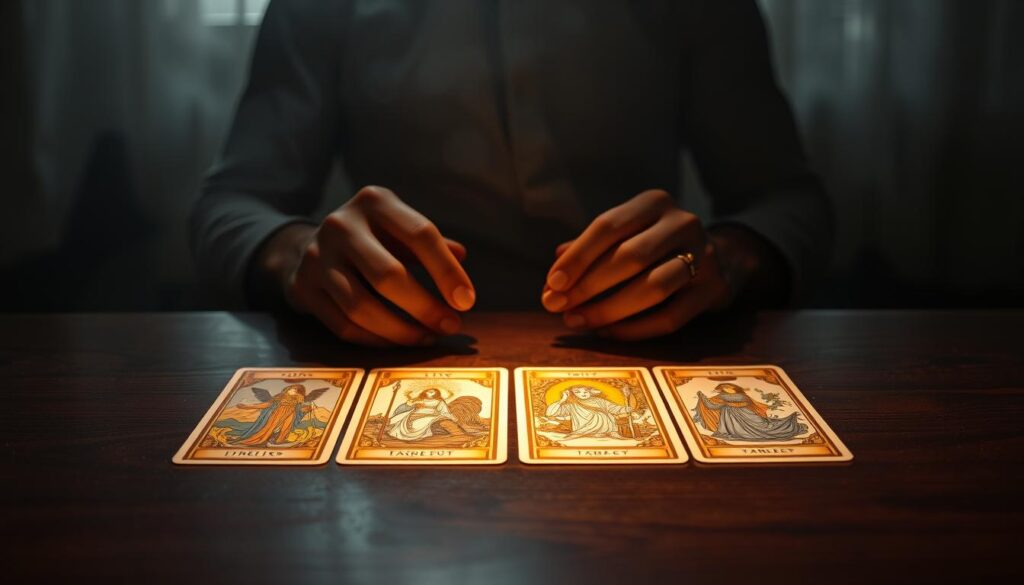
How to read the spread
Use the signifier as the core theme. It frames the three cards and gives context to details.
Interpret each Minor card in its realm. Body points to energy, sleep, or routines. Mind shows thoughts and feelings. Spirit hints at meaning and inner guidance.
Patterns, reversals, and overall energy
“Scan suits and repetitions first—those trends often tell the clearest story.”
- Watch for suit clusters: many Swords can mean mental strain; many Cups suggest emotional work.
- Decide on reversals ahead of time and keep that order consistent.
- Summarize the overall energy in one sentence: rest, action, or reflection.
| Signal | What it may mean | Practical action |
|---|---|---|
| Major Arcana signifier | Headline theme or life lesson | Frame the three-card details around this teaching |
| Many Swords | Mental strain, decisions pending | Try journaling or a short walk to clear thinking |
| Many Cups | Emotional focus, relationships | Call a friend or practice a boundary |
| Reversals common | Blocks or internal processing | Pull one gentle clarifier for the stuck position |
Document your meanings and one small step (hydrate, journal, meditate). Revisit this spread weekly or monthly to track change. For a deeper library of layouts, see a concise four-card spread guide.
Ask better questions to get clearer readings
Better questions move a reading from reassurance into useful guidance you can use now.
Begin by making your prompt specific and present-focused. Try: “What do I need to know to move this situation forward?” or “What action can I take today?” These ask for steps, not promises.

From “Is everything okay?” to “What action can I take now?”
Swap broad comfort-seeking questions for tight, time-bound ones. Limit the horizon to days or weeks so the guidance is practical.
Keep it to one clear prompt. Pull one card, write the exact question in your journal, then ask a brief follow-up only if needed.
Working with yes/no prompts and actionable follow-ups
“Yes/no questions can start a session, but always add: ‘What action supports the best outcome?'”
- Use present-tense wording: ask what to start, stop, or continue.
- If you use a yes/no, follow with an action prompt to turn a binary into a plan.
- Ask perspective-shifting prompts like, “What am I not seeing?” to avoid confirmation bias.
| Question type | Best use | Sample follow-up |
|---|---|---|
| Action-focused | Immediate steps and clarity | “What can I try in the next three days?” |
| Yes/No starter | Quick check, then expand | “If yes, what action supports it?” |
| Perspective prompt | Reveal blind spots | “What am I not seeing that matters?” |
| Boundary-aware | Reading self vs. others | “How can I stay helpful without crossing limits?” |
If you read yourself or others, set clear boundaries and steer sensitive topics toward empowerment. Track which phrasings work best and refine your go-to templates over time.
For guided sessions and services, explore trusted resources like psychic readings to learn how professional readers structure questions and follow-ups.
Keep a tarot journal to track insights, stalker cards, and growth
A compact practice notebook helps you notice patterns and turn snapshots into guidance. Use a short entry every day or whenever you pull a spread. Keep notes tight so you will return to them easily.

Set up your pages
Start with basics: date, spread used, the exact question, and the cards drawn. Write your intuitive impressions first—what the image suggested to your mind—before consulting guide meanings.
Follow-up checks
Return after a set time to note what actually unfolded. Record whether insights helped a choice, changed a plan, or simply shifted your mood. These follow-ups refine your interpretations over time.
Spot stalker cards and fuel creativity
List repeats in a running section. Repeated cards often point to an ongoing lesson or habit to integrate. Use a frequent image as a creative prompt: free-write a scene or sketch a character inspired by the symbol to spark new ideas.
- Jot your state of mind before a pull to compare how mood affects interpretations.
- Highlight one actionable takeaway per entry to celebrate small wins.
- Keep a weekly review page to summarize themes and course corrections.
| Entry item | Why it matters | Quick action |
|---|---|---|
| Date & spread | Tracks context and repeat patterns | Use consistent labels for easy search |
| Intuitive notes | Shows your first impressions and bias | Write before checking meanings |
| Follow-up note | Reveals what played out over time | Return in days or weeks and update |
| Stalker log | Highlights repeating themes that need attention | List dates and situations for each repeat |
“A short, regular log makes patterns clear and turns loose insights into useful steps.”
Read tarot your way: free-flow readings, boundaries, and beginner tips
Find a style that fits your rhythm.Some days a loose spread that feels like a conversation works best. Other times a labeled layout brings structure and clear steps. Both approaches are useful; choose what helps you act.

When to free-flow vs. use a spread
Free‑flow: lay a few cards and follow the images as if they are talking. This method surfaces big-picture feelings and themes without forcing labels.
Structured spread: pick a simple two- or three‑card spread when you want clear roles or steps. Michelle Tea and many experienced readers recommend three‑card layouts for practice and clarity.
Reading for self or others
Start with your own pulls to build confidence. Then practice with trusted friends who agree to gentle sessions.
If you read for others, set limits: scope, time, and topics. Prioritize consent and ethics—offer observations and options rather than fixed outcomes.
- Keep counts small: two or three cards usually bring clarity.
- Decide a consistent stance on reversals to avoid confusion.
- Use a one-sentence summary at the end to anchor next steps.
If overwhelmed, pause and pull a single card asking, “What helps me simplify right now?” Then act on that prompt. Make your process your own and let compassion guide your journey.
For a focused example on managing emotional pain and meaning, see this concise guide on the Three of Swords.
Conclusion
Close a session by picking one small action that turns insight into movement. A single step each day builds trust in your senses and helps meanings stick.
Keep it simple: choose an accessible deck, pull one item tomorrow at a set time, and jot your first impressions before checking any notes. Short pulls of one, two, or three pieces tell a usable story fast.
When you want more detail, try a Four-Card Check-In to map body, mind, and spirit. Track repeats and revisit notes to learn how your reader voice grows. For an example of theme and burden, see this Ten of Wands guide.
Start small, stay curious, and let steady practice turn images into helpful steps in daily life.