

In 1973, a well-known psychic attempted a bold experiment aimed at describing Jupiter from afar. He used focused mental techniques and reported detailed observations about the planet’s surface and atmosphere.
The session drew attention because it arrived long before probes reached the gas giant. Scientists and curious readers saw the work as a test of human perception and the limits of known science at the time.
Researchers still debate whether the information came from intuition or from something that crossed usual boundaries. Studying this case helps us learn how one person challenged scientific assumptions and sparked new inquiry.
Key Takeaways
- The 1973 experiment became a landmark in parapsychology.
- Reported descriptions predated spacecraft data and drew scrutiny.
- Experts continue to analyze the session to judge its credibility.
- The case highlights debates about human perception and science.
- It remains a key point of interest for students of consciousness.
The Legacy of Ingo Swann and Remote Viewing
Across decades, his work shifted how researchers approached extrasensory claims. Ingo Swann (1933–2013) moved from art circles into experiments that drew attention from universities and private labs.
He helped coin the term remote viewing and trained protocols that allowed controlled tests. Those methods prompted many scientists to take a closer look at perception beyond usual senses.

The legacy centers on a key point: the study of consciousness can cross disciplines. His approach made the topic part of mainstream debate and inspired new research methods.
“He placed subjective reports into objective frameworks, asking the world to judge by data.”
- Promoted reproducible protocols for extrasensory testing.
- Partnered with academic teams in the 1970s and 1980s.
- Left a lasting influence on how mind studies are framed today.
| Aspect | Contribution | Long-term Impact |
|---|---|---|
| Method | Structured reports and target controls | More rigorous experimental design |
| Collaboration | Work with labs and independent researchers | Cross-disciplinary interest |
| Theory | Mind as access to a universal field | Ongoing debate and new hypotheses |
Understanding the Origins of Remote Viewing
The move from casual reports to controlled tests changed how people studied extrasensory claims. What began as stories of second sight became a field that sought clear methods and repeatable outcomes.
Defining Remote Viewing
Remote viewing refers to the claimed ability to gather information about distant or hidden targets using mental focus. Researchers framed techniques so a single person could record perceptions in a consistent form.
Evolution from Clairvoyance
Before formal methods, many labeled these talents as clairvoyance or ESP. Over time, practitioners and scientists pushed for protocols that reduced bias.
- Early labels were anecdotal and varied by culture.
- Ingo Swann coined structured methods to test such claims.
- Researchers aimed to move the practice into a repeatable, testable form.
- Strict controls helped separate genuine data from guesswork.
To learn more about how clairvoyant claims evolved, see clairvoyant abilities.
The Stanford Research Institute and Psychic Investigation
A notable research institute stepped in to test whether trained mental techniques could yield measurable data under lab conditions.

The Stanford Research Institute led a formal study that moved claims from anecdotes into controlled experiments. The research institute worked directly with Ingo Swann to design trials that limited sensory cues.
Scientists such as Puthoff and Russell Targ implemented strict protocols. They set controlled conditions to reduce bias and to record observations in a repeatable way.
- This experiment marked one of the first major scientific probes into extrasensory claims using professional subjects.
- Careful documentation aimed to make data verifiable rather than purely anecdotal.
- Early viewing experiments at SRI helped shape later government-funded research programs.
The overall goal was clear: establish methods that allowed a serious study of perception. By doing so, the stanford research teams hoped to create a foundation for future inquiry into human awareness.
Ingo Swann Jupiter Remote Viewing Session Results
A 1973 experiment at the Stanford Research Institute asked whether a trained subject could produce planetary information before any space probe arrived. The trial sought clear, documentable data from focused perception.

During the test, the participant described atmospheric layers, surface-like features, and a ring system that was not yet known to science. Researchers logged these notes and compared them later with probe findings.
The outcomes sparked debate because some descriptions matched what Voyager later observed. This point challenged the scientific community to explain how such information could appear ahead of direct measurement.
- Key facts: the experiment produced documented observations before probe imagery.
- Researchers used strict controls to reduce sensory cues and record the material.
- The case remains a focal point when assessing whether remote viewing could describe distant targets.
Objectives and Experimental Protocols
The primary objectives were straightforward: test whether trained practitioners could gather verifiable information about a distant planet under controlled conditions. The team aimed for clear, documentable data and procedures that reduced guesswork.
To meet these objectives, Harold Puthoff and Russell Targ designed strict double-blind procedures. They made sure no one with target knowledge interacted with the subject during the experiment.
Double Blind Procedures
Participants received no prior clues about the target. All feedback was withheld until after reports were recorded and sealed. These steps limited contamination and helped preserve the integrity of the test.
- The experiment used controlled conditions to block possible leaks.
- Feedback was provided only after independent comparison.
- Documentation focused on reproducible notes for later review.

The protocol folded into a larger set of remote viewing experiments designed to produce results that the broader scientific community could assess. For more context on protocol and practice, see remote viewing experiments.
Key Observations During the Jupiter Session
Careful records from the experiment offered a striking description of cloud layers and distant volcanic signs. The notes balance sensory detail with brief scientific terms. They became a core part of later analysis.
Atmospheric Composition
Ingo Swann noted a heavy, poisonous mix and a deep hydrogen mantle beneath visible cloud layers. He mentioned crystal layers and a thermal inversion that could trap heat.
The description included cloud cover that showed like bands and strong prevailing winds. This short, concrete description helped researchers compare the data with later probe information.
The Discovery of Rings
The record also claimed faint rings around the planet. That note preceded clear images by probes and added weight to the earlier description.
Volcanic Activity on Io
Observers wrote about volcanic activity on a nearby moon and surfaces with shifting sands or like bands. These elements made the report more complex and testable.
| Feature | Reported Detail | Why It Mattered |
|---|---|---|
| Atmospheric layers | Crystal layers; hydrogen mantle; thermal inversion | Matched later probe readings of layered gases |
| Cloud dynamics | Cloud cover; cloud layers; prevailing winds | Provided testable meteorological claims |
| Rings | Faint ring system | Confirmed later by space images |
| Moon activity | Volcanism on Io; shifting sands | Added geological detail to compare with probes |
These observations form a concise description that researchers still examine against probe images and formal data. For context on clairvoyant claims and methodology, see clairvoyant abilities assessed.
Comparing Psychic Data with Astronomical Knowledge
Comparing mental impressions to sparse probe data demanded careful, methodical cross-checking by scientists. Teams matched notes from the 1973 experiment against early findings from NASA’s Pioneer 10 and 11.
Reviewers checked which areas of the report aligned with recorded data and which remained speculative. Some descriptions fit the probe’s later observations, while other parts lacked support in contemporary sources.
The team recorded the steps used to compare each claim. They tracked atmospheric notes, ring mentions, and lunar activity and then scored those items against space probe information available at the time.
That process showed two things: several reported items matched documented facts, and many claims needed more evidence. By reviewing the results, researchers assessed how reliable such remote viewing information might be when applied to distant celestial areas.
- Comparisons used probe logs and published astronomical data.
- Matched items strengthened interest; gaps kept skepticism alive.
The Role of the Voyager Space Probes
The Voyager missions of 1977 gave scientists the first close look at the giant planet in 1979. Those flybys returned a wealth of data and images that allowed careful comparison with earlier descriptive reports.

Confirming Planetary Features
Voyager 1 and 2 confirmed many features that matched prior notes. High-resolution photos showed complex cloud cover, distinct cloud layers, and banded patterns similar to the earlier descriptions of like bands.
Instrument reads supported signs of a deep hydrogen mantle and thermal structures consistent with a thermal inversion. Observers also saw atmospheric stripes and motions that matched reports of prevailing winds.
Other details, such as faint rings and surface hints like crystal layers or shifting sands, were checked against Voyager data and contemporary sources. Together, this comparison of documented notes and probe results keeps the debate alive about the accuracy of early remote viewing claims.
- The space probe imagery verified ring structure and many atmospheric traits.
- Some descriptive items matched; others remained ambiguous when tested by hard information.
Analyzing the Accuracy of Swann’s Descriptions
Assessing the fidelity of those early descriptive notes requires a clear method and sober scrutiny. Researchers must match each claim to verifiable sources and note where interpretation fills gaps.
How to compare notes to hard data: start by aligning timestamps, sealed reports, and the space probe logs. Then mark which phrases are precise and which are poetic or vague.
The Problem of Reproducibility
The main challenge was that later participants in viewing experiments did not always produce the same element of detail.
This affects the perceived accuracy of the original description when repeated tests fail to match cloud cover, hydrogen mantle notes, or claims about cloud layers.
Bias in Documentation
Documentation can carry hindsight bias and selective emphasis. Reviewers check whether words like like bands, crystal layers, or shifting sands are concrete observations or flexible metaphors.
- Compare sealed notes to probe data for objective matches.
- Rate ambiguous phrases separately from precise items such as thermal inversion or prevailing winds.
- Use strict protocols to limit interpretive drift in remote viewing experiments.
Scientific Skepticism and Peer Review Challenges
The published accounts prompted debate over whether lab conditions were strict enough to rule out bias. Peer-reviewed journals rarely accepted such studies, citing problems with control and objective verification.
The Problem of Reproducibility
One major barrier was reproducibility. Independent teams struggled to replicate the same data and the same results under matched conditions.
That gap made it hard for mainstream sources to accept the work as reliable science.
Bias in Documentation
Critics argue documentation sometimes mixed poetic description with testable claims. Notes that mentioned cloud cover, hydrogen mantle, or cloud layers could be read in multiple ways.
Study elements such as prevailing winds, thermal inversion, shifting sands, crystal layers, and like bands need more than anecdotal images to pass peer review. Establishing clear conditions and strict protocols is essential if remote viewing is to gain wider scientific acceptance.
CIA Involvement and Cold War Intelligence
During the Cold War, U.S. intelligence quietly funded programs that tested whether extrasensory methods could deliver usable data. Agencies wanted any edge against potential Soviet breakthroughs, so they backed exploratory work in psychic research.
One well-known person, Ingo Swann, was recruited because his reports seemed to offer actionable information. The experiment aimed to learn if a trained subject could supply accurate, timely data about distant targets.
Findings were mixed. Some reports matched later observations, while many claims lacked independent verification. These uneven results fed debate over usefulness for national security.
“The programs showed promise in isolated cases but failed to produce reliable, repeatable intelligence.”
- The CIA pursued such studies as part of broader intelligence innovation.
- Field tests measured accuracy and operational value.
- Long-term monitoring continued despite limited evidence of clear impact.
| Area | Goal | Outcome |
|---|---|---|
| Personnel | Recruit skilled subjects | Mixed accuracy; some compelling notes |
| Operational use | Test actionable reports | Few reliable leads; limited deployment |
| Research | Assess scientific validity | Ongoing debate; more study requested |
For more on this strand of research see psychic powers studies.
Project Stargate and Its Historical Impact
Project Stargate operated as a secretive umbrella for government-funded psychic research that ran until its closure in 1995. The program pooled several efforts to test whether trained people could produce usable information about distant targets.
The program used the expertise of ingo swann to run controlled experiments and a range of viewing experiments aimed at intelligence gathering. Declassified documents show analysts often checked the accuracy of the notes and weighed their potential impact on national security.
Those released files provide a trove of data that historians now study to judge utility and method. Researchers compare sealed logs and later verification to score the results and understand operational value over time.
Declassified Documents
Declassified records reveal how teams reviewed material from trials, how they scored results, and where claims matched or diverged from independent sources. The archive shows a mix of promising hits and many ambiguous entries.
- Program archives link viewing experiments to Cold War intelligence needs.
- Analysts tracked data quality and noted limits on repeatability.
- The legacy shaped discussion about government, science, and the unexplained.
Notable Collaborators in Remote Viewing Research
Harold Puthoff and Russell Targ led the lab design and protocols at the Stanford Research Institute. Their methods aimed to limit cues and make an experiment repeatable.
Several other skilled people joined the effort. Hella Hammid and Joe McMoneagle worked alongside a trained subject to offer independent checks on reported information.
The team focused on strict conditions to study how a person might achieve reliable information transfer. Scientists logged sealed notes and compared them later to hard data.
The study drew experts from different fields to test interactions between mind and distant objects or areas. This cross-disciplinary group helped the research institute frame protocols that other teams could use.
- Key roles: lab design, data control, observer validation.
- Goal: measure information transfer under strict conditions.
- Outcome: structured records that advanced remote viewing research and broader psychic research discussions.
Theories on Consciousness and Nonlocal Perception
A growing group of thinkers argues that consciousness might act nonlocally, linking minds with distant phenomena. This idea moves the mind from a closed system to a wider, interacting field.
Quantum Consciousness Theories
Some models use quantum ideas to suggest how a person could access raw information without classical sensing. These theories propose that micro-processes in the brain allow a subtle form of coupling with physical systems.
Under this view, perception is less local and more about correlations. That gives a possible mechanism for limited information transfer across space without standard signals.
The Universal Field
Other thinkers, including ingo swann, proposed a universal field that holds every element of reality. In that model, a mind can tap a specific point in the field and retrieve impressions.

Whether framed in quantum terms or as a shared field, these theories aim to explain how limited reports of distant perception—often studied in remote viewing experiments—might occur.
- Consciousness as nonlocal offers a testable research path.
- Quantum and field models give different mechanisms for the same effect.
- Studying both approaches can clarify how the mind may connect beyond the brain.
Modern Meditation Techniques Inspired by Remote Viewing
Practitioners now adapt lab-style focusing drills into daily meditation routines for clearer mental images and steadier attention.
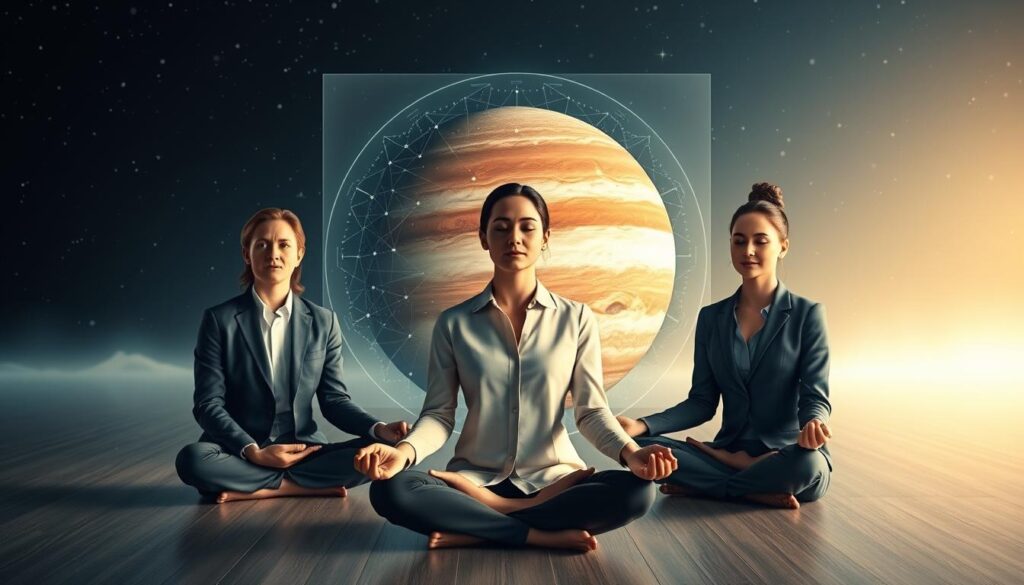
Many modern techniques borrow the protocol-like process used in early experiments. These steps train a person to hold simple impressions without judgment.
Students practice structured visualization to encourage slow, reliable information transfer and to notice sensory-like images.
Journaling is part of the routine. Recording feedback and brief notes turns vague impressions into reviewable data.
Focused topics help. Teachers often use planetary cues such as cloud cover, cloud layers, a deep hydrogen mantle, or patterns like prevailing winds as neutral anchors.
| Technique | Purpose | Practice Tip |
|---|---|---|
| Structured visualization | Improve image clarity | Use a 5–10 minute guided script |
| Sealed reporting | Reduce bias in notes | Write impressions, seal, review later |
| Focused anchors | Train specific attention | Pick one element such as cloud layers |
| Feedback journaling | Track progress and patterns | Log date, time, and short observations |
These practices mirror steps from historical Stanford Research and later protocols used in remote viewing experiments. With steady work, individuals can test how much their own attention supports subtle perception.
Conclusion
What began as a bold test grew into a long-term puzzle that links curiosity, method, and exploration. Ingo Swann’s 1973 account remains a fascinating case that challenges how we think about consciousness and perception.
The team effort, including figures like russell targ, helped put remote viewing into scientific view. While full validation still divides experts, the experiments influenced both research and practice.
Beyond intelligence work, many adapted these structured drills for personal growth and focus. For practical guidance on developing inner skills, see intuition development exercises.
Legacy: the debate continues, and these early pioneers keep guiding thoughtful, careful study of the mind.