
Did Nostradamus predict calamities through short, enigmatic quatrains that readers still debate? A 16th-century French writer used four-line verses that many people link to events that shocked the world.
The book of verses and his almanacs made him a touchpoint for wondering if old words can match modern events. Scholars and hobbyists study those lines and offer varied interpretations, so clear matches are rare.
This piece looks back through history to examine famous predictions and prophecies already tied to specific incidents. It does not offer new forecasts about the future. Instead, it weighs when text and event align and when they do not.
Over centuries, interest persisted because the verses invite retrofitting. Readers often map short, cryptic lines to known outcomes rather than testing them before events unfold.
Key Takeaways
- Quatrains can be read many ways, which fuels debate.
- Fame came from popular almanacs and wide circulation in his lifetime.
- This article reviews historical claims, not future forecasts.
- Interpretive flexibility explains lasting public fascination over centuries.
- Expect a mix of intrigue and context when comparing lines to events.
Nostradamus in Context: The physician, astrologer, and poet behind the prophecies
In a century marked by outbreaks and religious tension, Michel de Nostradame mixed practical healing with published verse. His background as a trained physician and an astrologer shaped how contemporaries read his work.

From plague doctor to famed prognosticator: a life in Renaissance France
Born in Saint-Rémy-de-Provence in 1503, his family had converted to Catholicism, a fact that colored his place in French history. He studied languages and medicine, then traveled treating the plague, which bolstered his practical reputation.
He faced a 1538 heresy charge and an expelled-student story at Montpellier, but he was acquitted and kept serving patients. Such episodes show the risk of public life in that century.
Quatrains, almanacs, and the rise of his fame during his lifetime
In the 1550s his annual almanacs and quatrains spread his name beyond regional circles. The resulting fame led elites, including Catherine de Medici, to seek him out after he advised on courtly matters.
“My writings were meant for the age and its rulers.”
He died in 1566, but the circulation of his texts kept his ideas alive. For those curious about later ties between verses and events, see a collection of modern perspectives on psychic predictions.
did nostradamus predict what really happened? Understanding the list you’re about to read
Brief, metaphor-heavy stanzas leave space for readers to connect lines to real events. These quatrains are short, vivid, and often lack dates or names. That makes them easy to reuse as a reference for many episodes.
Why ambiguous quatrains can fit multiple events
Quatrains and short poems use symbolic animals, celestial signs, and unnamed leaders. Those images echo across eras, so one line can match different stories.
Testable forecasts need clear timeframes and facts. Most quatrains gain meaning only in hindsight. People point to one apt detail and ignore mismatches.
“Readers often map a single phrase onto history and forget the rest.”
His background as a physician and experience with plague made illness and chaos recurring themes. Translations add more wiggle room, too.
- Method: show the quatrain, list the claimed event, then rate the fit.
- Watch for confirmation bias when reading each example.
- Consider whole text, not a single line, before judging accuracy.
| Feature | Quatrain trait | Effect on claim |
|---|---|---|
| Length | Four short lines | Allows broad reading |
| Imagery | Metaphors, animals, stars | Matches many events |
| Dating | No fixed dates | Hindcasts favored over forecasts |
| Author background | Physician; plague experience | Themes of disease and disorder recur |
Before you read the list, keep both the allure of prophecy and the pitfall of confirmation bias in mind. For broader modern perspectives on psychic material, see a collection of modern dream and psychic perspectives.
Death of Henry II of France: “the young lion” and a fatal joust
A tragic tournament in July 1559 fixed one quatrain to a real royal death.
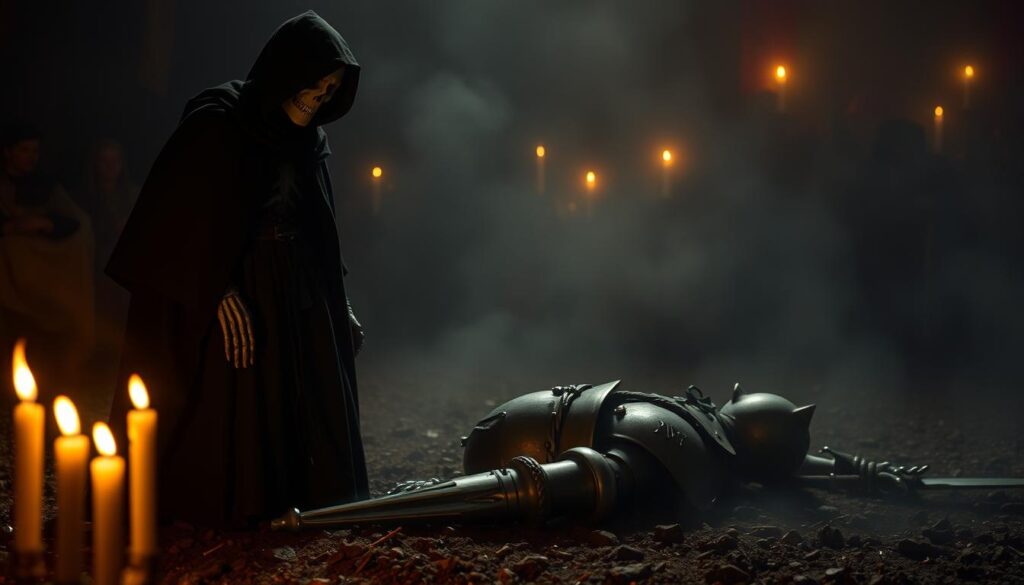
The quatrain speaks of “the young lion” overcoming an older man, eyes pierced “through a golden cage,” and “two wounds” bringing a cruel end. Those lines map in striking detail to Henry II’s accident: a shattered lance sent splinters into his visor and face.
What the quatrain says vs. the real tournament accident
Historically, Henry was injured in a celebratory joust when a lance splintered. Shards penetrated his eye and skull. He survived for days but died of sepsis from the wounds.
The poem mentions a single field battle, not a festal tournament. That mismatch makes the link less certain even as the imagery fits court armor and heraldry.
- Accident: shattered lance, eye and skull trauma, sepsis.
- Verse match: striking parallels in imagery but not setting.
- Court context: prior letters and visibility at court amplified the association and boosted his fame.
| Element | Quatrain detail | Historical record |
|---|---|---|
| Figure | “Young lion” vs. older man | Henry II, wounded by a younger opponent |
| Wound | “Pierce his eyes through a golden cage” | Lance splinters through visor and eye |
| Setting | “Field of combat, single battle” | Festive tournament, not pitched battle |
Why it still matters: This case remains one of the most cited references linking verse to event. It shows both the power of vivid imagery and the need to weigh context before concluding prophetic foresight.
For a related courtly angle, see a brief knight reference that explores tournament symbolism.
The Great Fire of London: London named, “twenty threes the six,” and a city in flames
A single stanza that cites London and an odd arithmetic phrase has fueled claims about a famous city fire.
“The blood of the just will commit a fault at London, Burnt through lightning of twenty threes the six: The ancient lady will fall from her high place, Several of the same sect will be killed.”
Reading 1666 into the verse—and the puzzle of “lightning” and the “ancient lady”
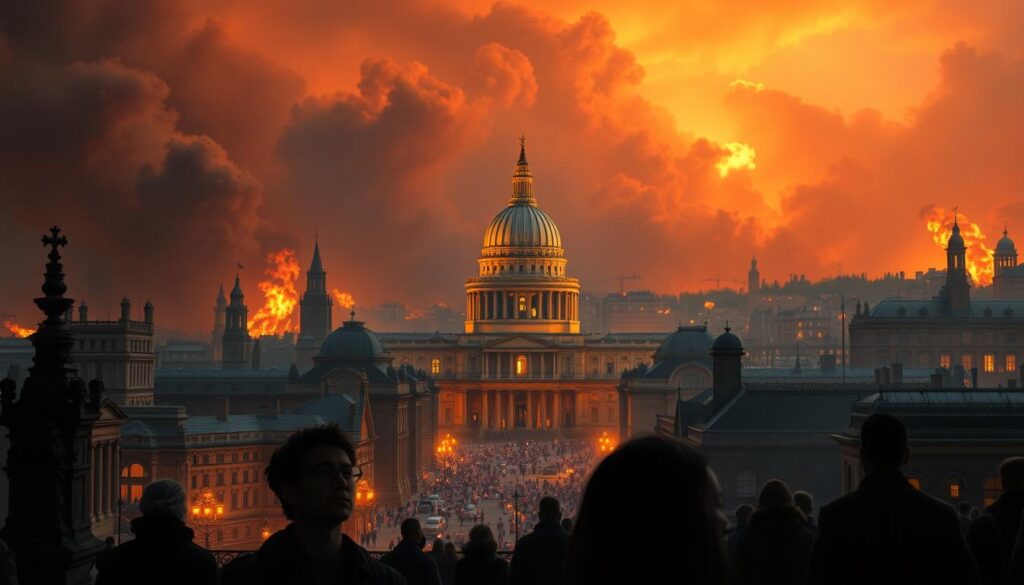
The phrase “twenty threes the six” is often read arithmetically (20 × 3 + 6 = 66) and tied to 1666. That near-match makes this quatrain one of the clearest references to a place and date in the collection of quatrains.
Yet the verse says “lightning,” while the great fire started in a Pudding Lane bakery. The spark there came from a hearth and oven, not a thunderbolt. The image of an “ancient lady” is also unclear; some readers equate it with the city itself, a church, or an institution.
Fire, Parliament, and a city remade
Factually, the fire spread fast through timber buildings and narrow streets. It reshaped London in the 17th century. Parliament later enacted rebuilding measures and new codes to prevent similar disasters.
Why does this quatrain endure? It names London and hints at a date, which draws attention even when key details, like the ignition source, do not match. That mix of specificity and ambiguity helps the verse anchor one of the most cited links between short, vivid lines and historic events.
- Why readers focus on the name and numbers: clear city reference plus a calculable year feels compelling.
- Why skeptics push back: mismatched trigger (lightning vs. bakery) and vague metaphors weaken a firm connection.
- Result: strong attraction to the idea, coupled with measured doubt about a literal reading.
Rise of Adolf Hitler: “From the depths of the West of Europe” and the mystery of “Hister”
A line about a charismatic boy born in Western lands later attracted readers who sought links to modern tyrants.
The verses describe a child “from the depths of the West of Europe” who charms crowds “by his tongue” and whose renown reaches beyond the continent. Another stanza mentions fighting “close by the Hister.”
When a name sounds right:
When a name sounds right: Hister vs. the Danube
Historians note that “Hister” was a classical name for the Danube. The near-homophone with a 20th-century leader tempts many readers to read the quatrain as a direct reference.
That phonetic match is tempting. But reality matters: the river term predates modern names by centuries.
How WWII propaganda amplified prophetic readings
During the war, Goebbels and other propagandists repurposed such verses to shape public opinion. Linking ancient lines to current leaders made convenient narratives for readers under stress.
“Mass trauma invites pattern-seeking; political actors often steer which patterns win attention.”
- Verses offer broad descriptors: birthplace, rhetoric, conquest.
- Wide events like world war invite retrofitting of old lines.
- Political use shows how reception can be guided, not just discovered.
| Item | Quatrain detail | Historical note | Interpretive weight |
|---|---|---|---|
| Birthplace | “West of Europe” | Broad geographic hint | Low — fits many figures |
| Speech | “Seduce people by his tongue” | Charisma is common to many leaders | Medium — descriptive but not unique |
| “Hister” | River reference | Classical name for Danube | Low — phonetic trap rather than proof |
| Propaganda | WWII-era usage | Goebbels amplified links | High — shows active shaping of meaning |
In short, the alignment rests mostly on wide descriptors, not precise identifiers. Treat such references with caution and consult broader context and reliable scholarship rather than lone lines. For some readers, older verses still feel eerily apt; for others, they illustrate how history and rhetoric shape what counts as a meaningful prediction. See ancient theories for related material: ancient theories.
Hiroshima and Nagasaki: “Within two cities” and “famine within plague”
A quatrain that begins “Within two cities, there will be scourges the like of which was never seen” draws a direct line in many readers’ minds to the twin strikes near the end of World War II.

The couplet that adds “famine within plague” and “people put out by steel” fits emotionally with the scale of destruction and the later radiation sickness. Those phrases can echo food shortages, illness, and the mass loss of life that followed the blasts.
But the verse is ambiguous. As a physician, the poet wrote often about epidemic misery, so the lines could describe disease outbreaks or siege famine instead of a new weapon.
- Fact: the sudden attacks caused immense death and lasting harm to people and cities.
- Fact: “steel” may poetically evoke aircraft or blades, not a specific technology.
- Fact: the match rests on interpretation, not on a unique label or date in the original text.
“Emotional parallels can feel like proof, yet they do not replace concrete markers.”
Ultimately, this example shows how broad prophecy language can seem prescient once shocking events enter the record. Careful attention to context and verifiable fact matters when weighing such claims.
The Kennedy assassination: “evil will fall on the great man” and a blamed innocent
A short quatrain that says “From on high, evil will fall on the great man” and that “a dead innocent will be accused of the deed” is often cited after the Dallas shooting in 1963.
The lines link the presidential man who suffered a public death to the rapid killing of the accused, Lee Harvey Oswald. That sequence — leader shot, suspect then killed — fits the broad sequence many observers point to.

Why the match feels strong: the verse echoes two headline moments and the subsequent controversy about who was really responsible. The quatrain’s mention that the true culprit will “remain in the mist” matches long‑lasting doubts in public memory.
Yet the language is general: “great man”, “from on high”, and no clear name or date appears. That vagueness lets readers map the words onto several high‑profile attacks of the 20th century.
- Historical placement: This case sits squarely in the American century, a moment of deep cultural shock.
- Interpretive caution: Selective emphasis on a few resonant phrases can mask lines that do not fit.
“The persistence of alternative theories shows how uncertainty invites prophecy to fill interpretive gaps.”
Consider the mix of memory, media, and short poetic lines when weighing such references. For a wider look at famous claims, see a roundup of famous psychic predictions.
Parliament executes a king: London’s Senate and the beheading of Charles I
A striking stanza speaks of a city assembly turning on its monarch. The quatrain that mentions the “Senate of London” is often read as a reference to Parliament putting its king to death.
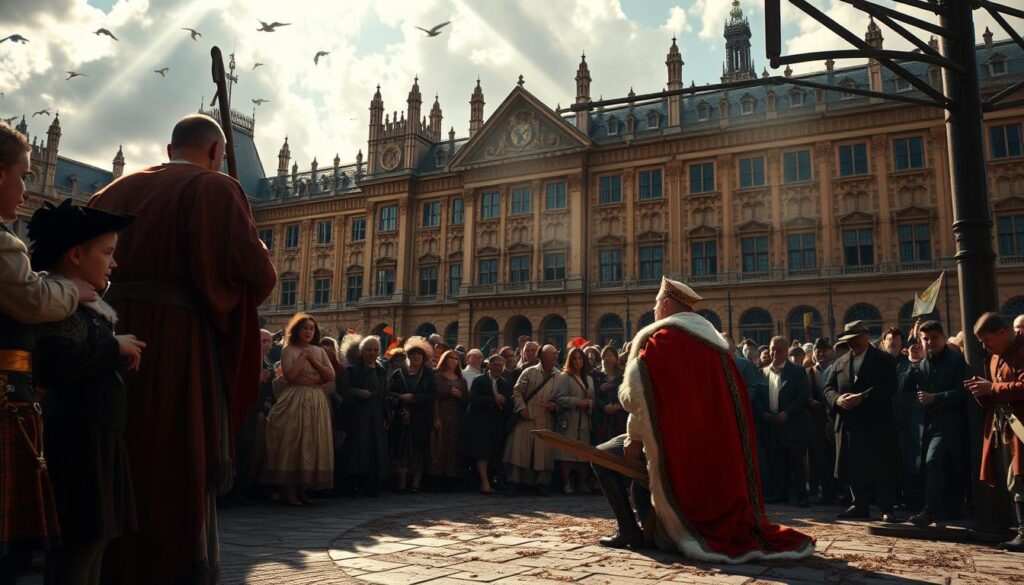
In 1649 Charles I was executed after charges of treason amid civil war. The king’s death followed deep constitutional conflict and years of violent political change in the century.
Forecast or fitting after the fact?
Language matters: translations render the original phrase as “Senate,” “council,” or “Parliament,” so readers can map it onto 17th‑century events. That flexibility helps make the verse feel specific.
Still, the quatrain lacks dates and clear identifiers. Paired with the later line about London burned in “thrice twenty and six,” readers saw a double match: execution and a famous fire in 1666.
| Claim | Quatrain wording | Historical event |
|---|---|---|
| Regicide | “Senate of London will put their King to death” | Execution of Charles I, 1649 |
| City disaster | “Burned by fireballs in thrice twenty and six” | Great Fire of London, 1666 |
| Specificity | No dates or names | Hindcast interpretation common |
Weighing two high‑profile matches against vague phrasing shows how circulation and selective reading raise the sense of prophetic accuracy. Treat memorable turns of phrase as intriguing historical references, not definitive forecasts.
From moon landing to 9/11 and climate change: modern events fans link to his prophecies
When a world‑shifting moment hits the news, people search centuries‑old stanzas for lines that seem to match. Modern attributions often point to the Apollo 11 moon landing (1969), the September 11 attacks (2001), and warnings about rising temperatures and storms.
When interpretation meets headlines and history
Fact: Apollo 11 put people on the Moon on July 20, 1969. Supporters cite celestial language as a match, but the original quatrains lack clear dates or names.
Fact: The September 11 attacks destroyed towers and killed thousands. Readers find echoes in verses about falling structures and sudden war, yet specific identifiers are absent.
Claims about climate change use lines about droughts, floods, and “hot summers” to link old poems to modern environmental crises. Those images can fit many eras.

“Headlines drive searches; the internet spreads selective quotes fast.”
- Headlines renew interest and encourage selective quotation.
- Media and the web amplify unverified matches without original sourcing.
- Emotional resonance often outweighs factual fit when readers map quatrains to events.
Bottom line: evocative lines invite connections, but absence of precise names, dates, or context keeps each claim open to debate rather than settled fact.
Did he predict the end of the world? July 1999’s “King of terror” and new end-times claims
One quatrain that names July 1999 — “from the sky will come a great King of terror” — fed millennial panic. The line arrived amid Y2K worries, rising tech dependency, and wide cultural unease.

Why end-of-world prophecies persist in public imagination
The dated month made this verse unusually testable. Because no global catastrophe happened, skeptics point to that failure as proof against literal readings.
Yet the absence of disaster did little to stop interest. People reinterpreted the phrase, moving the event, or renaming the threat to fit new fears.
End-narratives endure because they give order to chaos. They also make a dramatic story that is easy to repeat and share.
- Flexible imagery: celestial threats can mean comets, planes, or cyber collapse.
- Name recognition: a known prophet’s name keeps old lines active across centuries.
- Psychological pull: apocalypses simplify complex anxiety into a single, memorable plot.
“A single ambiguous line rarely equals a full eschatology; yet it will resurface whenever societies seek a narrative for their fears.”
Read such references in historical cycles rather than as definitive forecasts for the world. That view helps separate dramatic headlines from careful evaluation of any prophecy or set of predictions.
How to read Nostradamus today: poems, prophecies, and the pull of the future
Reading the quatrains today calls for patience: short lines favor mood and metaphor over literal facts.
Start with reputable translations and read each full quatrain before jumping to conclusions. Compare versions and note how translators choose words.
Check timing: ask whether a claim appeared before or after an event. That test separates genuine forecasting from hindsight fitting.
- Favor whole-text reading over single-phrase highlights.
- Look for unique identifiers (dates, names) rather than broad images.
- Note the author’s lifetime role as an astrologer and physician; themes like plague, disorder, and stars recur.
- Distinguish cultural reuse (movies, memes) from scholarly sourcing.
“Curiosity about the future is natural, but rigorous reading starts with the text.”
Appreciate the poems as literary craft and as a window into Renaissance thought. That approach lets people weigh claims about the future without giving up critical judgement.
Conclusion
For readers, a Renaissance man left short, vivid quatrains that spark debate across centuries. Those lines entertain and confuse, surfacing whenever a crisis seeks a story.
Context matters: his life amid plague, war, and court politics explains recurring images without proving literal foresight. Ambiguity and after‑the‑fact mapping account for many apparent matches.
Admire the poetry but keep a clear lens. Treat each verse as literature first and a claim about the future second. Healthy skepticism helps separate lore from evidence about the end.
Curiosity about a prophet or past warnings is natural. Learn the history, compare sources, and enjoy the mystery while holding fast to careful reading.