
Choose a set that fits your purpose and taste. This guide helps you pick between playing-style sets and modern cartomantic editions common in the United States. We explain how a 78-card framework balances big archetypes with everyday situations so your readings cover both life themes and practical choices.
Expect clear comparisons of popular systems like the rider-waite® tarot, the Thoth tradition, and classic Tarot de Marseille art. You’ll learn how symbolism and imagery shape interpretation and how features like guidebooks, stock, and packaging affect value.
We also cover buying tips for online shoppers, ways to test a new set, and simple routines for breaking in a fresh deck. By the end, you’ll know which style suits your reading practice and where to find reliable editions.
Key Takeaways
- Know your purpose: playing, studying, or divination guides choice.
- The 78-card system blends Major Arcana themes with Minor Arcana practicals.
- Compare rider waite and Thoth versus Marseille for imagery and meaning.
- Check guidebooks, card stock, and packaging before you buy.
- Simple rituals help you break in a new set and improve reads.
Start Here: How to Choose the Right Tarot Card Deck Today
Match your experience and goals before you buy. Beginners often learn faster with clear scenes on minor cards, a helpful guidebook, and straightforward symbolism that ties images to meaning.
Seasoned readers may value system fidelity (Rider‑Waite‑Smith, Thoth, or Marseille), niche themes, or experimental formats that change orientation and flow. Define whether you want daily draws, relationship insight, spiritual work, or creative prompts so the artwork and symbolic depth suit the use.

- Compare products by key details: card count, scenic minors, keywords-on-cards, and guidebook style.
- Check stars in reviews for shuffle feel, stock thickness, print quality, and color accuracy.
- Balance price with durability; higher cost can mean better finishes, but value sets can teach well.
| Priority | Beginners | Seasoned Readers |
|---|---|---|
| Imagery | Clear scenes, literal symbolism | Complex motifs, artistic nuance |
| Guide | Step-by-step keywords and examples | Reference texts and tradition notes |
| Handling | Narrower size, linen finish | Preferred stock and special formats |
From Games to Divination: A Brief History That Shapes Your Choice
Tracing the path from 15th-century games to 18th-century divination clarifies what to look for when you shop.
Tarot first appeared in northern Italy as carte da trionfi. These early packs combined four suits of 14 cards with a 21-card trump set and the Fool.
Play styles spread across Europe and survive today in places that still use tarock and similar game formats. Later, Parisian occultists recast the imagery for divination, giving us the Major/Minor split readers know worldwide.
Two lineages: playing packs vs reading systems
- Game tradition: varied trump orders and regional suits, rich historic art and rules.
- Cartomantic editions: standardized imagery to make meanings easy to learn and cite.
- Shopping tip: decide if you want authentic Marseille-style pips or scenic minors common in a new tarot for beginners.

| Feature | Playing Packs | Cartomantic Products |
|---|---|---|
| Purpose | Trick-taking games | Divination and study |
| Imagery | Regional art, pips | Scenic minors, symbolic art |
| Learning curve | Steep for readers | Lower; many include guidebooks |
“Scholarly evidence points to a 15th‑century Italian origin, with divinatory uses appearing much later.”
Understanding these lineages helps you choose products whose function and art match how you’ll use them day to day. For layout examples and practice spreads, see tarot spreads.
What’s Inside a 78-Card Tarot Deck
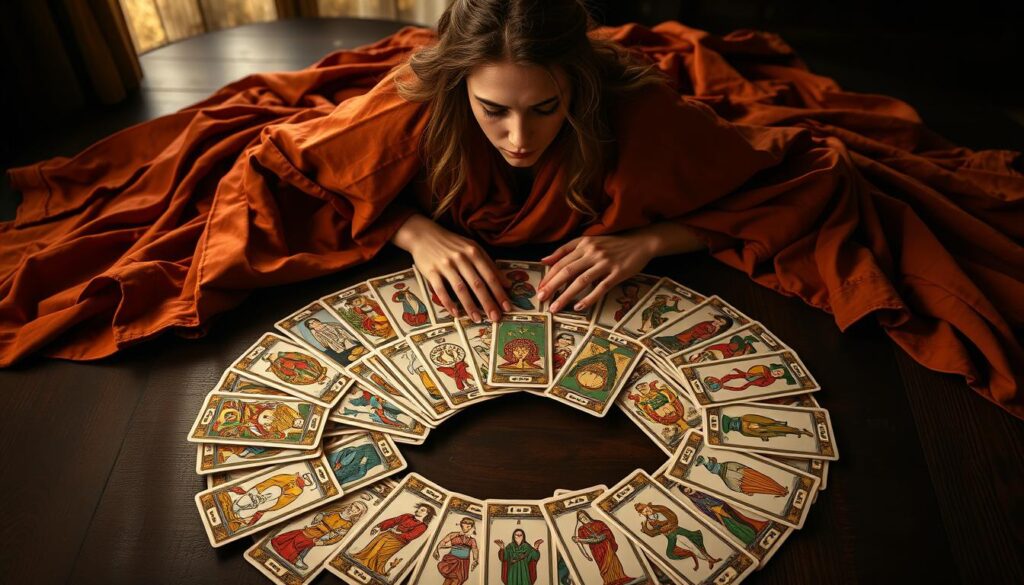
A standard 78-card tarot deck divides life into two readable layers: the Major Arcana and the Minor Arcana. This setup gives you a narrative backbone and practical, everyday cues to interpret during spreads.
Major Arcana: The Fool’s Journey
The Major Arcana contains 22 trump cards that trace an arc from The Fool through The World. Readers use this sequence as a symbolic journey of growth, from beginnings and trials to completion and integration.
Minor Arcana: Suits, Courts, and Pips
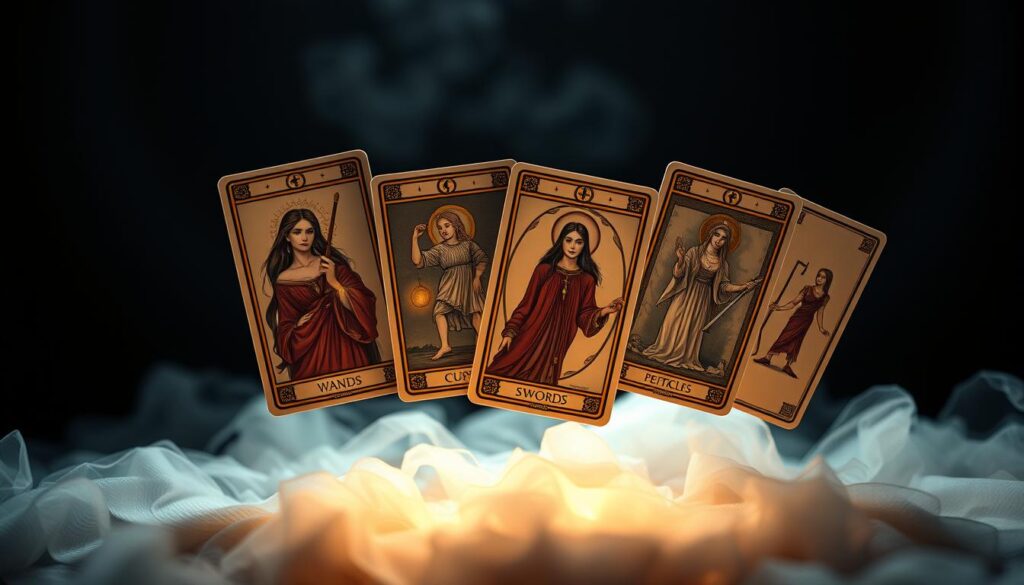
The Minor Arcana splits into four suits—Wands, Cups, Swords, and Pentacles—each with ten pip cards (Ace–10) and four court figures (King, Queen, Knight, Page).
These cards handle daily situations, roles, and energies. Scenic pips help visual learners; plain pips favor numerology and suit theory.
Card Count Essentials
- Expect 78 cards in most modern reading sets: 22 Majors and 56 Minors.
- Historically noted as 21 trumps plus The Fool, the format remains dominant and reliable for study.
- Confirm counts and names when joining a study group so your learning matches the materials and details used in class.
“The Fool’s unnumbered freedom gives readings flexibility between endings and new starts.”
Need practice spreads or buying notes? See resources to help pick and learn at learn more about spreads and study.
Understanding the Suits: Wands, Cups, Swords, Pentacles
Understanding the four suits helps you spot where energy sits in a spread. Each suit points to a practical area of life and brings its own strengths and pitfalls.
Wands — fire: energy and creativity
Wands channel drive, ambition, and creative spark. Upright wands show initiative and bold action.
When imbalanced, they can signal haste, recklessness, or scattered effort.
Cups — water: emotions and relationships
Cups mirror feelings, empathy, and intuition. They describe how you relate and respond emotionally.
Too many cups suggest overwhelm, fantasy, or weak boundaries.
Swords — air: thought and communication
Swords focus on clarity, analysis, and truth. They highlight decisions and messages.
Their shadow includes harsh words, overthinking, or cold detachment.
Pentacles — earth: work and stability
Pentacles ground readings in money, health, and practical concerns. They show long-term security and skill.
Watch for greed, short-sighted accumulation, or stinginess when pentacles dominate.
Quick tips: Courts show how a suit expresses itself—Pages learn, Knights act, Queens nurture, and Kings direct. Pips (Ace–10) trace cycles from fresh starts to integration, adding nuance to each meaning.
| Suit | Element | Keywords |
|---|---|---|
| Wands | Fire | Will, creativity, initiative |
| Cups | Water | Emotion, intuition, relationships |
| Swords | Air | Thought, truth, communication |
| Pentacles | Earth | Work, health, prosperity |
“When one suit dominates a spread, it highlights the main arena of attention in the querent’s life.”
Iconic Systems and Artists: Rider‑Waite, Pamela Colman Smith, Thoth
Artist choices and system rules determine how imagery guides interpretation. A few signature systems set visual languages that readers still rely on today.

The Smith‑Waite Centennial reproduces Pamela Colman Smith’s 1909 artwork and shows why the rider-waite® tarot reshaped modern practice.
Rider waite style uses scenic minors so learners link images to meaning quickly. Pam’s line work and color choices make study group references simple and memorable.
Thoth and Harris
The thoth tarot deck pairs Aleister Crowley’s system with Lady Frieda Harris’s geometric, alchemical art.
Thoth favors dense symbolism and numerological precision. It rewards deeper study and suits readers who like layered correspondences.
Marseille influence
Marseille packs keep historic pips and a European feel. Many practitioners use Marseille for suit theory and technique sharpening.
- Choose by use: narrative clarity (Colman Smith) vs symbolic depth (Harris) vs traditional pips (Marseille).
- Pro tip: confirm system names in listings so your guidebooks match the art.
- Explore: collectors often pair systems for different reading styles.
“Artists shape how images teach meaning; their intent matters in every spread.”
For a practical example of imagery-driven interpretation, see an analysis of The Chariot at The Chariot interpretation.
Specialty Styles: Round Tarot Decks, Motherpeace, and Art Nouveau
When form changes, so does interpretation: round formats and art‑forward sets shift emphasis.
Round tarot deck formats introduce tilt and flow as meaning cues. Small angles can add nuance beyond upright or reversed, creating motion in a spread.
Motherpeace round tarot popularized circular cards with a feminine, communal focus. Its non‑linear spreads invite group reads and body‑centered layouts.

Handling matters. Practice shuffling, clear table space, and a pouch to protect curved edges. Check photos for print registration; misaligned borders show more on curves than rectangles.
Art Nouveau aesthetics and practical tips
Art nouveau artwork brings ornate line work, floral frames, and flowing drapery. This style can add romance and visual richness, but heavy borders may reduce image clarity in low light or on small screens.
- Confirm titles and a guidebook if an artist restyles classic names.
- Specialty formats make lovely gifts and memorable pro tools for public readers.
“Beauty should not sacrifice clarity — choose style that supports your practice.”
Formats, Packaging, and Extras: Deck Guidebook, Keepsake Box, Deck Tin
Packaging choices shape how you use and protect your set every day. Look past art and price to the small details that affect longevity and daily handling.
What’s in the box
Some modern sets print keywords on the face for quick prompts. Others include a full deck guidebook with spread examples and deeper context.
Choose keywords-on-cards if you want fast reads. Pick a guidebook when you prefer study and story-driven meanings.
Storage and durability
Metal tins offer compact, durable storage; a deck tin is handy for travel or field reads. A larger keepsake box holds a thick guidebook and protects corners on a shelf.
Card stock and finish matter. Matte reduces glare, linen helps riffle, and thicker stock resists wear. Small production details—magnetic lids, ribbon pulls, or interior foam—improve daily use.
- Decide between quick prompts or a full deck guidebook.
- Use a deck tin for travel; choose a keepsake box for at-home storage.
- Check product details, dimensions, and review stars for box integrity.
“Packaging often reveals the maker’s care for both art and function.”
Publishers and Availability in the U.S.: U.S. Games Systems and Beyond
Major U.S. publishers made reading-focused products easy to find nationwide. In the United States, companies such as U.S. Games Systems brought classic patterns and modern artist collaborations into bookstores and online outlets. That helped standardize availability and made study resources widely accessible.

How U.S. Games Systems shaped the U.S. market
U.S. Games Systems and similar games systems publishers ensured consistent print runs and clear product details across retailers. This consistency makes it easier to compare size, finish, and whether a full guidebook is included.
- Availability: mainstream distribution means better replacement options and predictable shipping times.
- Artist partnerships: established publishers work with artists to improve color accuracy and packaging durability.
- Price and runs: larger runs from u.s. games systems often keep price accessible versus limited indie printings.
If you want reliable specs for classroom use or gifting, choose products from major publishers. For indie or experimental work, seek small presses and creators—but verify printer and edition year before buying.
Explore related reading services to pair with study materials and products from trusted U.S. sources.
Tarot Card Meanings at a Glance: Major Arcana Themes
The Major Arcana functions like a roadmap of growth, highlighting key lessons and milestones. These twenty-two archetypes name phases from new starts to completion.
Upright themes are concise cues: The Fool — innocence and new beginnings; The Magician — will and creation; The High Priestess — intuition; The Empress — fertility and nature; The Emperor — authority; The Hierophant — tradition; The Lovers — partnerships; The Chariot — direction; Strength — inner courage; The Hermit — inner guidance; Wheel of Fortune — change; Justice — truth; The Hanged Man — sacrifice; Death — endings and transformation; Temperance — balance; The Devil — materialism; The Tower — upheaval; The Star — hope; The Moon — intuition and illusion; The Sun — joy; Judgement — awakening; The World — completion.
Reversals often show blocks, delays, or shadow expressions rather than pure negatives. Use Majors as a quick diagnostic: they flag identity shifts and life cycles when dominant in a spread.

- Pair archetypes with context and surrounding suits for precise readings.
- Artists’ art choices influence tone — minimalist work gives direct clarity; ornate art invites layered reading.
- Keep a short reference list and a journal to track how meanings unfold over time; patterns reveal deeper lessons in the world.
For an example tying suit energy with a Major, see an Ace of Wands overview.
Buyer Priorities: Price, Stars, and Product Details
Look beyond stars and images: handling, print quality, and finish usually decide real value for daily use.

Reading reviews: treat stars as a quick snapshot. Dig into written comments for shuffle feel, stock resilience, and color fidelity.
Reading reviews: what “stars” really signal about shuffle and print
High stars can mask variation across runs. Check recent posts to spot changes in finish or hue.
“Stars are a starting point; reviewers explain the tactile truth.”
Price tiers explained: budget, midrange, and premium
Budget: good for learning; may skip archival printing or thick lamination.
Midrange: often balances price and durability—this is common in the U.S. market for reliable products.
Premium: archival print, linen textures, and luxe packaging that last under heavy use.
| Tier | Typical features | Best for |
|---|---|---|
| Budget | Basic finish, short guide, lower GSM | Beginners, casual use |
| Midrange | Improved GSM, matte or linen finish, decent guidebook | Regular readers, gift buyers |
| Premium | Archival printing, special edges, sturdy box | Collectors, daily heavy use |
Scan product details like exact GSM, finish (matte, gloss, linen), and edging before you buy. If returns are easy, ordering two to compare in hand can justify a higher price.
The Best Tarot Card Deck for Beginners
Start with a practical set that makes learning visual and repeatable so habits form fast. A clear, full 78-card option aligns study with most classes and reference books. That consistency helps you learn vocabulary, spreads, and patterns without confusion.
Why a 78-card deck with clear symbolism helps learning
A full 78-card tarot gives you every Major and Minor in a single package. That means your practice matches community standards and course materials.
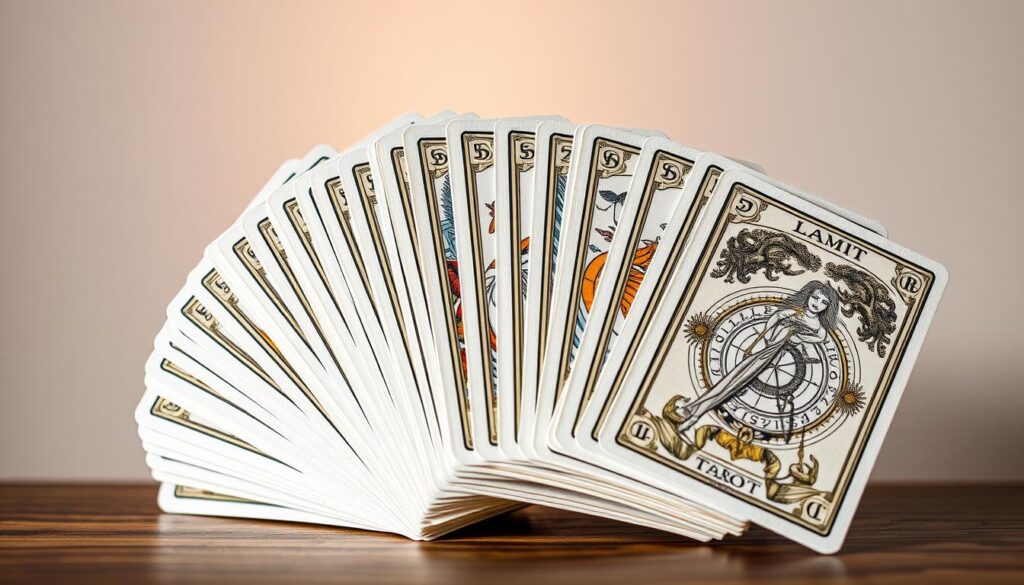
Scenic minors turn pips into tiny stories. When images map to actions and feelings, memorization becomes natural and much faster for many beginners.
Choosing artwork that supports memorizing minor arcana
Pick sets with consistent imagery across suits so patterns pop during readings. A friendly guidebook with upright and reversed meanings reduces overwhelm in month one.
- Check product details like card size and finish before buying.
- Use stars in reviews to spot praise for image clarity and sturdy stock.
- Keep price reasonable; upgrade later once you know preferred handling.
“Start simple, practice daily, and you’ll internalize the minor arcana quickly.”
For focused practice, try a one-card-a-day habit and a short journal note. For spread examples and extra practice materials, see a useful guide to minor arcana study.
Tarot Card Deck Care, Use, and Ethics
How you handle a new set shapes readings and preserves the artwork over time. Simple habits make your tools last and keep sessions professional.
Breaking in your set: shuffling, bonding, and storage
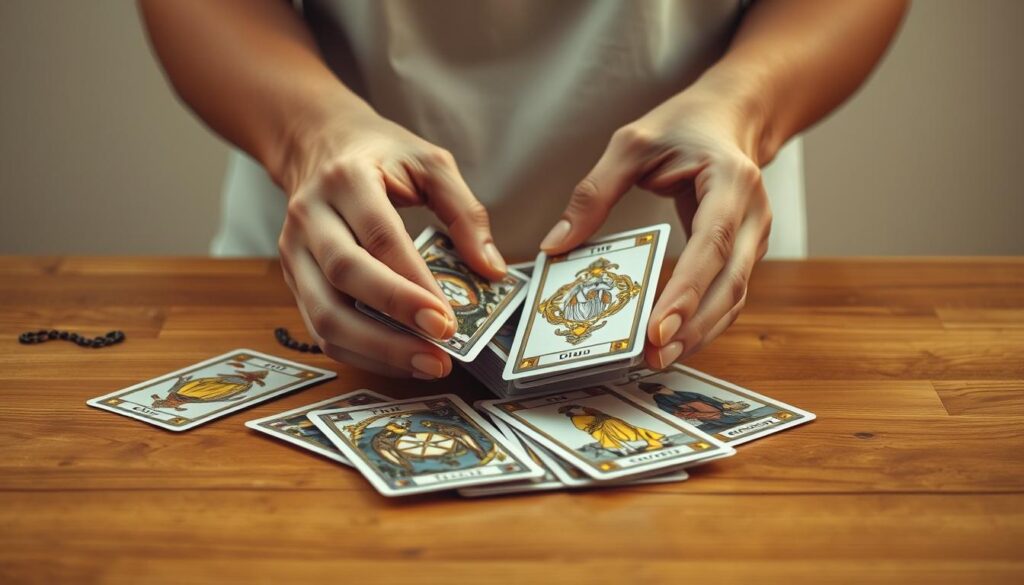
Break-in routine: overhand shuffle and riffle gently if the stock allows. Do daily single draws to learn imagery and feel.
Store the cards in a pouch, a deck tin, or a keepsake box. Keep them away from moisture and direct sunlight to avoid bowing and faded art.
Practice hygiene and reading boundaries
Clean hands matter—oils and lotions transfer to finishes. Use a soft cloth on the table to protect faces and help spreads glide.
Set ethical limits: be honest, avoid medical or legal advice, and get consent. Clear boundaries build trust and protect your practice.
- Rotate decks to let cardstock rest and extend life.
- Reorder from The Fool to The World as a reset after heavy use.
- Journal notable readings to track when accuracy felt strongest.
| Storage | Benefit | Note |
|---|---|---|
| Pouch | Portable protection | Use soft fabric |
| Deck tin | Durable for travel | Check fit for size |
| Keepsake box | Best for long-term care | Holds guidebook and extras |
“Cards began as playing tools; the occult layer developed later in the late 18th century.”
Conclusion
, Aim for a balance of reliable specs, sensible price, and artwork that sparks your curiosity.
Choose by purpose first: learning, study, or display. Let clear images and solid handling guide daily practice.
Compare reviews for shuffle feel and check the stars in recent posts. Read written notes for real-world wear and finish details.
Start with a full 78‑card set to match common study materials, then explore specialty art and systems as you grow. Protect your tools with good storage and gentle care so they last.
Across the U.S. market you can test products, compare price and specs, and use return windows to find the right match for your practice and the wider world.