

Michel de Nostredame grew up in 16th‑century France and left a lasting mark through his book, Les Prophéties (1555). Born in Saint‑Rémy‑de‑Provence in December 1503, he trained as a physician and served during plague years. He also worked as an apothecary, astrological consultant, and author of yearly almanacs.
His family converted to Catholicism a generation before his birth. Patrons such as Catherine de’ Medici boosted his reputation and spread his name across the world. Readers still link his short quatrains to major events, which keeps interest alive today.
Scholars debate the vague wording, later translations, and how people attach predictions to past events. He suffered gout that led to edema and died in July 1566, closing the human story behind the seer.
Key Takeaways
- Michel de Nostredame wrote the famed book of quatrains, Les Prophéties.
- He worked as physician and apothecary during plague years.
- Elite patrons helped shape his reputation across the world.
- Scholars examine vagueness, translation, and retrofitting of predictions.
- His health declined with gout; death came in 1566.
- Learn more about related supernatural abilities here.
What Is a Nostradamus? Defining the Name, Role, and Why It Endures
During the Renaissance, many scholars Latinized surnames. This made Michel de Nostredame easier to cite and helped the shorter name stick in print and memory.

Nostredame means “Our Lady” and reflects a family shift to Catholic identity after earlier conversion. That choice shaped social standing and opened doors to patrons in his life.
The many roles he held
- Astrologer: cast horoscopes and advised timing.
- Physician: treated patients during plague years.
- Apothecary: mixed remedies and sold medicines.
- Author: wrote almanacs and the famed quatrains.
- Reputed seer: popular imagination turned his work into prophecy.
“He did not claim prophetic powers,” wrote the man himself in prefaces, careful amid religious scrutiny.
| Role | Activity | Why it mattered |
|---|---|---|
| Astrologer | Cast charts | Linked astrology and medicine |
| Physician | Plague care | Built medical reputation |
| Author | Almanacs, quatrains | Printed reach, lasting references |
Later sections will clarify key terms such as quatrains, Centuries, and almanacs. For related modern services see psychic readings.
Nostradamus’s Early Life and Education: Family Roots, Avignon to Montpellier
Records trace the de Nostredame family from Jewish roots in Provence to a public Catholic identity by the late 1400s. That change produced the family name later Latinized in print and helped place them among Avignon’s civic networks.
Born in Saint‑Rémy in 1503, he entered university avignon near age 14. His studies likely followed the classical trivium. Studies ended abruptly when a severe plague closed the school, forcing him into practical work.

For several years he traveled and gathered sources on herbal remedies. Practical training as an apothecary allowed him to compound medicines and build a local reputation.
In 1529 he enrolled at university montpellier to study medicine but faced expulsion because apothecary work conflicted with statutes; the registry entry (Register S 2 folio 87) survives. Despite that setback, he continued to practice and later earned recognition as a physician.
Those early adult years shaped his life: interrupted study, hands‑on learning, and a growing network. Family beginnings and later children would mark both loss and legacy in the years ahead.
Life, Work, and the Plague: Marriage, Loss, and Medical Reputation
Tragedy shaped his early adult years and steered much of his medical work. Invited to Agen in 1531 by Jules-César Scaliger, he married and had two children.
In 1534 a sudden plague swept through the region. His first wife and both children died, a loss that left him both grief-stricken and determined to help others during later outbreaks.
He served as a physician and apothecary across Provence. In 1545 he assisted Louis Serre in Marseille and later treated patients in Salon-de-Provence and Aix-en-Provence. His remedy known as the “rose pill” grew part of his local reputation.
Returning to Salon-de-Provence in 1547 marked a turning point in private life. He married Anne Ponsarde and raised six children, while civic projects and steady practice anchored his standing in the town.
Between 1556 and 1567 he and his wife invested in the Canal de Craponne to irrigate the Crau. That venture shows how medical service, parish ties, and civic plans combined to expand his social network and support later literary efforts.
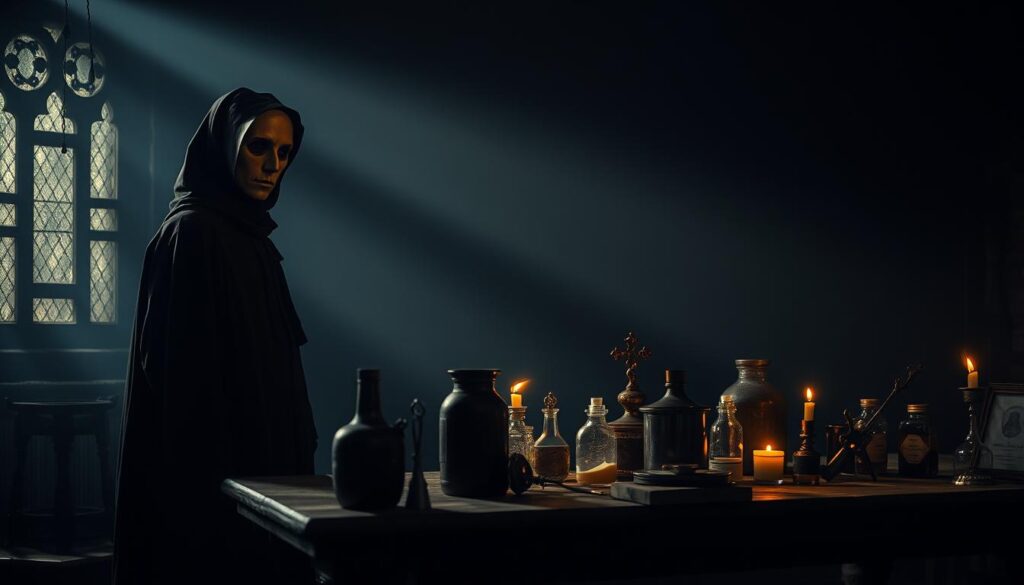
“He mixed practical remedies with outreach, seeking relief for fearful communities.”
| Year | Event | Outcome |
|---|---|---|
| 1531 | Invitation to Agen; marriage | Two children born |
| 1534 | Plague outbreak | Wife and children died |
| 1545 | Assisted Louis Serre in Marseille | Reputation as physician grew |
| 1556–1567 | Investment in Canal de Craponne | Local development and social ties |
These years of loss and service shaped his medical standing and public presence. For related background on starseed traditions, see the Sirian starseed profile.
Inside Les Prophéties: Quatrains, Centuries, Editions, and Almanacs
The printed quatrains form a deliberate structure that invites close reading and broad interpretation.
Les Prophéties, first issued in 1555, gathers 942 mostly rhymed quatrains.
They are grouped into ten sets called Centuries—nine of 100 and one of 42—which framed the work as sweeping yet fragmentary.

Sixteenth-century printing meant each edition shows variant spellings and punctuation.
No two copies read the same, so punctuation should not be treated like secret codes.
Almanacs and other books
Beginning in the year 1550 he issued annual almanacs that mixed weather, charts, and short prognostications.
Those calendars won patrons and broadened his audience across years and courts.
He also published medical and literary works: a Galen paraphrase, the Traité des fardemens, and the Orus Apollo manuscript.
These books reveal his range beyond prophetic verse.
“Readers linked verses to dramatic events, and the phrase ‘nostradamus predicted’ entered popular use.”
| Work | Content | Why it mattered |
|---|---|---|
| Les Prophéties | 942 quatrains | Poetic compression, open to interpretation |
| Almanacs | Annual prognostications | Built patrons and public reach |
| Other books | Medical recipes, paraphrase, Orus Apollo | Showed scholarly sources and breadth |
Language blends multilingual wordplay and deliberate vagueness, which earned both praise and skeptical responses from people in his day.
Next section will trace the sources and methods behind that style.
For further reading on spiritual numerology, see best book on angel numbers.
How Nostradamus Crafted Predictions: Methods, Sources, and Astrology
He mixed practical medical notes with celestial charts to give weight to his claims. This blend of hands‑on apothecary practice and learned study framed much of his work.

Judicial charts and comparative horoscopy
Judicial astrology was the Renaissance way to judge the quality of events by reading planetary configurations. He used it to frame each short prediction and to mark likely moments in time.
Comparative horoscopy meant matching a future chart to an earlier chart that seemed similar. Peers warned this method could mislead, because surface likenesses do not prove causal links.
Calculation limits and evidence of error
Critics found calculation errors and missed adjustments for place or birth time. Those mistakes give concrete evidence that some charts were fallible.
Sources and literary scaffolding
He drew on many references: the Mirabilis Liber, Richard Roussat’s work, classical historians such as Livy and Suetonius, medieval chroniclers, and texts on magic like Iamblichus.
| Type of source | Examples | Role in his method |
|---|---|---|
| Apocalyptic compendia | Mirabilis Liber | Provided striking images and motifs |
| Classical historians | Livy, Suetonius, Plutarch | Offered narrative templates and analogies |
| Medieval chronicles | Froissart, Villehardouin | Supplied historical parallels and dates |
| Magic and philosophy | Iamblichus | Shaped symbolic language and tone |
Obscuring meaning and interpretive strategy
He often used multilingual wordplay, dense syntax, and Virgilianized phrasing to hide clear meaning. This allowed multiple readings and reduced risk in a strict religious climate.
“Understanding his method helps separate text from projection.”
Consider his training at university avignon and university montpellier and his apothecary habit when judging any prediction. The method has weak points, yet the layered sources create a rich web of references that still invites study.
For related context on claimed psychic abilities see psychic superpowers.
What Is a Nostradamus: Predictions, Claims, and Scholarly Evidence
Popular claims connect terse quatrains to wars, rulers’ deaths, and other headline events.

From kings and world events to doomsday: examples often attributed
Supporters cite verses from les prophéties and point to lines that seem to mirror royal deaths or great fires.
They link short passages to specific events across centuries and present the book as proof of pattern.
Skeptical views: vagueness, mistranslations, and retrospective fits
Scholars argue many matches rely on loose translation and retroactive fitting.
Verses lack firm dates, so after the time passes, readers map lines to news.
This weakens claims and reduces reliable evidence for literal prophecy.
Supporters, media, and modern reinterpretations
Media stories and enthusiasts keep these interpretations alive.
People often repeat the phrase “nostradamus predicted” after events appear.
Balanced reading means checking original lines, context, and translation before accepting any claim.
“Evaluate the source text and avoid selective quoting when judging prophetic claims.”
| Claim type | Reason cited | Scholarly response |
|---|---|---|
| Royal deaths | Similar imagery | Vague language, retrofitting |
| Wars and fires | Shared motifs | Undated verses allow broad fits |
| Doomsday | Dramatic tone | Poetic elasticity, not proof |
Reputation, Court Connections, Death, and Legacy Today
Court favor gave his printed almanacs an unexpected reach among rulers and ministers. Catherine de’ Medici read those pages and summoned him to Paris. Her patronage led to an official title as Counselor and Physician-in-Ordinary to King Charles IX, which bolstered his reputation at court and beyond.

Court honors and royal service
Being named to the royal household mixed medical duty with political access. As physician he attended elite circles and advised on horoscopes for the king and court.
Final years, sickness, and burial
In later time his painful gout worsened and produced edema that limited movement. He reportedly foretold his own death the night before and died on 1 or 2 July 1566.
He left a detailed will. First buried in a Franciscan chapel, his remains later moved to the Collégiale Saint-Laurent. Curiously, part of that former chapel now forms a restaurant space.
Afterlife of the work
After his end, new editions and books spread across Europe. More people read and debated the prophecies in the years that followed.
“His name became shorthand for uncanny foresight, even as scholars applied tighter methods.”
Today his legacy threads scholarship and pop culture. For related perspectives on symbolic cards and interpretation see this modern reading.
Conclusion
, His quatrains compress history, myth, and astronomy into short, echoing lines that invite many readings.
This guide closes by noting the clear arc of his life: a physician and apothecary who faced plague, served courts, and wrote a book whose quatrains travel across century and year to meet new readers.
Those prophecies and predictions do not foretell the future like a mirror. They offer poetry plus pattern-seeking. For reliable judgment, check original references, careful translations, and context before accepting dramatic claims.
If you want further background on modern readings of historical prophecy, see this short guide to psychic predictions. Understanding method helps us read both the text and our own urge to find meaning in uncertain times.