

This practical how-to guide helps you use tarot card reading love to gain clear, compassionate insight into your relationship today.
Expect reflection, not fortune-telling. The methods here offer calm, practical guidance so you can approach your love life with confidence.
We cover basics, beginner-friendly spreads, and simple ways to turn interpretations into action that improve trust and connection.
You don’t need to be an expert or own a rare deck. Any accessible set of cards will work when you ask focused questions and read with empathy.
Ethics matter: respect consent, stay neutral, and protect emotional safety so readings support both your heart and your partner’s boundaries.
This article walks you step-by-step from setup to interpretation, with quick options for fast, practical answers for singles and couples alike.
Try simple spreads like a three-card or five-card layout to reveal dynamics without overwhelm. For more spread ideas, see easy spread examples.
Key Takeaways
- Use this guide for clear, compassionate insight into your relationship.
- Approach practice as reflection and action, not prediction.
- Any accessible deck works if you ask focused questions.
- Keep readings ethical: consent, neutrality, and safety matter.
- Try short spreads for fast, useful answers in real life.
What “tarot card reading love” means today and how it helps your relationship
Used well, the method becomes a calm way to sort feelings, identify needs, and prompt constructive talks.
This approach treats tarot as a reflective practice, not a prediction machine. It helps you explore patterns, communication gaps, and priorities so you can act with care.

User intent: get clear, compassionate insight
You’re here for usable answers that reduce doubt and support honest conversations. Focused questions let the spread mirror the heart of your situation and show practical steps.
- Energy in a pull shows what’s active now: mixed signals, quiet drift, or hopeful growth.
- Insights organize thoughts and highlight kinder ways to engage your partner.
- Use results as conversation starters, not verdicts, and set small goals—like a check-in or shared plan—to move forward.
Whether you seek a new romance or want to deepen a long-term relationship, this practice adapts. Revisit spreads and journal thoughts to track how your life and relationships evolve with intention.
For a deeper look at a major influence, see the Chariot.
Love tarot basics: decks, cards, and energies that influence romance
A deck’s art and structure shape how relationship themes appear and feel in a spread. Art style and system guide which symbols jump out, so choose one that matches your taste and emotional rhythm.

Rider‑Waite‑Smith imagery often makes romance symbolism easy to read, while Marseille systems focus on number and suit dynamics to reveal patterns over time. Popular decks you’ll see include Golden Thread Tarot, Luminous Spirit Tarot, Seventh Sphere Tarot, Arcana Iris Sacra, and Tarot of the Velvet Moon.
Key indicators beyond the obvious
Look past The Lovers and Two of Cups. Swords show honest communication. Pentacles point to shared effort and stability. Cups track emotional flow, and Wands show passion or momentum.
- Hope & healing: The Star signals renewal.
- Completion or change: The World marks a cycle ending or a new chapter.
- Friendship & foundation: Four of Wands and Three of Cups highlight friends and celebration.
- Drive & balance: The Chariot warns to align goals so momentum doesn’t outpace presence.
Notice gestures, distance between figures, and recurring symbols. Keep notes on how your chosen deck emphasizes emotions versus practical steps. Use one deck consistently to build familiarity, then switch occasionally to refresh insight and see new things in your relationship.
How to get started with a love reading: step-by-step for beginners
Begin with a single, practical question that centers on growth and next steps for your relationship. Clear focus helps a spread point to actionable moves instead of vague outcomes.

Prepare your questions, space, and deck
Choose one or two specific questions that invite insight, for example: “What supports emotional safety between us now?” Keep prompts open-ended and kind.
Set a calm space with minimal distractions. Place your deck, a notebook, and a grounding item like a candle to mark intentional time.
Shuffle, draw, and set intention
Shuffle in the way that feels natural. Pause and sense the energy before selecting a tarot spread.
Draw slowly and note first impressions — images, colors, or sensations often point to practical next steps for your love life.
Reading etiquette: grounding, neutrality, and consent
Consent matters: never read for someone without permission. If you lack consent, frame questions about your actions, not another person’s private choices.
Ground yourself with deep breaths before interpreting. Journal one small action to try this week so the insight becomes real-world progress.
- Clarify your focus.
- Create a quiet space.
- Set a gentle intention.
- Shuffle, draw, and note impressions.
- Close with thanks and plan a follow-up.
Three-card relationship spread: problem, context, solution
A quick three-card layout gives a clear snapshot of what’s active, what you’re doing, and where things may head.

Positions explained: pinpoint the core issue fast
Lay the spread left-to-right. Position 1 reveals the current energy in your relationship. Position 2 shows the actions you’re taking now. Position 3 points to the likely direction and practical advice.
Example: Position 1 could reflect friendship or stability. If Four of Wands appears, the deck may be highlighting friends and foundation rather than romance.
Interpreting completion, hope, and next steps in love
Read Position 2 as active steps. If The Star shows up, it suggests hopeful, healing behaviors and a call for patience.
- Combine signals: when Position 1 and Position 3 both hint at completion or celebration, expect a meaningful shift.
- Reframe completion: The World can mean a cycle completes and a new stage begins, not only an ending.
- Turn insight into action: schedule a date night, set a boundary, or invite friends to support connection.
When you share reflections with your lover, use “I” statements and focus on shared goals. Show compassion for both partners and include community or friends if the spread emphasizes that support.
Follow-up: Journal one sentence about what you learned and one small action you’ll take this week. For more ways to explore personal guidance, try a professional psychic reading.
Five-card love tarot reading to see both partners clearly
Use a five-card layout to map each person’s stance and the force that holds you together.
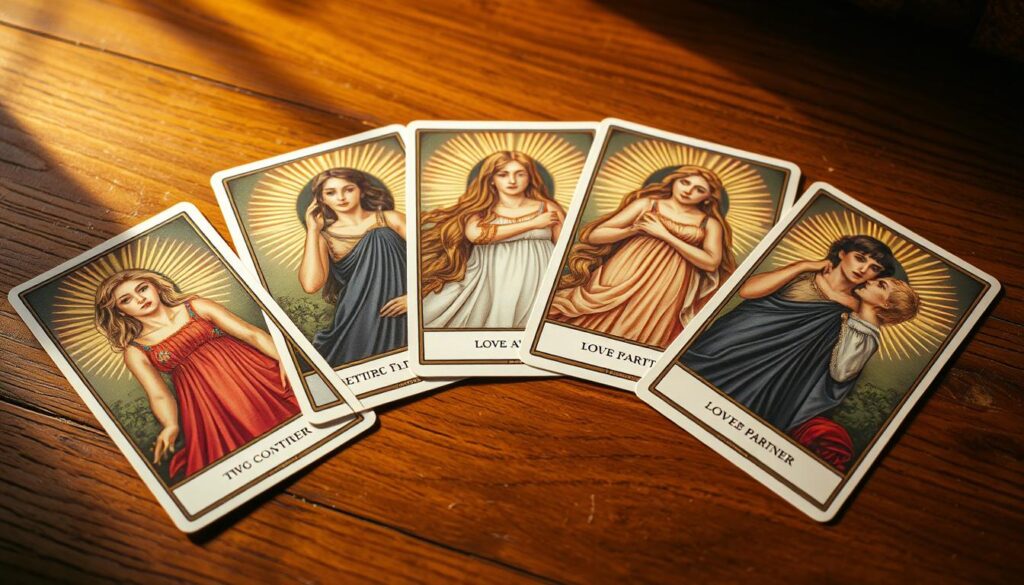
Positions and what they show
You: reveals your current stance and feelings in the relationship.
Your challenge: highlights what tests your balance or focus.
Partner: shows their headspace and main priorities.
Their challenge: clarifies external pressures or blind spots they face.
Unifying force: identifies the shared energy or message that can guide you both this week.
How to synthesize dynamics and map the path forward
Read positions together and watch for matching themes. If Ten of Cups appears for you while The Chariot is your challenge, you may be open-hearted but rushed. That suggests slowing down to be present.
If your partner shows Three of Cups, their energy may include friends and support. Their challenge might push them toward leadership or passion.
- Journal one thought for each partner and a shared note on what the relationship needs next.
- Choose one action for you, one for your partner, and one joint step tied to the unifying message.
- Use neutral, curious language in conversation so both people feel seen, not judged.
Tip: Repeat this spread in a few weeks to track shifting energy and recalibrate goals if the same themes recur. Let the unifying card anchor your week—honesty, patience, or playfulness can keep the connection grounded.
Use love-focused spreads for immediate answers and guidance
Fast layouts give immediate clarity so you can act with calm and intention.

Free love tarot formats deliver quick insight when you need it most. A popular three-position layout maps current energy, your actions, and where this is leading. Pull three cards and note one practical step for each position.
Quick options for today
- Yes/No: a binary pick that helps cut indecision before a choice.
- One-Card check-in: a short, mindful snapshot to anchor your day.
- 5-Card relationship: deeper view of both partners, challenges, and a unifying direction.
Use free tarot apps or interactive sites like Labyrinthos to guide draws and interpretations. Frame clear questions—“What supports trust right now?”—so quick readings deliver useful suggestions.
| Format | When to use | Result |
|---|---|---|
| Three-position | Short prep before a talk | Energy, action, practical advice |
| Yes/No | Binary choices | Clear direction to decide |
| One-Card | Daily focus | Mindful anchor for behavior |
| 5-Card | Deeper check-in | Both perspectives and next steps |
Tip: Jot one action and one boundary after a free reading. If patterns repeat, schedule a longer session to explore underlying themes.
From insight to action: applying tarot messages to real relationships
Translate messages into one small action you’ll try this week — a five-minute feelings check-in or a tech-free dinner. Small moves make steady results.

Align actions with the spread’s main message. If presence is the theme, reduce phone distractions. If overwhelm shows up, set a clear boundary to protect your heart and shared time.
“A single, repeatable habit beats a perfect plan you never start.”
Track outcomes by journaling before and after. Use a calendar reminder or a shared note as accountability. If a theme repeats across sessions, turn it into a monthly micro-goal you revisit together.
| Step | Example | Why it helps |
|---|---|---|
| One small action | Five-minute check-in | Builds consistent connection |
| Align with message | Phone-free evenings | Nourishes presence and heart |
| Track results | Journal before/after | Shows what truly shifts |
When emotions run high, pause and regulate before acting. A quick follow-up pull from a trusted tarot reader can confirm progress and point the next way forward in your relationship and love life. For inspiration on partnership themes, see The Lovers.
Conclusion
Finish with one clear step: pick a tarot deck you connect with, ask a focused question, and try a short three- or five-card spread this week.
Use the result as a mirror, not a verdict. Turn insights into one small habit—an honest check-in or a tech-free evening—to build trust and clarity in your relationship and love life.
Revisit spreads regularly, study card meanings, and use free tools to practice confidence as a reader. If a topic feels heavy, pause or consult a trusted source.
Finally, name one message from your latest spread and one micro-action to try with your partner. For a helpful example of romantic insight, see Knight of Cups insight.