
Welcome to a clear, beginner-friendly guide that demystifies how images, numbers, and suits work together to create meaning you can use every day.
This guide shows how each card tells part of a larger story — from the Major Arcana’s life milestones to the Minor Arcana’s everyday themes. You’ll learn to spot patterns, reflect, and choose a better way forward instead of chasing fixed predictions.
The deck is simple when you break it down: 22 Major Arcana cards map a journey from The Fool to The World, and 56 Minor Arcana cards cover suits and court figures for daily life. Focus on a few core symbols first to build real confidence.
No psychic powers needed: bring curiosity, respect, and regular practice. Ahead we’ll cover suits and elements, key archetypes, basic numerology, starter spreads, ethics, and practical examples to apply meanings in real situations.
Key Takeaways
- Major Arcana = big life themes; Minor Arcana = daily people and events.
- Images, numbers, and suits form a practical language you can learn.
- Learn core symbols rather than memorizing everything at once.
- Use readings as reflection tools, not fixed predictions.
- Practice and curiosity build confidence and clarity.
What Tarot Is and Why Symbolism Matters Today
A 78-piece deck acts as a portable map for reflection and decision-making. It uses images and structure to prompt insight, not to declare a fixed future. Readers rely on these prompts to notice patterns in work, relationships, and personal growth.
Historically, this practice started in 15th-century Italy with the Visconti-Sforza sets. The Major Arcana points to big life lessons, while the Minor Arcana speaks to day-to-day events and people.
Think of it as a tool for guidance—a way to translate mixed emotions and competing priorities into clear next steps. Even simple spreads can show what’s helping, what’s hindering, and what’s ready to change in a tidy order.
- Use readings to reflect, not to replace choice.
- Journal the images and phrases that stick; this builds a personal dictionary for the self.
- Stay curious. You can value the creativity and psychological insight without adopting specific beliefs.
Consistency beats perfection. Small, regular readings improve confidence and help you make clearer decisions as life shifts.
Beginner’s Guide: How to Learn and Read Tarot with Confidence
Start small and kind: set a purpose before you shuffle. A clear aim helps your inner voice come through and keeps readings practical.

Setting clear intentions and asking aligned questions
State why you’re reading and what you hope to discover. Ask open prompts like, “What am I not seeing about this choice?” or “What supports my next step?”
Use respectful language and avoid yes/no demands. This respects free will and makes results easier to apply to real life.
Building a daily practice that grows your intuition
Keep a simple routine: a single daily pull, a short journal note, and a weekly review to spot patterns. Learn basic meanings first, then add spreads such as Past–Present–Future.
Clean your deck regularly—try moonlight or placing the cards near clear quartz to reset focus. Record spreads with dates and initial thoughts to track how your interpretations evolve.
- Begin with a small toolkit: a deck you connect with, a journal, and a quiet space.
- When stuck, describe colors, actions, and expressions, then translate them into practical steps.
- Read ethically: emphasize agency, not fate.
The Structure of a Tarot Deck: Major and Minor Arcana
A full deck organizes life’s big themes and daily details into a clear, learnable order. A standard set has 78 cards: 22 Major Arcana (numbered 0–21) and 56 Minor Arcana across four suits.
The Major Arcana traces the Fool’s Journey from The Fool (0) to The World (21). These arcana cards often point to major shifts, identity questions, and long-term growth.
The Minor Arcana breaks into four suits: Wands (Fire), Cups (Water), Swords (Air), and Pentacles (Earth). Each suit shows how an element colors situations and how outcomes may unfold.
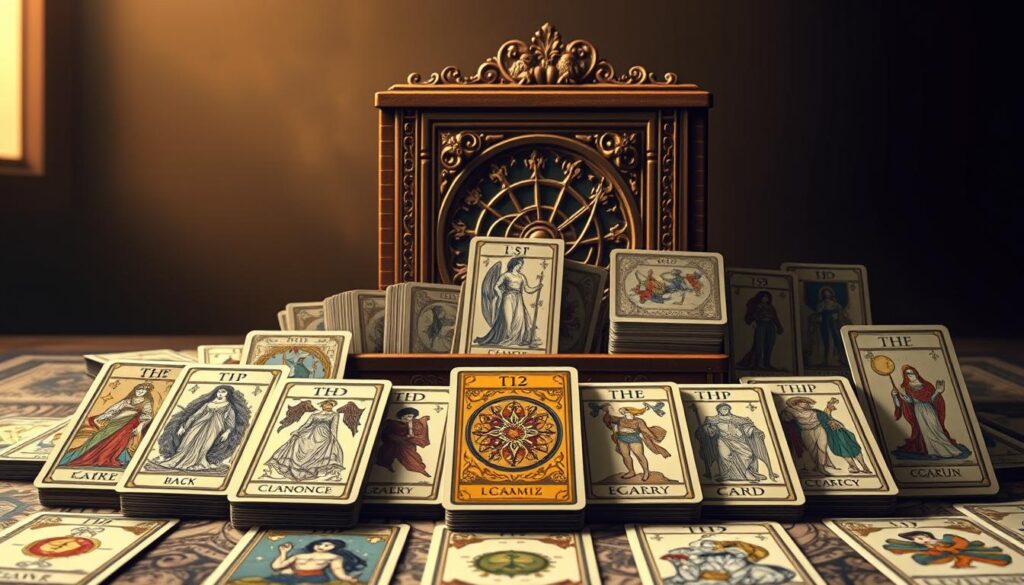
Within each suit, Ace through Ten show stages of development. Court cards — Page, Knight, Queen, King — act as people, roles, or modes of action.
| Group | Count | Focus |
|---|---|---|
| Major Arcana | 22 | Big life themes, turning points |
| Minor Arcana (Suits) | 56 | Daily dynamics, timing, behavior |
| Court Cards | 16 | People, roles, approaches |
Study tip: sort your deck into Majors and Minors, then by suit. Seeing the order makes repeating numbers and elements jump out. Practice readings will show how position in a spread modifies meanings and how elements blend for precise insight.
If you want a guided overview, check a clear primer on tarot basics to reinforce learning.
Major Arcana Archetypes: The Fool’s Journey from Zero to Wholeness
Think of the Major Arcana as a roadmap: each stop marks growth from zero to wholeness. The Fool’s Journey reveals a pattern of risk, learning, mastery, and integration that ends with The World’s completion.
The Fool
New beginnings: the Fool stands for pure potential. Embrace curiosity and trust when moving forward even without all the facts.
The High Priestess
Inner voice and quiet knowledge live here. Slow down, listen to subtle signals, and let intuition shape smarter choices.
The Emperor
Structure and healthy boundaries create safety. Use discipline and steady leadership to support long-term goals and positive control.
Wheel of Fortune
Cycles and fate are at play—some change is out of your hands. Surrender what you cannot steer while guiding what you can.
The World
Completion and the end of cycle bring harmony and reward. Honor milestones before you begin the next chapter.

- Quick tip: when major arcana cards appear together, zoom out to the big archetypal lesson.
- Try journaling scenes that mirror these roles—leaps, intuition, order, cycles, and closure.
- Study majors in sequence to see how one archetype evolves into the next.
Minor Arcana at a Glance: People, Feelings, Work, and Everyday Situations
Everyday situations come into view through the Minor Arcana’s suits and scenes. Think of this group as the practical lens for people dynamics, small choices, and routine moments.
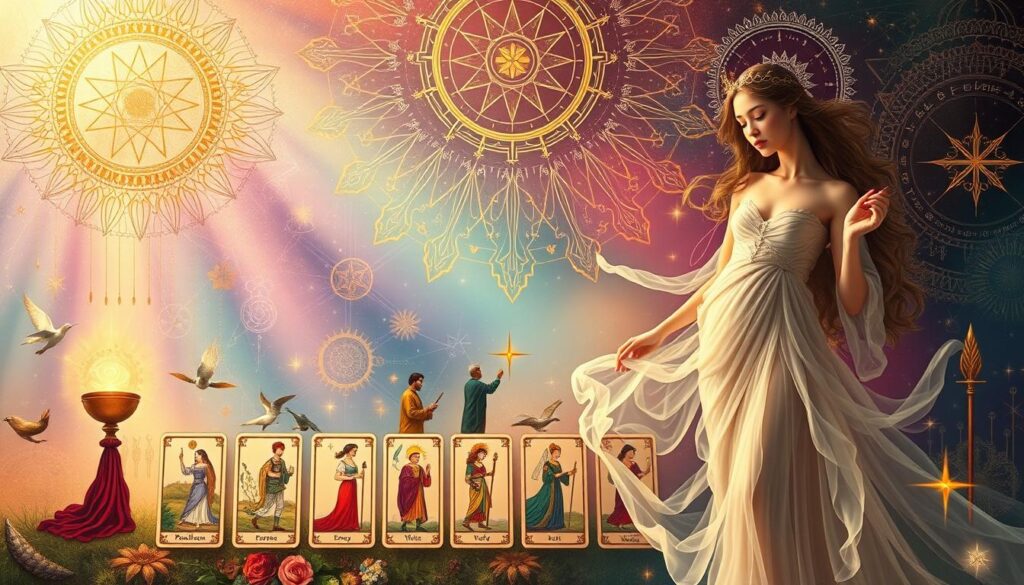
Quick suit summaries: Wands bring passion and momentum; Cups (water) show feelings and relationships; Swords focus on ideas, decisions, and conflict; Pentacles cover resources, work, and stability.
Same topic shifts tone by element. A work issue can be about bold action (wands) or careful planning and critique (swords). Minor Arcana often point to timing and behavior tweaks that change outcomes without a full overhaul.
- Repeating suits in a spread shows where energy concentrates—lots of wands means drive; many cups signals emotional processing.
- Notice body language, backgrounds, and gaze direction for subtle clues.
- Try a one-suit-per-week practice to internalize feel, then compare across suits.
Tip: track suit patterns in a journal to spot where life asks for balance. Combined with spread positions, these small cards answer practical “how” and “when” questions with clarity.
Suit of Wands: Fire, Passion, Action, and Creativity
Fire fuels ambition. The Wands suit is the spark that ignites projects and keeps momentum when you take aligned action. Think of it as energy directed outward—bold, visible, and eager to grow.

Associated element: Fire and how it fuels ambition
Fire brings drive and urgency. Passion becomes plans when you focus willpower into steps. Without control, that same spark can turn reckless or exhausting.
From Ace to Ten: sparks, hard work, and momentum
Ace of this suit marks new ideas and fresh starts. For a quick primer see the Ace overview.
Middle ranks build skills, teams, and steady progress. Ten often warns of too much on your shoulders—time to delegate.
- Work & creativity: Wands often mirror career initiatives, startups, and creative sprints.
- Control check: A spread heavy in wands suggests recalibration—lead, don’t bulldoze.
- Practical step: Pick one bold action a day to convert inspiration into results.
- Track when you feel most productive and schedule key tasks then.
- Pair suits for nuance: wands + swords = strategy, wands + pentacles = build, wands + cups = inspire people.
- Use imagery—flames, staffs, movement—to read urgency and growth cues.
Suit of Cups: Water, Relationships, Emotions, and the Heart
The Cups suit opens a window into how we feel, connect, and respond to one another. As the water suit, it maps emotional truth, empathy, and creative flow. These cards ask how you receive and give care.

Two of Cups and deeper connections
Two of Cups often signals union and mutual respect. It points to partnerships that balance give and take—romantic, friendly, or collaborative.
Use Two of Cups as a check-in: is the connection reciprocal? What builds trust and ease here? Look for imagery cues like joined vessels or mirrored faces to spot true harmony.
Listening to feelings without losing clarity
Emotional literacy matters: name your feelings and notice patterns before you act. Sit with sensations until they calm—clarity comes when waters settle.
- Try breathwork, journaling, or a short walk to process without reacting impulsively.
- Read Cups with other suits: Cups + Swords = honest talk; Cups + Pentacles = family care; Cups + Wands = inspired teamwork.
- Watch for river, vessel, or moonlit imagery—these suggest flow, reflection, or the need to let go.
Sensitivity is strength. Use these readings to highlight healing, forgiveness, and compassion in relationships that matter most. When you balance intuition with clear boundaries, the heart guides wise choices.
Suit of Swords: Air, Thoughts, Conflict, and Clarity
The Swords suit cuts through confusion with a focus on thought, language, and decisive action. Linked to Air, these cards represent intellect, logic, and communication. They clarify direction but can also wound when used carelessly.
Read Swords as signals about mindset. They often point to reframing beliefs or releasing mental loops that block progress. In many situations, they ask you to name the thought pattern before changing it.
“Facts paired with empathy resolve more than a win-at-all-costs argument.”
- Mindful communication: combine facts and warmth to de-escalate conflict.
- Conflict checklist: core issue, projection, desired outcome—write these down.
- Power & control: assert healthy boundaries; avoid dominating others.
- Use Swords for strategy: set criteria, weigh risks, pick the ethical step.
- Pairings to try: Swords + Cups for honest compassion; Swords + Pentacles for contracts; Swords + Wands to act decisively.
- Post-reading action: write one clear statement that simplifies the decision at hand.
Balance matters. Logic becomes useful when grounded in real experience. Let clarity guide action, not replace empathy in everyday tarot work.
Suit of Pentacles: Earth, Work, Security, and the Material World
Think of this suit as the practical field where plans grow into lasting results. Pentacles point to the material world: career, home, health, and the routines that keep life steady.

Financial security, stability, and long-term investments
Financial security often appears as steady progress rather than sudden windfalls. Readings highlight budgeting, savings, and small habits that compound over time.
Practical frame: set clear goals, know your risk tolerance, diversify, and review progress quarterly.
- Pentacles show skills development and schedules that support growth.
- Imagery like fields, coins, gardens, and homes signals patience and yield.
- Watch for pitfalls: greed or over-attachment can block true security.
Pairings add nuance: Pentacles + Swords for contracts, Pentacles + Cups for family budgets, Pentacles + Wands for launching ventures. Use small actions—automate savings, set calendar reviews, and track wins—to build stable foundations.
Hard work matters, but pace it. Consistency beats intensity when you want lasting results that match your values and support real financial security.
Court Cards Explained: Pages, Knights, Queens, Kings
Court figures act like living roles in a spread, showing how people or energies show up.
Pages bring a beginner’s mind. They signal messages, curiosity, and a fresh start. Think of them as students or messengers who invite learning.
Knights show movement and method. They reveal how to proceed—bold (wands), strategic (swords), caring (Cups), or steady (Pentacles).
Queens hold receptive mastery. They guide with emotional intelligence and practical care, tuning into feelings and context.
Kings direct and decide. They set strategy, allocate resources, and take responsibility for outcomes.

“Read court figures as roles you can use: colleagues, parts of self, or action styles.”
Quick ID tip: ask, “Is this a person, a part of me, or a style of action needed now?” Journaling them as team members helps reveal blind spots and dynamics.
| Figure | Energy | Core Action |
|---|---|---|
| Page | Curiosity | Learn, receive messages |
| Knight | Motion | Pursue, apply effort |
| Queen | Care | Support, cultivate |
| King | Authority | Lead, decide |
Practical note: Court figures in the minor arcana shape everyday approaches, not destiny. Blend their energy with spread positions to pick the clearest next step.
Aces as New Beginnings: Seeds of Each Suit’s Story
Think of an ace as a small seed: it holds a season of possibility and asks to be planted. As green lights, Aces point to pure potential that needs your yes and a little work.

Each suit gives that seed a flavor: wands bring spark and action; cups open emotional connection; swords offer a clear idea or truth; pentacles present a practical resource or offer.
Aces don’t fulfil themselves. Without follow-through, potential stays unrealized. Name one concrete move to nurture the ace within 24 hours—email, sketch, phone call, or a small purchase.
- Page + Ace = eager student energy to learn fast.
- Knight + Ace = push forward with momentum and action.
- Ones in numerology begin cycles that unfold into mastery.
“Celebrate small starts; they compound into meaningful change.”
Track ace appearances across work, relationships, and growth to spot seasons of beginnings. For a focused look at idea-driven starts, see the Ace of Swords overview.
Numerology in Tarot: How Numbers Shape Meanings
Patterns of two, three, or nine help you spot momentum, collaboration, or closure fast. Numbers act like a backbone across suits, giving a quick sense of where a situation sits in a cycle.
Aces, threes, nines — quick guide:
- Ace: initiation and clean starts. Treat an ace as a seed that needs one concrete step.
- Three: expansion, others joining, or the first visible results of a plan.
- Nine: near-completion—reflection and integration before the final change.
Numbers modify suit stories. For example, a Three of Wands points to expanding action and planning with partners. A Three of Swords signals a triangulated conflict or emotional complexity. Notice how the same number shifts tone with each element.

| Number | Core sense | How to read it |
|---|---|---|
| Two | Choice / polarity | Weigh options, identify the split |
| Four | Stability / structure | Look for foundations or needed boundaries |
| Five | Challenge / disruption | Expect friction that prompts change |
| Six | Harmony / aid | Support appears; accept help |
| Seven | Assessment | Pause to test options and evidence |
| Eight | Movement / mastery | Skillful progress or swift shifts |
| Nine | Completion / integration | Wrap up and reflect before transition |
| Ten | Culmination / new cycle | Finish one chapter; begin planning the next |
Practice tip: pull the same number across all suits for a week to see how element changes tone. Journal each reading and title entries by the dominant number to train pattern recognition.
“Numerology provides the frame; suits and positions fill in the picture.”
Final note: repeat numbers in a spread highlight themes—growth spurts or plateaus. Use numbers plus imagery (count figures, note symmetry, watch gateways) to make meanings richer and more concrete. For a focused case on conflict, see the Three of Swords discussion at three of swords.
Tarot Spreads for Beginners: Using Symbolism for Guidance
A simple spread gives quick context and a practical way to decide. Start with clear intent, breathe, and shuffle while thinking of your question.

Past–Present–Future: a three-card way forward
Use three cards to map context, current energy, and likely direction when moving forward. Lay them left-to-right: past, present, future.
Ask focused questions like, “What supports my goal?” or “What action aligns with my values?”
Note Major Arcana in any position—especially the final one—to see weighty themes that may shape fate or timing.
The Celtic Cross: destiny, environment, hopes, and results
The Celtic Cross uses ten positions in a clear order. Lay cards one through ten and label each as you place it.
- Focus (central issue)
- Crossing (help or hindrance)
- Subconscious influences
- Past
- Destiny / higher path
- Near future
- Self / internal state
- Environment / outside factors
- Hopes and dreams
- Final result (or destiny)
Tip: watch for the Wheel of Fortune as a cue about cycles or fate; read nearby cards to decide how to respond with deliberate action.
“Shuffle with purpose, cut once, take a breath, then pull.”
Practice notes: photograph the spread and journal first impressions. Read reversals only after you know upright meanings. Remember: spreads show possibilities, not guarantees. When ready, adapt positions or build themed layouts—experimentation helps you learn read tarot with confidence.
For more layouts and step-by-step examples, see a full spread guide.
Tarot and the Zodiac: Signs, Elements, and Major Arcana Links
Elements in astrology mirror the suits, giving practical cues about timing and temperament.
Wands = Fire, Cups = Water, Swords = Air, Pentacles = Earth. Use these bridges to add personality and timing to readings and to pick days that support a plan.

Many readers match signs to the major arcana: Aries—The Emperor/The Fool; Taurus—The Hierophant; Gemini—The Lovers; Cancer—The Chariot; Leo—Strength; Virgo—The Hermit; Libra—Justice; Scorpio—Death; Sagittarius—Temperance/Judgment; Capricorn—The Devil; Aquarius—The Star/The Hanged Man; Pisces—The Moon.
Note: The World and Wheel of Fortune carry fixed-sign imagery (Taurus, Leo, Scorpio, Aquarius). This helps spot themes of stability and cycles.
Try these practical steps: check your natal chart for strong sign placements, choose spreads that match active transits, and journal when a major arcana card repeats in certain seasons.
“Use zodiac links as friendly clues, not strict labels.”
- Family patterns: match recurring sign energy to household roles to see repeating lessons.
- Pair elements with actions: Water = reflection, Fire = action, Earth = planning, Air = research.
Reading Ethically: Accuracy, Free Will, and Empowered Choices
Honest guidance asks for consent, limits, and a focus on practical next steps. Start each session by stating your reading philosophy: you support informed choices and personal growth, not certainty or control over someone’s life.
Avoid deterministic language. Make clear that accuracy depends on the reader–querent connection and that insights reflect current energy. Emphasize the future is fluid and changes with new actions.
Clarify consent and boundaries before you shuffle. Agree on topics, time limits, and scope. This protects psychological safety and builds trust.

Use compassionate phrasing and offer resources when sensitive issues arise. Empower clients to decide—your role is to reflect patterns and possibilities, not to direct their lives.
- Practical ethics: confidentiality, clear pricing, written expectations, and a short code of conduct.
- Recommend cleansing rituals as a focusing practice to protect session integrity and the client’s sense of security.
- Invite follow-up questions to co-create clarity, not to chase certainty.
“Reflect what you see, acknowledge limits, and refer out when matters exceed your scope.”
End every session with one concrete action step for the querent’s self-care or next move. When readers model humble accuracy, guidance becomes useful and grounded.
Tarot Card Symbolism in Real-World Readings
A reading becomes useful when it points to one clear action you can try this week.

Use a Major Arcana anchor to set tone. For example, The Chariot in a work spread suggests disciplined momentum and a strategic roadmap. That shifts vague advice into a plan with checkpoints.
Wands-heavy spreads call for project steps: list milestones, assign roles, and set short timelines to keep momentum focused. When wands meet swords, draft the decisive email or schedule the meeting that turns plans into action.
Swords conflict cards often mean communication needs clarity. Create scripts, clarify goals, and set decision criteria before tough conversations.
Pentacles point to material checks: audit budgets, tools, and daily routines. Use this audit to align resources with goals and prevent wasted effort.
“Ten of Wands can signal the need to delegate while keeping standards.”
Quick walkthrough:
- Identify the core issue.
- Choose a simple spread (3–5 cards).
- Interpret suits and numbers for roles and timing.
- Extract one practical action and test it for a week.
| Element | Read as | Practical output | One-week test |
|---|---|---|---|
| Major Arcana | Anchor / theme | Strategy and tone | Follow the roadmap |
| Wands | Action / ambition | Milestones & roles | Daily progress check |
| Swords | Communication / decision | Scripts & criteria | Hold one clarifying talk |
| Pentacles | Material / resources | Budget & tools audit | Adjust one routine |
Test insights, review outcomes, and iterate. Patterns guide work and material choices, but repeated practice turns insight into results.
Conclusion
Use each session to turn images into experiments you can test within days. This approach gives you a clear way to translate meaning into grounded action.
Learn in order: majors, suits, then numbers. That structure helps patterns feel natural and builds steady confidence.
Remember the Major Arcana traces a journey to The World—an end cycle that invites rest and new beginnings.
Try a weekly three-card spread to check relationships, work, and family priorities. Capture one practical takeaway after every reading so insight becomes forward motion.
Honor free will and keep ethics simple: offer options, avoid certainty, and celebrate small wins as progress compounds over time.
For a focused look at completion, see a short guide to The World. What’s one small step you can take today that fits what you learned?