

Curiosity about the mind meets careful methods in this balanced look at unusual experiences. Readers across the world find such topics compelling because they touch personal reports and public evidence.
This introduction frames a friendly, clear exploration. We will note what scientists accept, what research has tested, and where debates remain open. Expect historical experiments, modern physics views, and neuroscience findings tied to everyday life.
We preview sections on mainstream skepticism, replication challenges in parapsychology, CIA interest in remote viewing, and EEG patterns during altered states. The goal is simple: show where evidence is strong, where it is weak, and how careful studies can move the conversation forward.
Questions about consciousness are hard because they bridge subjective experiences and measurable brain activity. Stay curious, and keep an eye on solid research practices as we evaluate claims over time. For background on mental phenomena, see this overview on mind powers.
Key Takeaways
- We combine curiosity about the mind with scientific methods.
- Both lived experiences and empirical evidence will be examined.
- Expect coverage of historic tests, modern neuroscience, and physics views.
- We highlight where replication and methods limit conclusions.
- Practical points will show how study design shapes what we can trust.
Setting the Stage: Why the Mind-Science Debate Captivates Us Today
From the late 1970s, films like Star Wars and Poltergeist helped seed a broad idea that minds might reach beyond usual limits. Public figures such as Uri Geller made that notion part of daily talk. Many people found meaning in these stories, especially during loss or change.

Professional training often shifted early belief toward critique. Psychologists who grew up during those years later cited journals like Skeptical Inquirer and Skeptic as key influences. That training highlighted methodological pitfalls and psychological explanations.
- Why the debate endures: it touches identity, purpose, and how we make sense of strange experiences.
- Proof thresholds vary: different minds accept different standards for evidence.
- Progress takes time: careful methods reduce bias while keeping curiosity alive.
In 2013 an EEG project produced unusual brain signals during channeling-like states, which rekindled interest while keeping skepticism in view. This mix of culture, anecdote, and selective data explains why big questions about life and understanding persist. For an accessible overview of reported powers, see the list of super powers.
Clairvoyant abilities and science: where claims, experiments, and physics collide
When bold claims meet formal experiments, the result is often a mix of careful tests and sharp debate.
What mainstream physics says
Many physicists point to the Core Theory — the Standard Model plus relativity — as covering everyday phenomena. As a fact, they argue that any new forces or particles needed for world-changing powers would likely have shown up in particle searches by now.
From Rhine to Randi
J. B. Rhine at Duke reported early positive results that sparked decades of replication attempts. Critics noted lax controls, while skeptics and magicians pushed tight protocols to rule out ordinary explanations for strange things.
Daryl Bem and presentiment
Daryl Bem’s Cornell papers on precognition reignited interest. Some labs struggled to repeat the small effects, prompting debates over subtle choices in study design and statistical testing.

Government interest and remote viewing
The Stargate Program ran for years as agencies tested remote viewing. CIA evaluations assessed whether any operational value existed and helped frame how governments weigh extraordinary claims.
Inside the brain
EEG case work has shown right parietal shifts during channeling-like states. This brain part links to body awareness and self/other boundaries. Such changes can match altered feeling states without proving telepathy or information transfer beyond known channels.
- Bottom line: physics limits what is plausible; careful, pre-registered experiments are the best path to separate noise from possible signals.
How scientists study extraordinary abilities: methods, evidence, and open questions
Rigorous protocols give a fair shot to surprising results while blocking common errors. Careful design turns anecdotes into a testable study and helps answer persistent questions about reported phenomena.
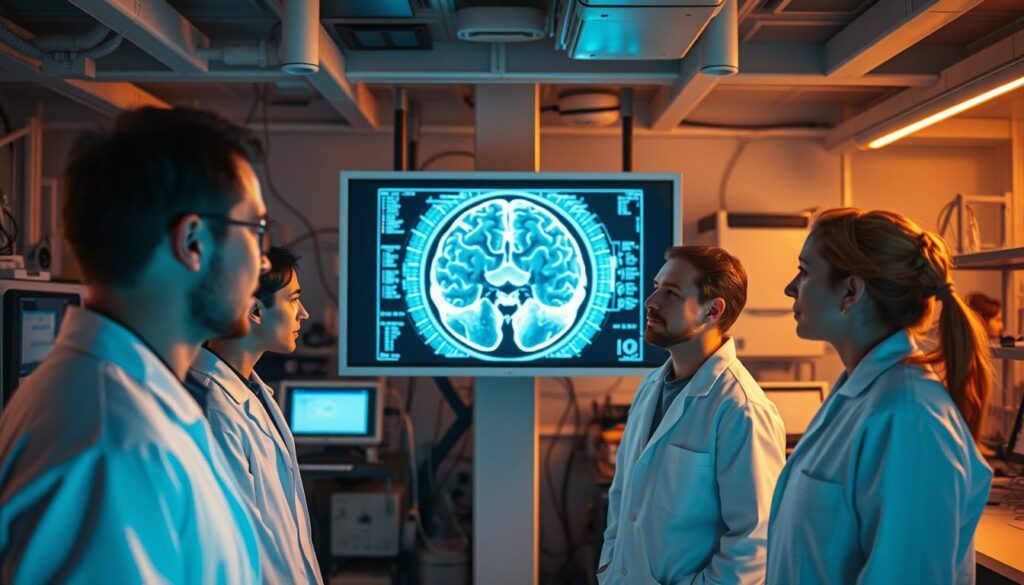
Designing rigorous experiments: blinding, controls, and minimizing bias
Gold-standard features include double- or triple-blind protocols, sham conditions, pre-registered analysis plans, and independent judges. Rhine’s replication controversies and James Randi’s no-winner challenge show why strict controls matter.
Statistics and reproducibility: signal vs. noise
Small effects often vanish when labs tighten methods. Use randomization, guard against information leakage, correct for multiple comparisons, and report all outcomes to reduce false positives.
Neuroscience tools and limits
EEG can measure broad rhythms and event-related potentials from the scalp and has flagged right parietal shifts during channeling-like states.
But scalp recordings cannot prove information transfer or validate telepathy by themselves; they are one part of converging research that must match plausible biological and physical mechanisms.
- Best path forward: multi-lab studies, open data, adversarial review, and clear protocols so results become useful evidence rather than isolated claims.
For related reading on reported powers, see psychic superpowers.
Mind, brain, and experience: making sense of telepathy, precognition, and channeling
Everyday reports of telepathy or precognition often mix chance events with striking moments that refuse easy explanation. That balance matters for anyone trying to sort meaningful signals from ordinary noise.
Everyday “hits” and misses: coincidence, pattern-seeking, and genuine anomalies
Our mind seeks patterns. Small coincidences can feel like proof of a hidden link. Confirmation bias and selective recall then make hits stand out while misses fade.
Practical step: keep a short journal. Time-stamp impressions before outcomes. Track hits and misses for weeks to calibrate what truly repeats.

Training the mind: meditation, attention, and the role of left-brain analysis
Meditation and focused attention can sharpen perception and lower reactivity. Some people report clearer intuition after regular practice.
At the same time, left-brain analysis can interrupt subtle cues. A useful way is to balance calm noticing with later, sober reflection.
Research notes one striking EEG case: a psychologist found large right parietal lobe shifts during a channeling-like state. That region links to body sense and self/other boundaries. When that boundary softens, subjective experience can change.
Independent evaluation mattered here: an anthropologist identified spontaneous spoken forms as Yanomami and other South American dialects. Expert review helps test content claims beyond personal interpretation.
- Journal entries and time stamps improve clarity.
- Compare impressions with simple controls or blind checks.
- Look for convergence: reports plus neural measures give stronger evidence than anecdotes alone.
| Practice | What it changes | How to track | What to watch for |
|---|---|---|---|
| Meditation | Attention, calm focus | Daily log, minutes practiced | Better clarity, fewer reactive memories |
| Journaling | Records hits and misses | Time-stamped notes before outcomes | Ratio of true hits to chance |
| Independent review | Content validation | Expert ID or blind judge | External corroboration of unusual outputs |
Takeaway: striking experiences occur inside a complex brain and body. Patient, structured observation and calm review let readers test claims without losing curiosity.
For hands-on practice with controlled exercises, see this guide on moving things with your mind.
Conclusion
Progress depends less on dramatic anecdotes than on repeatable results and honest methods. Reports from people keep the topic alive, while rigorous study sets the bar for claims about unusual powers.
The brain and body can create striking states of consciousness that deserve careful measurement. EEG reports point to right parietal shifts during channeling-like moments, which may explain some subjective change without proving information transfer beyond known senses.
Good next steps include pre-registered studies, multi-lab collaboration, and richer tracking of behavior and brain signals. Readers can document experiences responsibly; scientists can design tighter tests. Together, this way moves the world toward clearer evidence and better understanding.
For practical context on trained reports, see this clairvoyant resource.