

Welcome to a friendly, practical guide that makes this 78-card deck approachable. You’ll find a clear way to link imagery and archetypes to real questions about career, relationships, and life choices.
The deck’s structure pairs 22 Major Arcana that map big spiritual lessons with 56 Minor Arcana for everyday trials. This storytelling system mirrors growth and daily decisions.
Instead of memorizing everything, learn how suits and elements—Wands/Fire, Cups/Water, Swords/Air, Pentacles/Earth—point to themes. That lets you decode symbols faster and feel confident in readings.
Upright and reversed positions show different sides of the same image, giving a fuller meaning. Use this guide as both a quick-start reference and a deeper way to build your own intuitive style. For a focused look at action and forward motion, see a detailed example like The Chariot.
Key Takeaways
- This guide clarifies basic tarot card meanings for beginners and return readers.
- The 22 Major and 56 Minor Arcana form a narrative of growth and daily life.
- Elements help you read suits faster: Fire, Water, Air, Earth.
- Upright vs. reversed gives fuller, balanced interpretations.
- Use imagery and archetypes to find meaning without rote memorization.
What Is Tarot? Structure of the 78-Card Deck
Think of the deck as an ordered map. Major landmarks and minor paths work together so you can read big life chapters and everyday events with clarity.

Major Arcana vs. Minor Arcana at a Glance
The system contains 78 pieces: 22 major arcana and 56 minor arcana. The majors track karmic lessons and archetypal milestones. They can stand alone for high-level themes.
The 56 minors cover daily dynamics you can shape. They include 16 court figures—Pages, Knights, Queens, Kings—that add personality and social roles. The remaining 40 are numbered suit cards across Wands, Cups, Swords, and Pentacles.
How Imagery, Symbolism, and Story Connect
Images link across the deck to form a narrative, often called the Fool’s Journey. Repeated elements—numbers, animals, and elemental symbols—create patterns you can spot quickly.
Watch for repeats to speed interpretation without memorizing long lists of meanings. When suits overlap in a spread, the overall structure helps you weigh fate versus choice and read nuance with confidence.
Tarot Card Meanings and User Intent Today
Modern readers turn to this deck to get focused help with career choices, relationship questions, and everyday crossroads.

Major Arcana point to life lessons and long-term growth. Minor Arcana tackle practical, controllable issues that show up in daily life.
Finding guidance for work, relationships, and daily situations
People ask about work stability and growth; those queries often pull Pentacles energy. Questions about feelings or partnerships tend to call in Cups.
Analytical, clarity-seeking questions usually show Swords themes. Creative projects and initiative often look like Wands energy. Mixing majors with minors gives both the big lesson and a next step.
- Frame questions by naming the outcome you want and what you can change.
- Use one- or three-card readings for a quick insight each day.
- Journal patterns to make the deck a personal mirror of priorities.
| Focus | Element | When to Ask | Practical Tip |
|---|---|---|---|
| Career / work | Pentacles (Earth) | When choosing roles or seeking stability | Ask about resources and next steps |
| Relationships | Cups (Water) | When emotions and bonds feel unclear | Focus on intentions and boundaries |
| Decisions & creativity | Wands / Swords | When action or clarity is needed | Combine a Major for context + Minor for action |
Trust your intuitive nudges and practical definitions together. That blend makes readings feel useful and grounded in real life.
The Major Arcana: Archetypes, Fate, and the Fool’s Journey
The Major Arcana act as the deck’s spine, mapping big shifts and turning points in a person’s life. The set of 22 archetypes outlines a path from fresh innocence to mature completion.

The Fool to The World: Stages of spiritual evolution
The progression, often called the Fool’s Journey, tracks growth in clear stages. Each stage offers a focused lesson about choice, challenge, or insight.
For example: The Fool upright signals new beginnings and openness; reversed, it can warn of recklessness. The Magician upright shows willpower and manifestation; reversed, it suggests trickery. Justice upright points to clarity and cause-and-effect; reversed, it flags unfairness.
When readings focus on Major Arcana lessons
Spreads heavy with Major Arcana usually point to fate-driven themes and major life chapters. Use a Major-only spread when you want big-picture direction or to weigh a transformative choice.
- Pick Major-only: when seeking long-term guidance or evaluating a major transition.
- Watch repeats: recurring majors reveal core strengths or blocks to address.
- The World: signals cycle completion—celebrate integration before starting anew.
Reading Upright vs. Reversed: Core Interpretation Frameworks
The way a card lands can change how you read its message. Upright pulls tend to show a clear expression of core energy. Reversed pulls often point to blocks, delays, excesses, or imbalances.
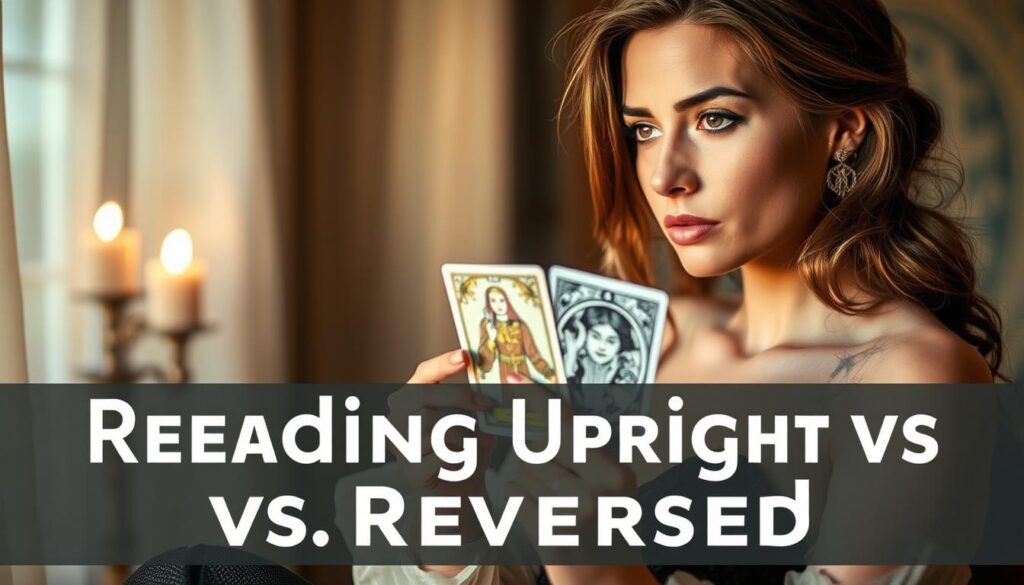
Cause, effect, and clarity versus blocks, delays, and imbalances
Justice upright emphasizes cause and effect, clarity, and truth. Reversed it can signal dishonesty or unfairness.
The Wheel of Fortune upright suggests cycles and helpful change. Reversed, it can reflect clinging to control and a streak of bad luck.
The Hanged Man upright shows sacrifice and release. Reversed, it often means stalling or fear of letting go.
“Reversals aren’t punishments; they’re useful signals about timing, perspective, and adjustment.”
Practical tip: if reversals feel intimidating, read them as the same meaning but with diminished or internalized energy. Decide in advance whether you will include reversed pulls and keep that order in your method. Journal upright and reversed pulls to learn how tone shifts over time.
Suit of Wands: Fire Element, Action, and Creative Will
When energy needs direction, the fiery suit points to where passion becomes purposeful work. Wands show where inspiration meets motion and how to turn sparks into plans.
Core keywords: energy, drive, passion, ambition
Wands are the Fire-aligned suit of energy and drive. They signal action, creativity, and the will to start or lead projects.
Shadow: recklessness and lack of direction
Watch for heat without a plan. Too many wands in a spread can mean impulsivity, burnout, or scattered goals that waste momentum.
The Ace of Wands and the spark of new action
The Ace is raw potential — a greenlight to act, experiment, and learn. Treat it as permission to pilot an idea and gather data fast.
- Wands often appear when launching projects or making bold moves.
- Repeated wands highlight timing for action and a nudge to trust instincts.
- Balance passion with strategy to turn sparks into steady progress.
| Focus | Signal | Practical prompt |
|---|---|---|
| Starting projects | High energy, quick moves | Pick one next step and test it |
| Creative work | Inspiration, momentum | Schedule short sprints to build habit |
| Shadow warning | Impulsivity, burnout | Add a simple plan and rest breaks |
Reflect: Where is your energy best spent now? If you want a focused read on the Ace, see a focused note on the Ace of Wands for practical next steps.
Suit of Cups: Water Element, Feelings, and Relationships
Water suits invite you to notice the small currents of emotion that guide daily choices.
Cups align with the water element and rule feelings, bonds, and the inner world. They point to subtle signals you feel before you can put them into words.
In readings, cups often surface in questions about relationships and empathy. They ask for presence, listening, and honest emotional work.
Shadow: fantasy, emotional overwhelm, disconnection
Healthy expression looks like naming what you feel and following the heart with clear boundaries.
Shadow patterns include romanticizing, avoidance, or emotional flooding. Cups can also mark creative flow, especially when paired with Wands for inspired action.
- Tune into body sensations and intuition to read cups beyond surface symbolism.
- Reflection prompts: What emotion is asking to be felt? Where can you create space for honest, heart-centered conversations?
- If cups are heavy, set boundaries and practice self-care to regain clarity and regulation.
When one tarot card highlights cups energy, use feeling-based prompts to find practical next steps rather than getting lost in fantasy.
Suit of Swords: Air Element, Intellect, and Conflict
The Swords suit centers on thought, clear language, and the decisions that shape outcomes. It links ideas to action and shows where mental processes affect real life.
Keywords: logic, truth, communication, decisions
Swords represent the Air element of analysis and clarity. They appear when negotiations, tough talks, or boundary-setting demand precise thinking.
Shadow: harshness, anxiety, mental rigidity
At their worst, these influences become cold logic, overthinking, or combative stances that create unnecessary friction. Watch for patterns that escalate rather than resolve conflicts.
Balancing thought with empathy
Use truth with care. Blend clarity and emotional intelligence so honesty lands without harm.
- Frame this suit as the analytical tool for decisions and control.
- Expect it in negotiations and ethical pivots paired with Major Arcana.
- Practice mindful communication: pause, clarify, verify.
“Words cut both ways—use them to clarify, not to wound.”
Suit of Pentacles: Earth Element, Security, and the Material World
The Pentacles suit grounds readings in everyday needs like income, health, and reliable routines.

Pentacles represent the Earth element and focus on practical life: money, work, habits, and physical resources. They point to stability and long-term plans that build tangible results.
These cards often speak to sustainable growth, practical investments, and steady progress. Repeated Pentacles urge structure, skill-building, and small steps that compound into real gains.
Shadow: greed, jealousy, over-control
Watch the shadow side. A scarcity mindset, clinging to control, or hoarding can block abundance and stall development. Balance planning with generosity and openness.
- Define focus areas: money, health, career paths, and foundations.
- Use Pentacles to guide long-range planning and sensible risk-taking.
- Reconnect with nature and the body to restore grounded clarity.
Prompt: What resource needs nurturing? Where can consistency replace urgency to create lasting security?
The Court Cards: Pages, Knights, Queens, and Kings Explained
Think of the court suite as a cast of 16 personalities—each one a useful shorthand in readings. These figures in the minor arcana point to people, roles, or approaches that affect the situation.
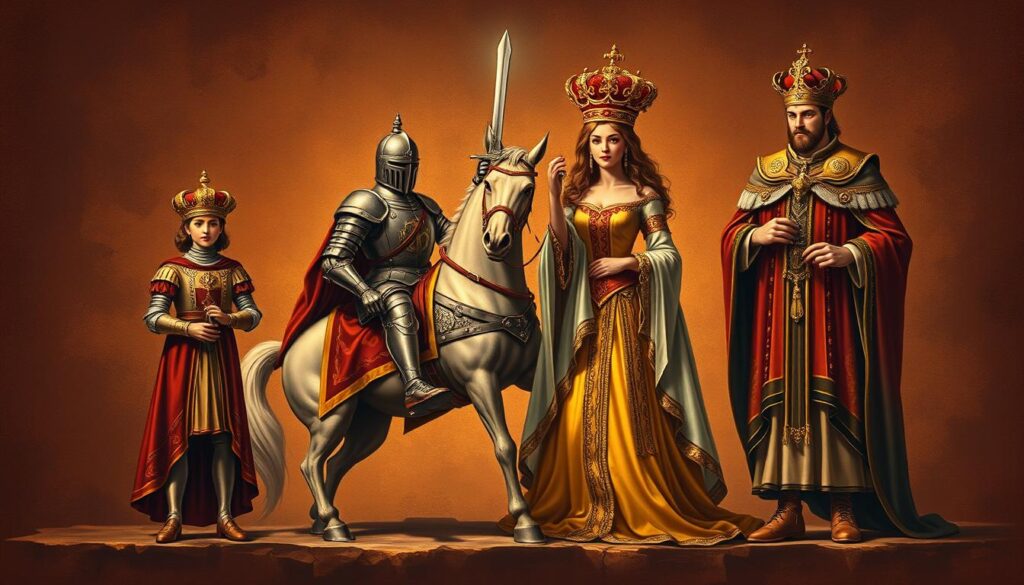
Sixteen personalities and roles
Pages are young learners or messengers. Expect curiosity, new information, or an invitation to explore.
Knights bring movement and mission. They push projects forward or signal a next step in action.
Queens show inner mastery and care. They reflect emotional intelligence and skillful response.
Kings represent stewardship and leadership. They organize resources, set strategy, and hold responsibility.
How courts signal people or approaches
Practical clues: use the suit element, the spread position, and context to identify if a page refers to someone literal or a role you must play.
Tip: when a court repeats, journal real-life parallels. Map which person or behavior keeps returning so the pattern becomes actionable.
“Court figures often describe approaches—curious Page energy versus decisive King energy—rather than literal people.”
From Card to Context: Work, Relationships, and Life Decisions
Turn a single pull into practical guidance by mapping suit, number, and position to your situation. Start with a short summary, then ask how the element and spread role change the advice. This makes abstract signals useful for day-to-day choices.

Career and material situations: control, security, growth
Read the suit first. Pentacles often point to steady growth, skill-building, and resources. Wands show timing for action and where initiative will help.
Apply the number: A low number can mean a next step; a court figure shows a role to adopt or a person to consult.
- Summarize the tarot card briefly.
- Fit it to the work question: where to build skills, where to act.
- Offer one clear next step: enroll, save, or pitch a project.
Love and relationships: union, harmony, and conflicts
Cups highlight emotional needs and patterns. Swords may signal necessary clarity or boundary resets. When majors appear, the choice often matters beyond the immediate moment.
Use reversals to locate blocks like mixed signals or over-control, and pick one corrective action.
“Summarize the pull, apply it to the question, note the element, and choose one clear action.”
Example approach: state the tarot card summary, translate it to the question, consider the element, and list one small step you can take today to move forward in life.
Elements and Symbolism: The Hidden Language of the Deck
Every spread hides an elemental map that helps you read themes before you name each symbol.
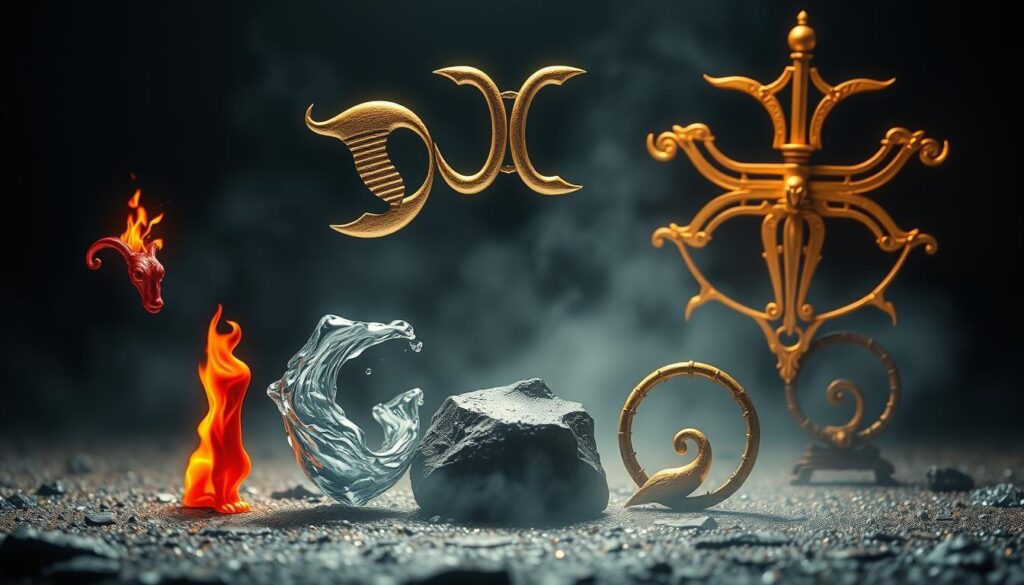
Fire (wands) points to drive, creation, and where action will matter most. Look for flames, bright colors, or paths cutting forward.
Water (cups) signals feelings, relationships, and inner currents. Rivers, pools, and soft blues steer readings toward emotion and connection.
Air (swords) brings logic, truth, and conflict to the surface. Sharp lines, birds, or open skies often mark a thinking or communication focus.
Earth (pentacles) anchors material needs, resources, and routines. Mountains, fields, and heavy tones suggest stability or practical work.
How to use elements fast
- Scan a spread for clusters. Many wands push action; many cups prompt feeling; many swords ask for clarity.
- Check balance. Too much of one element shows an area needing correction or support.
- Notice repeated motifs—rivers mean flow, peaks mean effort, and blades mean truth—and let those image cues guide one clear next step.
- Blend observation with intuition. Personal symbol associations make standard reading richer and more relevant.
| Element | Visual cues | Primary prompt |
|---|---|---|
| Fire (wands) | Flames, suns, warm hues | Take initiative; test one idea |
| Water (cups) | Rivers, pools, blue tones | Check feelings; offer or set boundaries |
| Air (swords) | Blades, birds, open sky | Clarify thoughts; speak plainly |
| Earth (pentacles) | Mountains, fields, earthy colors | Build routines; secure resources |
Quick tip: Learn to read the element first, then the specifics. For a deeper element primer and practice prompts, visit this element guide.
The Fool’s Journey in Practice: Lessons, Cycles, and Change
Think of the arc from innocence to mastery as a pattern you can apply to recent changes. The Fool’s path moves through trials, endings, and renewals that mirror real life.

Major arcana mark key turning points. The Tower can signal sudden upheaval. Death often signals an end that clears space for growth. The Star brings hope and healing.
Beginnings, awakenings, and completion
Translate these stages into practical prompts. Ask: Am I at a start, a mid-test, or near completion? Seeing the pattern helps you choose one steady next step.
Navigating upheaval, endings, and renewal
Reframe endings as metamorphoses. When multiple majors appear, treat the spread as a chapter shift that needs patience and reflection.
- Journal one recent event and name which stage it matches.
- Note what you must release to move forward.
- List one small action that honors the lesson and supports integration.
“Growth rarely moves in a straight line; cycles return with deeper insight.”
Use this practical lens to read a pull, learn the core meaning, and act with calm confidence.
How to Read Tarot: Spreads, Intuition, and Daily Readings
A practical reading practice blends a steady method with short reflection and journaling. Keep the focus narrow so each pull gives usable next steps.
Simple spreads for day-to-day guidance
Use three easy layouts: a one-card pull for focus, a three-card spread for situation/advice/outcome, and a seven-card weekly overview.
One-card gives a quick intention. The three-card layout offers context and a clear action. The weekly spread maps priorities for the coming days.
Journaling and keywords to build confidence
Keep a consistent setup order: shuffle, set intention, draw, then reflect. That rhythm trains attention and trust.
- Layer your read: note element and suit cues, add traditional notes, then listen for intuitive hits.
- Write the tarot card, context, two keywords, and one practical action to create a feedback loop.
- Build a personal keyword list so your understanding of card meanings evolves.
Timing tip: pull in the morning to set intention or at night to reflect on the day. Short, regular readings sharpen skill and make the guide feel personal.
“A small, steady practice beats occasional deep dives.”
Learning to Read: Building a Modern, Personal Guide
Make your study a conversation: combine traditional notes with what your intuition actually observes. This approach treats practice as both technique and personal inquiry.

Combining traditional meaning with your inner voice
Start with short experiments. Pull one card, note your first reaction, then check a trusted reference. Write how the official meaning matches or differs from your felt response.
Keep it light: study a few items each week and journal patterns as they repeat. Over time, your personal dictionary will grow and stay practical.
- Treat study as dialogue with the self—books guide, your impressions refine.
- Test-fit book notes against daily life and revise your entries when patterns emerge.
- Compare decks and authors to widen perspective without losing your voice.
Practice cycle: pull, jot first impression, read a reference, then add your personal take. This method builds skill while keeping interpretation flexible.
“Growth is the point—your voice matters as much as the books.”
For a focused example and to see how a single interpretation can be applied, consult this three of swords note.
Resources to Explore and Get Free Tarot Tools
A strong set of study aids and free tools makes learning faster and more practical.
Decks, reference pages, and reading aids

Start with reputable resources that offer clear upright and reversed summaries for quick study sessions. Bookmark a dedicated page for each tarot card so you can look up notes during practice.
Explore modern pages that add journaling prompts, affirmations, and short advice. These extras help retention and turn study into daily habit.
Compare a few decks and notice how imagery shifts nuance while core symbolism stays steady. Try different cards from each deck to see which visuals speak to you.
- Keep a bookmarked page for fast lookup during readings.
- Create simple aids: printable spread sheets, keyword cheat cards, and a daily draw tracker.
- Sample free tarot apps and PDFs, but only download from trustworthy sites.
“Use tools that match your goals—study, journaling, or quick prompts.”
Practical tip: choose two solid resources and one printable tool to start. That mix keeps practice focused without overload.
Conclusion
Bring big lessons and practical steps together. This short guide shows how the major arcana teach life lessons while minors point to everyday action. Use that blend so each reading feels useful and grounded.
Practice small spreads daily and keep notes. A single card can offer clear advice; journal repeating themes and your personal meanings to see patterns fast.
Scan suits for quick orientation—wands for momentum, cups for feelings, swords for thought, pentacles for stability—and let those cues guide one next step.
Reversals are signals, not failures. They often point to timing, imbalance, or a shift needed to move forward.
Trust your voice, refine keywords, and return to simple practice. For one focused example on emotional action, see the Knight of Cups note.