

Learn how a clear layout turns loose impressions into practical guidance. A good layout anchors a reading with focused positions so you gain clarity and steady direction, not scattered notes over time.
The guide starts with simple three-card options like past-present-future or situation-challenge-advice, then shows five-card patterns such as a cross that adds known and unknown influences.
Practice builds skill. Keep a journal, note how cards pair up, and watch how combinations form a coherent story. This method changes vague hints into useful information you can act on.
We also cover topic-focused approaches for love, career, daily check-ins, and event timing tied to lunar cycles. Ethical guardrails stress empowerment and helpful insight over strict prediction.
Key Takeaways
- Structure brings clarity: layouts anchor readings so insights stay linked to your question.
- Start simple with three-card layouts, then add five-card formats as confidence grows.
- Journaling and pattern-spotting turn single-card notes into cohesive stories.
- Use topic-focused formats for love, work, daily checks, and moon-timed events.
- Follow ethical guidelines to keep readings empowering and useful.
- For examples and templates, see a helpful collection of tarot spreads.
What a Tarot Spread Is and Why It Works for Effective Readings
A structured arrangement maps specific questions to positions, so each card answers a part of the issue and fits into a clear frame. This turns loose impressions into actionable insight and keeps you focused on intent.
Three-position layouts are ideal for quick clarity. They reduce overload and make it easy to compare past, present, and future or situation, challenge, and advice. Five-position formats add depth—think center, past, future, known, unknown—without becoming confusing.
Layouts act like a mirror for self-reflection. By anchoring cards to defined roles, you spot patterns and blind spots faster. Positions guide interpretation so you answer targeted questions instead of chasing tangents.
For complex issues, the Celtic Cross expands relationships between spots and cards to give a bigger view. Still, keep the structure flexible: rename positions or swap questions to match your goal.
Journal each position, question, and draw. Over time those notes build real understanding and boost confidence in readings. For a look at major-arcana focus and momentum, see a relevant example like the Chariot overview.

Get Ready to Read: Setting Intentions, Choosing a Tarot Deck, and Creating Space
Set a single, focused intention before you begin. Name the question you want to explore. This gives each card a job and keeps your focus tight.
Pick the right deck for the question and your style
Match the deck to the topic. Modern Love Tarot works well for relationship queries. The Penumbra Tarot suits shadow work and hidden themes.
For blunt feedback, try Bad Bitches Tarot. For gentler healing, reach for the Awakened Soul Oracle.
Frame clear, actionable questions to guide card positions
Ask specific, outcome-focused questions like, “What action supports X?” Avoid vague prompts that invite mixed feeling or cluttered answers.
Say the question aloud as you shuffle and cut. This links your intent to the cards and improves the flow of information.

Create a grounded reading environment and a journaling habit
Prepare the space: quiet, comfortable posture, and a brief breath to meet the present moment.
Shuffle with your question in mind, cut the cards, and lay one card per position. Keep a dedicated journal nearby to record cards, notes, and later insights.
Quick reference
| Deck | Best for | Tone |
|---|---|---|
| Modern Love Tarot | Relationships | Warm, relational |
| The Penumbra Tarot | Shadow work | Deep, introspective |
| Bad Bitches Tarot | Direct feedback | Bold, blunt |
| Awakened Soul Oracle | Healing | Soothing, gentle |
“You are the reader — your choices guide the outcome.”
Respect your power as the reader. If distractions come, pause, reset, and return to your question. For professional sessions or additional options, see psychic readings.
Core Techniques to Make Every Reading Count
Begin by tracing how each card leads to the next so the reading forms a natural story. This linear habit builds a clear sense of cause and effect.
Read combinations first, then widen the view. In a three-card line, ask how card one influences card two and how two moves toward three. That sequence gives practical steps you can share.
Move to holistic work only after you handle short chains well. When you add positions, hold links between cards rather than treating them as isolated notes.
- Use past-present-future to map timing and causes.
- Anchor every interpretation to the question so a single card fits the whole reading.
- Watch repeating suits and symbols — they highlight theme and add clarity.
Keep a brief journal of combinations. Over time pattern recognition speeds up and strengthens understanding.
“Focus on insight and agency — outcomes are paths, not fixed destinations.”
Finish by summarizing next steps in plain language so the querent leaves with one clear action.

How to Use a Tarot Spread Step by Step: 3-Card and 5-Card Methods
Begin by centering and naming one clear question. This anchors the session and gives each card a clear job.
Three-card essentials work well for fast clarity. Use past-present-future to trace time and cause. Use situation-challenge-advice when you need a practical path forward.
Quick clarity layouts
Action-reaction-outcome tests a plan in three quick cards. Do-don’t-proceed with caution helps you weigh boundaries before you act.
Five-card cross
Choose the five-card cross when you need more depth without overload. Lay center, past, future, known, and unknown to reveal hidden factors and direction.

Career focus and timing checks
For career work, channel Queen of Pentacles energy. Ask: current state; your attitude; supportive influences; biggest obstacle; and action to take. See a focused example at Queen of Pentacles career.
Before Mercury retrograde, pull five cards: prepare yourself; theme; wrap it up; hold your power; and clear communication. During a waning moon, use five cards to find the biggest obstacle, what to stop, what to release, what to keep, and guidance from guides.
“Center, set the question, shuffle with intent, cut, place one card per position, and journal.”
| Method | Positions | Best for | Action |
|---|---|---|---|
| Three-card | Past / Present / Future | Timing & cause | Trace a timeline and note one next step |
| Three-card | Situation / Challenge / Advice | Problem-solving | Identify friction and a clear action |
| Five-card cross | Center / Past / Future / Known / Unknown | Depth without overwhelm | Map hidden influences and direction |
| Special checks | Preparation / Theme / Finish / Power / Communication | Mercury retrograde & waning moon | Protect projects and release obstacles |
- Record positions, draws, and outcomes in a journal.
- Review patterns over several readings and adjust your approach.
Real-World Spreads Use: Love, Career, Daily, and Spiritual Growth
Use concise arrangements to turn an uncertain situation into clear next steps.
Love and relationships: Choose flexible layouts for finding new love, assessing connection health, or healing hard moments. Adjust positions to match the specific relationship problem and the people involved.
Career paths: Try strategic layouts for a job hunt or business kickoff. Use calling-focused positions to align work with values and set measurable milestones.
Daily practice: Build skill with brief three-card pulls or seven quick formats. Yes/no approaches can work well when questions are tight; add an advice card for nuance.
Spiritual insight: Use longer journey formats for self-growth, five-card decision checks, and two-card dream interpretation sets. Combine models like Jungian archetypes or Maslow’s hierarchy for deeper clarity.

“Keep readings concise and compassionate — aim for clarity that supports real choices.”
| Focus | Example Layout | Best for |
|---|---|---|
| Love | Finding new love / Healing heart / Troubleshooting | Connection health, communication gaps |
| Career | Job hunt / Business plan / Calling path | Strategy, milestones, alignment |
| Daily | Three-card / Seven quick / Yes/no | Skill building, quick guidance |
| Spiritual | 10-card self-growth / 5-card decision / 2-card dream | Inner work, choices, symbol decoding |
For a love-focused example and positions that map feelings to action, see The Lovers guide.
Working with the Moon and Sky: Full Moon, New Moon, and Celestial Event Spreads
Use moon phases as practical checkpoints to turn symbolic cards into timely actions. Aligning your work with lunar rhythms helps you translate a celestial moment into clear steps.
Full moon reflections by zodiac sign for monthly lessons
Full moons reveal what has culminated. Pick the sign of the current sky—Libra for balance, Scorpio for depth, Sagittarius for philosophical growth—and ask, What lesson must I integrate now?
Reflect on release: what to finish, what to reclaim, and which pattern repeats in your journal.
New moon intentions by zodiac sign to set direction
New moons are for planting aims. Choose the zodiac tone—Aries for initiative, Taurus for steadiness, Gemini for curiosity—and define one focused intention.
Pull cards to map steps, supports, and a simple timeline so intention gains practical direction.
Solar eclipse spread for transformational change
Solar eclipses mark turning points. Ask where to reclaim power, which identity shifts are emerging, and how to stabilize change.
“Honor timing, keep cards grounded in action, and track patterns across cycles.”

- Align readings with the phase: full moons = integrate lessons; new moons = set direction.
- Pick the zodiac-specific approach to match the sky and the work at hand.
- Simplify to three positions if the moment feels intense so you can act now.
Deep Dives with the Major Arcana
When you center a reading on the major arcana, each card becomes a lens for bigger life themes. Use these cards to move from impression to clear, action-focused guidance.
Celtic Cross confidence
Practice reading how positions talk to each other. Notice crossing influences, near–far relationships, and which card shifts the story. That habit builds nuance and trust in longer layouts.
Celtic Cross confidence and relationships between positions
Learn to name each card’s role: challenge, foundation, near future, or outcome. Then read links—how the foundation colors the present, or how a crossing card changes the goal.

Healing and shadow work: Star, Tower, Devil
Use the Star for hope and recovery. The Tower helps you navigate needed breakdowns with care. The Devil guides shadow integration without shame.
Decision-making and balance: Justice, Temperance, Wheel of Fortune
Pull Justice to weigh options and consequences. Use Temperance to blend approaches and find compromise. Let the Wheel of Fortune reframe change as part of a cycle, not a crisis.
Purpose and momentum: Chariot, Strength, World
Choose the Chariot when you need direction. Call on Strength to build courage for tough moves. Use the World to mark completion and next-phase planning.
“Pull a named major-arcana card as a significator, frame questions, then summarize one clear action to protect your power.”
Journal each session and watch how archetypal lessons repeat across work, relationships, and self-growth. For a helpful reference, see the major arcana reference.
Common Pitfalls, Smart Tweaks, and Practice Tips
The fastest way to improve is to tighten your process: fewer positions, clearer intent. Too many cards often bury the core issue and reduce clarity.
Avoid overcomplicating layouts and unclear questions
Start with a simple spread and one crisp question. If the reading feels thin, add a card or rename a position rather than expanding the whole format.
If a layout consistently misses the mark, adapt it. Swap prompts, shorten positions, or test a different sequence until it fits the person and the problem.
Adapt spreads to your situation and revisit what resonates
Keep notes on which spreads work best for different people and topics. Over times you’ll notice which things repeat and which approaches deliver reliable guidance.
When an issue persists, compare past readings to spot patterns before pulling new cards. Treat misreads as data: refine wording, tighten questions, and track what changed.
“Build a small rotation of trusted layouts and test tweaks to see what truly helps.”
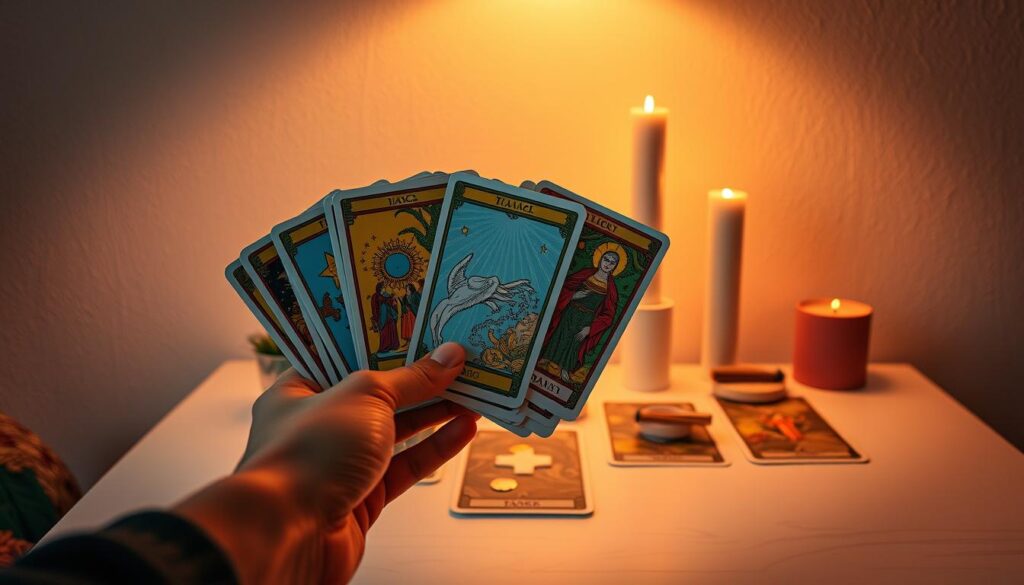
For a focused example on conflict and competition, see a useful write-up on the Five of Wands.
Conclusion
A strong ending ties cards to action. Close each session by naming one clear next step. That habit turns insight into useful work and helps you track change over time.
Use three- and five-card formats to keep focus, then expand to the Celtic Cross and major arcana themes as confidence grows. Adapt the layout to the question—swap positions or shorten the plan to fit the moment.
Explore love and relationship questions, career checks, and moon-timed pulls for timely perspective. Keep a journal so readings connect across lives and situations, and return to the tarot spread or two that reliably bring clarity.